Physics

Magnetism
Magnetism is a fundamental force that causes certain materials to attract or repel each other. It is generated by the movement of electric charges and is characterized by magnetic fields. Magnets have two poles, north and south, and like poles repel while opposite poles attract. Magnetism plays a crucial role in various technologies, including electric motors, generators, and magnetic storage devices.
Written by Perlego with AI-assistance
Related key terms
1 of 5
11 Key excerpts on "Magnetism"
- Britannica Educational Publishing, Erik Gregersen(Authors)
- 2010(Publication Date)
- Britannica Educational Publishing(Publisher)
CHAPTER 4 MAGNETISMM agnetism is a phenomenon associated with the motion of electric charges. This motion can take many forms. It can be an electric current in a conductor or charged particles moving through space, or it can be the motion of an electron in atomic orbit. Magnetism is also associated with elementary particles, such as the electron, that have a property called spin.FUNDAMENTALS
Basic to Magnetism are magnetic fields and their effects on matter, as, for instance, the deflection of moving charges and torques on other magnetic objects. Evidence for the presence of a magnetic field is the magnetic force on charges moving in that field; the force is at right angles to both the field and the velocity of the charge. This force deflects the particles without changing their speed. The deflection can be observed in the electron beam of a television tube when a permanent magnet is brought near the tube. A more familiar example is the torque on a compass needle that acts to align the needle with the magnetic field of Earth. The needle is a thin piece of iron that has been magnetized—i.e., a small bar magnet. One end of the magnet is called a north pole and the other end a south pole. The force between a north and a south pole is attractive, whereas the force between like poles is repulsive. The magnetic field is sometimes referred to as magnetic induction or magnetic flux density; it is always symbolized by B . Magnetic fields are measured in units of tesla (T). (Another unit of measure commonly used for B is the gauss, though it is no longer considered a standard unit. One gauss equals 10−4 tesla.)A fundamental property of a magnetic field is that its flux through any closed surface vanishes. (A closed surface is one that completely surrounds a volume.) This is expressed mathematically by div B = 0 and can be understood physically in terms of the field lines representing B
- David Jiles(Author)
- 2015(Publication Date)
- CRC Press(Publisher)
Section I ElectroMagnetism Magnetic Phenomena on the Macroscopic Scale This page intentionally left blank This page intentionally left blank 3 1 Magnetic Fields In this chapter, we will clarify ideas about what is meant by a magnetic field and then show that it is always the result of electrical charge in motion. This will be followed by a discussion of the concept of magnetic induction , also known as magnetic flux density , and its relation to the magnetic field. We will look at the various unit con-ventions currently in use in Magnetism and finally discuss methods for calculating magnetic fields. 1.1 MAGNETIC FIELD What do we mean by magnetic field ? One of the most fundamental ideas in Magnetism is the concept of the magnetic field. When a field is generated in a volume of space, it means that there is a force produced, which can be detected by the acceleration of an electric charge mov-ing in the field, by the force on a current-carrying conductor, by the torque on a magnetic dipole such as a bar magnet, or even by a reorientation of spins on elec-trons within certain types of atoms. The torque on a compass needle, which is an example of a magnetic dipole, is probably the most widely recognized property of a magnetic field. 1.1.1 G ENERATION OF A M AGNETIC F IELD How are magnetic fields produced? A magnetic field is produced whenever there is an electrical charge in motion. This can be due to an electrical current flowing in a conductor, for example, as was first discovered by Oersted in 1819 [1]. A magnetic field is also produced by a perma-nent magnet. In this case, there is no conventional electric current, but there are the orbital motions and spins of electrons (the so-called Ampèrian currents) within the magnetic material that lead to a magnetization within the material and a magnetic field outside. The magnetic field exerts a force on both current-carrying conductors and permanent magnets. eBook - PDF
Space Radiation Biology and Related Topics
Prepared under the Direction of the American Institute of Biological Sciences for the Office of Information Services, United States Atomic Energy Commission
- Cornelius A. Tobias, Paul Todd, Cornelius A. Tobias, Paul Todd(Authors)
- 2013(Publication Date)
- Academic Press(Publisher)
CHAPTER 6A Relevant Principles of Magnetism and Biomagnetics IRA L. SILVER and CORNELIUS A. TOBIAS 6A.1. Concept of Magnetism 293 6A.2. Magnetic Field Definitions 294 6A.3. Molecular Basis of Magnetism 298 6A.4. Quantum Energetics 300 6A.5. Chemical Bonding 301 6A.6. Thermodynamics 302 6A.7. Types of Magnetic Field Interactions with Biological Systems . . . 303 6A.8. Proposed Molecular Mechanisms 305 References 310 6A.1. CONCEPT OF Magnetism As theoretical physicists see it today, Magnetism is a necessary part of electricity. It exists as a result of the motion of electrically charged par-ticles. An electric charge gives rise to an electric field; however, when the particle moves in an external electric field, it produces a magnetic field as a secondary effect. Since both the electrons and the nucléons of molecules are in motion, all molecules can be expected to exhibit magnetic effects. Specifically, the motions are ( 1 ) the rapid orbital movement of electrons, ( 2 ) the spin of each electron around its own axis, and ( 3 ) a similar spin of the nucléons. The magnetic field lines of the atom are determined by the resulting angular momentum vector produced by the three kinds of motion. With certain exceptions, the atoms of a coupled system are randomly oriented because of thermal energy, and so the net angular momentum vector is 293 294 IRA L. SILVER AND CORNELIUS A. TOBIAS zero. Only in the presence of an external magnetic field will these systems exhibit magnetic properties. 6A.2. MAGNETIC FIELD DEFINITIONS Empirically, it is convenient to adopt the point of view that a moving charge sets up, in the space around it, a magnetic field. This field may exert a force on another charge. Thus, the magnetic field is said to exert a force on a second charged particle if there is relative motion between the two particles. eBook - ePub
Electromagnetism
Maxwell Equations, Wave Propagation and Emission
- Tamer Becherrawy(Author)
- 2013(Publication Date)
- Wiley-ISTE(Publisher)
Chapter 7Magnetism in Matter
Before the discovery of the magnetic effects of electric current and charges, the understanding of Magnetism pertained to permanent magnets. Even today, some of the magnetic properties of matter remain little understood and other properties remain to be explored. This does not prevent Magnetism from underlying many applications, ranging from the magnetic compass to measurement instruments, electric generators and motors, magnetic tapes for sound and video recording and for computer data storage, magnetic levitation, etc. The purpose of this chapter is to introduce some basic elements of Magnetism in matter.7.1. Types of Magnetism
Some materials, said to be ferromagnetic , become magnetized if they are exposed to a magnetic field and they remain permanently magnetized if the magnetic field is removed. A magnetized body is equivalent to a magnetic moment M in a characteristic direction SN . An external magnetic field acts on this body and orients it in such a way that the field B enters the body at S and leaves it at N (Figure 7.1a ). Particularly, in the Earth's magnetic field, N points approximately toward the geographic North and S toward the South (Figure 7.1b ). However, contrary to the electric charges, which constitute an electric dipole, the “magnetic poles” cannot be separated and the concept of magnetic pole is simply an analogy with electric charges. Similar to dielectrics, which polarize if they are placed in an electric field, all materials become magnetized to some extent if they are submitted to the magnetic field B of an electric current or another magnetized body. Some materials (such as aluminum, chrome, platinum, etc.) acquire a magnetic moment in the direction of B , they are said to be paramagnetic . Other materials (such as silver, gold, copper, mercury, lead, etc.) acquire a magnetic moment in the opposite direction to B , they are said to be diamagnetic . A magnetized body produces its own magnetic field, which leaves the body near N and enters the body near S (Figure 7.1c ). No longer available |Learn more
- (Author)
- 2014(Publication Date)
- Library Press(Publisher)
Magnetism Most materials respond to an applied B-field by producing their own magnetization M and therefore their own B-field. Typically, the response is very weak and exists only when the magnetic field is applied. The term ' Magnetism' describes how materials respond on the microscopic level to an applied magnetic field and is used to categorize the magnetic phase of a material. Materials are divided into groups based upon their magnetic behavior: • Diamagnetic materials produce a magnetization that opposes the magnetic field. • Paramagnetic mater ials produce a magnetization in the same direction as the applied magnetic field. • Ferromagnetic materials and the closely related ferrimagnetic materials and antiferromagnetic materials can have a magnetization independent of an applied B-field with a comp lex relationship between the two fields. • Superconductors (and ferromagnetic superconductors) are materials that are characterized by perfect conductivity below a critical temperature and magnetic field. They also are highly magnetic and can be perfect diamagnets below a lower critical magnetic field. Superconductors often have a broad range of temperatures and magnetic fields (the so named mixed state) for which they exhibit a complex hysteretic dependence of M on B . In the case of paraMagnetism, and diaMagnetism the magnetization M is often pro-portional to the applied magnetic field such that: where μ is a material dependent parameter called the permeability. In some cases the permeability may be a second rank tensor so that H may not point in the same direction as B . These relations between B and H are examples of constitutive equations. However, superconductors and ferromagnets have a more complex B to H relation. eBook - PDF
- Richard L. Myers(Author)
- 2005(Publication Date)
- Greenwood(Publisher)
Magnetism and ElectroMagnetism Introduction Magnets have fascinated us since we were young children and provided some of our earliest scientific experiences. These include observations that magnets are attracted to and stick to some metal objects, magnets don't stick to nonmetals, and two magnets might attract or repel each other depending how they are aligned to each other. As early as 600 B.C.E. ancient Greeks recorded simi- lar observations on a type of iron ore called loadstone. A geographic area associated with loadstone was on the Turkish coast near the settlement of Magnesia, thus providing the source of the name used today for mag- netic phenomenon. Magnetic compasses, fashioned out of natural magnetic materials such as lodestone, appeared in China around 800 C.E. William Gilbert (1540-1603), a physician in Queen Elizabeth's court, com- pleted a major work on Magnetism in 1600. Gilbert's work, entitled De Magnete, pre- sented two decades of his studies on magne- tism. De Magnete was thefirstcomprehensive scientific examination of Magnetism. It dis- cussed aspects such as permanent Magnetism, magnetic induction, the loss of Magnetism upon heating, and magnetic poles. Gilbert adopted the term "electrick," from the Greek word elektron (elektron was a type of pine pitch or amber that attracted objects when rubbed with various substances), to explain the attractive and repulsive forces associated with charging by friction. Gilbert also pro- posed that the Earth itself was a giant magnet and introduced the idea of magnetic inclina- tion or dip angle. Gilbert was a proponent of Copernicus' heliocentric model, and his ideas were very influential on other scien- tists. He was highly praised by Galileo and is often called the father of modern electric- ity and Magnetism. Until the start of the nineteenth cen- tury, Magnetism was considered a distinct force separate from electricity. No longer available |Learn more
- (Author)
- 2014(Publication Date)
- Learning Press(Publisher)
________________________ WORLD TECHNOLOGIES ________________________ Chapter- 9 Magnetic Field A magnetic field is a field of force produced by moving electric charges, by electric fields that vary in time, and by the 'intrinsic' magnetic field of elementary particles associated with the spin of the particle. There are two separate but closely related fields to which the name 'magnetic field' can refer: a magnetic B field and a magnetic H field. The magnetic field at any given point is specified by both a direction and a magnitude (or strength); as such it is a vector field. The magnetic field is most commonly defined in terms of the Lorentz force it exerts on moving electric charges. The relationship between the magnetic and electric fields, and the currents and charges that create them, is described by the set of Maxwell's equations. In special relativity, electric and magnetic fields are two interrelated aspects of a single object, called the electromagnetic field tensor; the aspect of the electromagnetic field that is seen as a magnetic field is dependent on the reference frame of the observer. In quantum physics, the electromagnetic field is quantized and electromagnetic interactions result from the exchange of photons. Magnetic fields have had many uses in ancient and modern society. The Earth produces its own magnetic field, which is important in navigation since the north pole of a compass points toward the south pole of Earth's magnetic field, located near the Earth's geographical north. Rotating magnetic fields are utilized in both electric motors and generators. Magnetic forces give information about the charge carriers in a material through the Hall effect. The interaction of magnetic fields in electric devices such as transformers is studied in the discipline of magnetic circuits. ________________________ WORLD TECHNOLOGIES ________________________ History One of the first drawings of a magnetic field, by René Descartes, 1644. eBook - PDF
- John D. Cutnell, Kenneth W. Johnson, David Young, Shane Stadler(Authors)
- 2018(Publication Date)
- Wiley(Publisher)
LEARNING OBJECTIVES After reading this module, you should be able to... 21.1 Define magnetic field. 21.2 Calculate the magnetic force on a moving charge in a magnetic field. 21.3 Analyze the motion of a charged particle in a magnetic field. 21.4 Describe how the masses of ions are determined using a mass spectrometer. 21.5 Calculate the magnetic force on a current in a magnetic field. 21.6 Calculate the torque on a current- carrying coil. 21.7 Calculate magnetic fields produced by currents. 21.8 Apply Ampère’s law to calculate the magnetic field due to a steady current. 21.9 Describe magnetic materials. Suranga Weeratunga/123RF. com CHAPTER 21 Magnetic Forces and Magnetic Fields This beautiful display of light in the sky is known as the northern lights (aurora borealis). It occurs when charged particles, streaming from the sun, become trapped by the earth’s magnetic field. The particles collide with molecules in the upper atmosphere, and the result is the production of light. Magnetic forces and magnetic fields are the subjects of this chapter. 21.1 Magnetic Fields Permanent magnets have long been used in navigational compasses. As Figure 21.1 illustrates, the compass needle is a permanent magnet supported so it can rotate freely in a plane. When the compass is placed on a horizontal surface, the needle rotates until one end points approximately to the north. The end of the needle that points north is labeled the north magnetic pole; the opposite end is the south magnetic pole. Magnets can exert forces on each other. Figure 21.2 shows that the magnetic forces between north and south poles have the property that like poles repel each other, and unlike poles attract. This behavior is similar to that of like and unlike electric charges. However, there is a significant difference between magnetic poles and electric charges. It is possible to separate positive from negative electric charges and produce isolated charges of either kind. eBook - PDF
Ultra-High-Density Magnetic Recording
Storage Materials and Media Designs
- Gaspare Varvaro, Francesca Casoli, Gaspare Varvaro, Francesca Casoli(Authors)
- 2016(Publication Date)
- Jenny Stanford Publishing(Publisher)
Chapter 1 Fundamentals of Magnetism Paolo Allia a and Gabriele Barrera b a DISAT, Politecnico di Torino, Corso Duca degli Abruzzi 24, Torino, 10129, Italy b Chemistry Department, Universit ` a di Torino, Via Pietro Giuria 7, Torino, 10125, Italy [email protected], [email protected] This chapter is intended for readers approaching Magnetism and magnetics without a substantial knowledge of the subject matter and/or looking for a summary account of its highlights. A difficulty in mastering the topic stems from the fact that Magnetism is a multiscale research area, spanning from basic quantum theory of single atoms (the Aufbauprinzip of Bohr and Pauli) to the functional properties of macroscopic magnetic materials. This chapter will touch upon all these aspects by following a slightly unconventional order. The author is aware of the existence of excellent textbooks on Magnetism; some are listed as references. However, it is hoped that this effort will be of some interest to some people in some circumstances. Ultrahigh-Density Magnetic Recording: Storage Materials and Media Designs Edited by Gaspare Varvaro and Francesca Casoli Copyright c 2016 Pan Stanford Publishing Pte. Ltd. ISBN 978-981-4669-58-0 (Hardcover), 978-981-4669-59-7 (eBook) www.panstanford.com 2 Fundamentals of Magnetism 1.1 Magnetic Fields and Energies: A Macroscopic Approach 1.1.1 Magnetic Fields In spite of the purely quantum nature and origin of ferromag-netism [1–3], an entirely classical framework is often expedient to describe the magnetic properties of magnetized bodies. In a classical approach, use is made of the three magnetic vectors in the continuum approximation. Of course, such an approach loses validity when the size of a magnetized body becomes comparable in at least one dimension to the typical interatomic distance a (or is not exceedingly large with respect to a ). eBook - PDF
- John D. Cutnell, Kenneth W. Johnson, David Young, Shane Stadler(Authors)
- 2015(Publication Date)
- Wiley(Publisher)
21 | Magnetic Forces and Magnetic Fields This beautiful display of light in the sky is known as the northern lights (aurora borealis). It occurs when charged particles, streaming from the sun, become trapped by the earth’s magnetic field. The particles collide with molecules in the upper atmosphere, and the result is the production of light. Magnetic forces and magnetic fields are the subjects of this chapter. 21.1 | Magnetic Fields Permanent magnets have long been used in navigational compasses. As Figure 21.1 illustrates, the compass needle is a permanent magnet supported so it can rotate freely in a plane. When the compass is placed on a horizontal surface, the needle rotates until one end points approximately to the north. The end of the needle that points north is labeled the north magnetic pole; the opposite end is the south magnetic pole. Magnets can exert forces on each other. Figure 21.2 shows that the magnetic forces between north and south poles have the property that like poles repel each other, and unlike poles attract. This behavior is similar to that of like and unlike electric charges. However, there is a sig- nificant difference between magnetic poles and electric charges. It is possible to separate positive from negative electric charges and produce isolated charges of either kind. In con- trast, no one has found a magnetic monopole (an isolated north or south pole). Any attempt to separate north and south poles by cutting a bar magnet in half fails, because each piece becomes a smaller magnet with its own north and south poles. Surrounding a magnet, there is a magnetic field. The magnetic field is analogous to the electric field that exists in the space around electric charges. Like the electric field, the magnetic field has both a magnitude and a direction. We postpone a dis- cussion of the magnitude until Section 21.2, concentrating our attention here on the Chapter | 21 LEARNING OBJECTIVES After reading this module, you should be able to...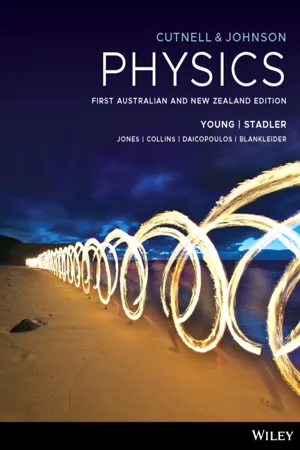 eBook - PDF
- John D. Cutnell, Kenneth W. Johnson, David Young, Shane Stadler, Heath Jones, Matthew Collins, John Daicopoulos, Boris Blankleider(Authors)
- 2020(Publication Date)
- Wiley(Publisher)
CHAPTER 21 Magnetic forces and magnetic fields LEARNING OBJECTIVES After reading this module, you should be able to: 21.1 define magnetic field 21.2 calculate the magnetic force on a moving charge in a magnetic field 21.3 analyse the motion of a charged particle in a magnetic field 21.4 describe how the masses of ions are determined using a mass spectrometer 21.5 calculate the magnetic force on a current in a magnetic field 21.6 calculate the torque on a current‐carrying coil 21.7 calculate magnetic fields produced by currents 21.8 apply Ampère’s law to calculate the magnetic field due to a steady current 21.9 describe magnetic materials. INTRODUCTION This beautiful display of light in the sky is known as the northern lights (aurora borealis). It occurs when charged particles, streaming from the sun, become trapped by the earth’s magnetic field. The particles collide with molecules in the upper atmosphere, and the result is the production of light. Magnetic forces and magnetic fields are the subjects of this chapter. Source: Suranga Weeratunga / 123RF.com 21.1 Magnetic fields LEARNING OBJECTIVE 21.1 Define magnetic field. FIGURE 21.1 The needle of a compass is a permanent magnet that has a north magnetic pole (N) at one end and a south magnetic pole (S) at the other. S N Permanent magnets have long been used in navigational compasses. As figure 21.1 illus- trates, the compass needle is a permanent magnet supported so it can rotate freely in a plane. When the compass is placed on a horizontal surface, the needle rotates until one end points approximately to the north. The end of the needle that points north is labelled the north magnetic pole; the opposite end is the south magnetic pole. Magnets can exert forces on each other. Figure 21.2 shows that the magnetic forces between north and south poles have the property that like poles repel each other, and unlike poles attract. This behaviour is similar to that of like and unlike electric charges.
Index pages curate the most relevant extracts from our library of academic textbooks. They’ve been created using an in-house natural language model (NLM), each adding context and meaning to key research topics.

