Physics

Medical Physics
Medical Physics is a branch of physics that applies the principles and methods of physics to the diagnosis and treatment of human diseases. It involves the use of radiation, imaging techniques, and other technologies to improve medical care. Medical physicists work closely with healthcare professionals to ensure the safe and effective use of these technologies in clinical settings.
Written by Perlego with AI-assistance
Related key terms
1 of 5
5 Key excerpts on "Medical Physics"
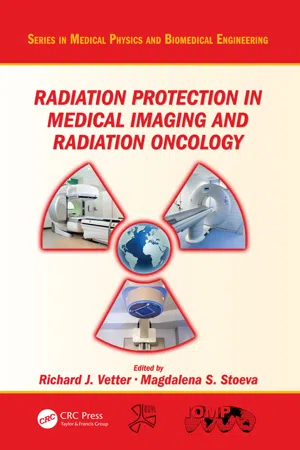
- Richard J. Vetter, Magdalena S. Stoeva, Richard J. Vetter, Magdalena S. Stoeva(Authors)
- 2016(Publication Date)
- CRC Press(Publisher)
III Overview of Medical Health Physics (Radiation Protection in Medicine) 45 C H A P T E R 4 Radiation Protection in Medicine (Medical Health Physics) Richard J. Vetter Mayo College of Medicine, Mayo Clinic, Rochester, MN USA Magdalena S. Stoeva Publication Committee, International Organization for Medical Physics (IOMP) CONTENTS 4.1 Introduction ................................................. 48 4.2 Radiation Protection in Medicine .......................... 49 4.3 Measurements and Dosimetry .............................. 49 4.4 Radiology ................................................... 49 4.5 Nuclear Medicine ........................................... 52 4.5.1 Diagnostic Nuclear Medicine ........................ 52 4.5.2 Therapeutic Nuclear Medicine ...................... 53 4.5.3 Positron Emission Tomography (PET) ............. 56 4.6 Radiation Oncology ......................................... 57 4.6.1 External Beam Shielding ............................ 57 4.6.2 Brachytherapy ...................................... 58 4.6.3 Low-Dose-Rate Brachytherapy ...................... 58 4.6.4 High-Dose-Rate Brachytherapy ..................... 59 4.7 Radiation Accidents in Medicine ........................... 59 4.8 The Role of Recommendations and Regulations ........... 60 4.9 Conclusion .................................................. 60 47 48 Radiation Protection in Medical Imaging and Radiation Oncology M EDICAL PHYSICS is the science associated with the accuracy, safety, and quality of the use of radiation in medical procedures including med-ical imaging and radiation therapy. Various chapters in this book focus on the safe use of radiation in specific areas of medicine. This chapter is intended to review the scientific literature of radiation protection in medicine, to provide readers with a brief background in the development of safety practices and the science of radiation protection in medicine. eBook - PDF
- William R. Hendee, E. Russell Ritenour(Authors)
- 2003(Publication Date)
- Wiley-Liss(Publisher)
It certainly has made writing it more fun. Medical imaging today is a collaborative effort involving physicians, physicists, engineers, and technologists. Together they are able to provide a level of patient care that would be unachiev- able by any single group working alone. But to work together, they must all have a solid foundation in the physics of medical imaging. It is the intent of this text to provide this foundation. We hope that we have done so in a manner that makes learning enriching and enjoyable. WILLIAM R. HENDEE, Ph.D. E. RUSSELL RITENOUR , Ph.D. xv PREFACE TO THE FIRST EDITION This text was compiled and edited from tape recordings of lectures in medical radiation physics at the University of Colorado School of Medicine. The lectures are attended by resident physicians in radiology, by radiologic technologists and by students beginning graduate study in Medical Physics and in radiation biology. The text is intended for a similar audience. Many of the more recent developments in medical radiation physics are discussed in the text. However, innovations are frequ- ent in radiology, and the reader should supplement the book with perusal of the current literature. References at the end of each chapter may be used as a guide to additional sources of information. Mathematical prerequisites for understanding the text are minimal. In the few sections where calculus is introduced in the derivation of an equation, a description of symbols and proce- dures is provided with the hope that the use of the equation is intelligible even if the derivation is obscure. Problem solving is the most effective way to understand physics in general and medical radiation physics in particular. Problems are included at the end of each chapter, with answers at the end of the book. Students are encouraged to explore, discuss and solve these problems. Example problems with solutions are scattered throughout the text. eBook - PDF
- Paul Peter Urone, Roger Hinrichs(Authors)
- 2012(Publication Date)
- Openstax(Publisher)
32 MEDICAL APPLICATIONS OF NUCLEAR PHYSICS Figure 32.1 Tori Randall, Ph.D., curator for the Department of Physical Anthropology at the San Diego Museum of Man, prepares a 550-year-old Peruvian child mummy for a CT scan at Naval Medical Center San Diego. (credit: U.S. Navy photo by Mass Communication Specialist 3rd Class Samantha A. Lewis) Chapter Outline 32.1. Medical Imaging and Diagnostics • Explain the working principle behind an anger camera. • Describe the SPECT and PET imaging techniques. 32.2. Biological Effects of Ionizing Radiation • Define various units of radiation. • Describe RBE. 32.3. Therapeutic Uses of Ionizing Radiation • Explain the concept of radiotherapy and list typical doses for cancer therapy. 32.4. Food Irradiation • Define food irradiation low dose, and free radicals. 32.5. Fusion • Define nuclear fusion. • Discuss processes to achieve practical fusion energy generation. 32.6. Fission • Define nuclear fission. • Discuss how fission fuel reacts and describe what it produces. • Describe controlled and uncontrolled chain reactions. 32.7. Nuclear Weapons • Discuss different types of fission and thermonuclear bombs. • Explain the ill effects of nuclear explosion. Chapter 32 | Medical Applications of Nuclear Physics 1277 Introduction to Applications of Nuclear Physics Applications of nuclear physics have become an integral part of modern life. From the bone scan that detects a cancer to the radioiodine treatment that cures another, nuclear radiation has diagnostic and therapeutic effects on medicine. From the fission power reactor to the hope of controlled fusion, nuclear energy is now commonplace and is a part of our plans for the future. Yet, the destructive potential of nuclear weapons haunts us, as does the possibility of nuclear reactor accidents. Certainly, several applications of nuclear physics escape our view, as seen in Figure 32.2.
- Jacob Van Dyk(Author)
- 2013(Publication Date)
- Medical Physics Publishing(Publisher)
http://www.nndc.bnl.gov . 16.9 Mailing Lists/Discussion Forums American Medical Physics mailing list. http://lists.wayne.edu/cgi-bin/wa?A0=MEDPHYSUSA. Global Medical Physics mailing list. http://lists.wayne.edu/cgi-bin/wa?A0=MEDPHYS. Medical Dosimetry mailing list. http://health.groups.yahoo.com/group/meddos/. Radiation Therapy mailing list (for radiation therapy professionals). http://health.groups.yahoo.com/group/RADIATIONTHERAPY/. 16.10 Guide to Medical Physics Practice Guide to Medical Physics Practice. American College of Radiology. http://www.acr.org/Membership/Legal- Business-Practices/Group-Practice-Resources/Guide-to-Medical-Physics-Practice. What Do Medical Physicists Do? AAPM website. http://www.aapm.org/medical_physicist/default.asp. Technical Standards for Medical Physics Practice. American College of Radiology (ACR). http://www.acr.org/Quality-Safety/Standards-Guidelines/Technical-Standards-by-Modality/Medical-Physics. Glossary of Nuclear Science Terms. http://ie.lbl.gov/education/glossary/glossaryf.htm. CHAPTER 16: RADIATION ONCOLOGY Medical Physics RESOURCES FOR WORKING, TEACHING, AND LEARNING 547 16.11 On-line Medical Physics-related Staffing Information Staffing Requirements in Radiation Medicine. Vienna: International Atomic Energy Agency (IAEA). In preparation, 2013. Medical Physics Staffing for Radiation Oncology: Report on a Decade of Experience in Ontario, Canada. J. J. Battista, B. G. Clark, M. S. Patterson, L. Beaulieu, M. S. Sharpe, L. J. Schreiner, M. S. MacPherson, and J. Van Dyk. J. Appl. Clin. Med. Phys. 13:93–110 (2012). http://www.jacmp.org/index.php/jacmp/article/view/3704/2383 and http://www.jacmp.org/index.php/jacmp/article/view/3915/2434 (Erratum). Manual for ACRO Accreditation. July 2012. Bethesda, MD: American College of Radiation Oncology (ACRO), 2012. http://www.acro.org/Accreditation/ACROManualWeb%209-21-12.pdf. Safety Is No Accident: A Framework for Quality Radiation Oncology and Care. eBook - PDF
The Modern Technology of Radiation Oncology, Vol 4
A Compendium for Medical Physicists and Radiation Oncologists
- Jacob Van Dyk(Author)
- 2020(Publication Date)
- Medical Physics Publishing(Publisher)
16.5 Summary This chapter has addressed a number of issues related to global considerations in radiation oncology Medical Physics, ranging from variations in education and train- ing (along with the corresponding credentialing) to addressing global disparities that are not only mani- fested in LMIC contexts, but also exist in HIC contexts, as indicated by, e.g., gender disparities. Models for addressing global physics education were addressed, along with a discussion on issues to contemplate in addressing global disparities and the corresponding con- siderations in international outreach. These issues and their solutions are not simple; however, this chapter has attempted to provide some food for thought on factors to consider in this context. The role of the medical physi- cist is crucial to providing safe and effective radiation therapy, as well as providing support in diagnostic imaging departments. This role needs to be promoted and clearly enunciated in the entire global domain. This chapter provides support for these kinds of delibera- tions. References AAPM. (2019). “American Association of Physicsts in Medicine (AAPM) Government and Regulatoir Affairs.” https:// www.aapm.org/government_affairs/licensure/default.asp. AAPM/IOMP. (2019). “AAPM/IOMP Equipment Donation Program.” https://aapm.org/international/EquipmentDonation.asp. Abdel-Wahab, M., E. Fidarova, and A. Polo. (2017). “Global Access to Radiotherapy in Low- and Middle-income Countries.” Clin. Oncol. (R. Coll. Radiol.) 29(2):99–104. Amols, H. I., F. Van den Heuvel, and C. G. Orton. (2010). “Point/counterpoint. Radiotherapy physicists have become glorified technicians rather than clinical scientists.” Med. Phys 37(4):1379–81. Atun, R., D. A. Jaffray, M. B. Barton, F. Bray, M. Baumann, B. Vikram, T. P. Hanna, F. M. Knaul, Y. Lievens, T. Y. Lui, M. Milosevic, B. O’Sullivan, D. L. Rodin, E. Rosenblatt, J. Van Dyk, M. L. Yap, E. Zubizarreta, and M Gospodarowicz.
Index pages curate the most relevant extracts from our library of academic textbooks. They’ve been created using an in-house natural language model (NLM), each adding context and meaning to key research topics.

