Physics

Phase Space
Phase space in physics refers to a mathematical space in which all possible states of a system are represented, with each state corresponding to a unique point in the space. It is often used to analyze the behavior of dynamic systems, such as particles or waves, by plotting their positions and momenta. Phase space provides a comprehensive way to study the evolution of a system over time.
Written by Perlego with AI-assistance
Related key terms
1 of 5
6 Key excerpts on "Phase Space"
 eBook - PDF
Statistical Thermodynamics and Stochastic Kinetics
An Introduction for Engineers
- Yiannis N. Kaznessis(Author)
- 2011(Publication Date)
- Cambridge University Press(Publisher)
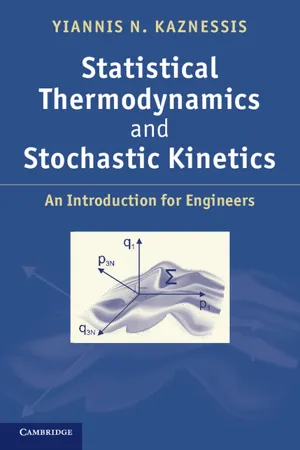
We call this the Phase Space of the system, and denote it with . This is simply a mathematical construct that allows us concisely to define the microscopic states of the system. Each point in Phase Space X is a microscopic state of the system: X ( p , q ) = ( p 1 , p 2 , . . . , p N , q 1 , q 2 , . . . , q N ) (3.57) or X ( p , q ) = ( p 1 , p 2 , . . . , p 3 N , q 1 , q 2 , . . . , q 3 N ). (3.58) We can now define a phase orbit or phase trajectory as the succession of microstates X (t ), with momenta and coordinates ( p (t ), q (t )) being the solution of forward integration of Hamilton’s equations of motion for a set of initial conditions X (0) = ( p (0), q (0)). The phase orbit can be simply considered as a geometrical interpretation of Hamilton’s equa- tions of motion: a system with N mass points, which move in three dimensions, is mathematically equivalent to a single point moving in 6 N dimensions (Fig. 3.4). As discussed in the previous section, knowledge of the microscopic state of a system X (t 1 ) at a particular time instance t 1 completely 44 Phase Spaces, from classical to quantum mechanics, and back determines the microscopic states of the system for all times t 2 (both in the future, with t 2 > t 1 , and in the past, with t 2 < t 1 ). The following observations can be made regarding the Phase Space: 1. Distinct trajectories in Phase Space never cross. Proof: let X A (t 2 ) and X B (t 2 ) be two Phase Space points of two systems A and B characterized by the same Hamiltonian at the same time t 2 . Assume that at this time t 2 they are different, i.e., X A (t 2 ) = X B (t 2 ). Then the observation states that X A (t 1 ) = X B (t 1 ), ∀t 1 . If they did cross at time t 1 , then by integrating the equations of motion for t 1 − t 2 yields X A (t 2 ) = X B (t 2 ), which of course vio- lates the initial premise. Therefore distinct trajectories never cross (Fig. 3.5). eBook - PDF
- Marcos Mariño(Author)
- 2021(Publication Date)
- Cambridge University Press(Publisher)
3 The Phase Space Formulation of Quantum Mechanics 3.1 Introduction The standard formulation of quantum mechanics, developed in the 1920s by Heisenberg, Born, Jordan, Schr¨ odinger, Dirac, and others, culminated in the math- ematical synthesis due to Von Neumann in the early 1930s. This synthesis is based on the theory of self-adjoint operators on a Hilbert space. Vectors in this Hilbert state represent pure states of the quantum system, while operators represent physical observables. A general, mixed state is represented by a density operator. This mathematical language is clearly very different to that of classical physics, where states are probability distributions in Phase Space, and physical observables are functions on Phase Space. This mismatch leads to many conceptual and technical difficulties. In particular, we expect quantum mechanics to become equivalent to classical mechanics in the limit in which is small as compared to the actions involved in the problem. However, it is not easy to see how functions and distributions on Phase Space can be obtained as limiting objects if one starts with operators in a Hilbert space. Clearly, a formulation of quantum mechanics in the mathematical language of classical mechanics would make this problem easier to solve, and would provide us with the rich geometric intuition associated with Phase Space. Such a formulation was first sketched by Wigner in 1932 when he was trying to understand the semiclassical limit of quantum statistical mechanics. Wigner’s approach was further developed by Groenewold and Moyal in 1940–1950, and various additions to the theory were made in subsequent years, leading to what we will call the Phase Space formulation of quantum mechanics. In this formulation, the basic object describing a state is Wigner’s function, which is defined on Phase Space and has many of the properties of a probability distribution in classical statistical mechanics. eBook - PDF
- Roger G. Newton(Author)
- 2021(Publication Date)
- Princeton University Press(Publisher)
It turns out that the orientation of the Earth's axis is stable only because of the presence of the Moon. See J. Laskar, Large-scale chaos and marginal stability in the solar system, in D. Iagolnitzer, ed., Eleventh International Congress of Mathematical Physics (Boston: International Press, 1995), pp. 75-120. 46 THE STATE OF A PHYSICAL SYSTEM The original field in which physics explicitly abandons strict de-terminism and instead deals with probabilities is, of course, statis-tical mechanics. Since the complete microscopic state of a system of molecules making up a gas is never knowable, nor indeed of much interest, attention is focused instead on the macroscopic state of the system. To accomplish this shift of focus, we introduce coarse graining: the Phase Space is subdivided into cells whose size and shape are determined by the precision of our observations and the closeness of our attention in various regions of Phase Space. Most important, since it is of no interest which particular molecule of a fluid is located in a specified position, a coarse grain will con-tain all the microscopic states that differ from one another sim-ply by exchange of identical molecules. 4 A macrostate thus defined corresponds to a large number of microstates; it is represented by a phase-space region of finite volume rather than by a point. Replac-ing microstates by macrostates in initial conditions will then result in the abandonment of strict determinism in favor of probabilis-tic predictions, based on a counting of the number of microstates contained in a given macrostate. This is the essence of classical sta-tistical mechanics. Meanwhile, let us look at quantum mechanics. QUANTUM MECHANICS In quantum mechanics the state of a physical system is specified by its state vector, or more generally, by its density operator, and its equation of motion is the Schrodinger equation. The appropriate space in which to represent the state now is a Hilbert space rather than Phase Space. eBook - PDF
Quantum Mechanics In Phase Space: An Overview With Selected Papers
An Overview with Selected Papers
- Thomas L Curtright, David B Fairlie, Cosmas K Zachos(Authors)
- 2005(Publication Date)
- World Scientific(Publisher)
202 311 Progress of Theoretical Physics, Vol. 11, Nos. 4-5, April-May 1954 The Formulation of Quantum Mechanics in terms of Ensemble in Phase Space’’ Takehiko TAKABAYASI (Received November 16, 1953) The formulation of non-relatiristic quantum mechanics in terms of ensemble in Phase Space is established by clarifying the subsidiary conditions for the Phase Space ensemble to represent a pure state, and thereby the equivalent correspofidence between this formulation and the alternative for- mulation in terms of quantum potential previously developed is exhibited. § 1. Introduction and summary The ordinary formulation of quantum mechanics, as established by the fusion of Heisenberg’s matrix mechanics and Schrodinger’s wave mechanics, is certainly the most fundamental and powerful one, having its own ‘ picture ’ in a broad sense* essentially non- classical. Nevertheless we may consider another consistent formulation of quantum mechanics with its associated picture, for instance, path integral formulation by Feynman”. Generally such a new formulation and picture would reveal new aspects of physical and mathematical construction of quantum mechanics, and might serve to suggest new clues to future progress of quantum theory itself **, apart from its usefulness for practical applications to specified class of problems. From such viewpoint we have examined in detail a certain formulation of quantum mechanics in previous paper^^'^' (see 5 (a)): The method is based on the transforma- tion of customary Schrodinger equation into simultaneous equations for the phase and amplitude of the wave function, which are found to be of the form of Hamilton-Jacobi-like equation or Euler’s equation of motion for velocity potential, and the equation of continuity. eBook - PDF
- Michael Kotelyanskii, Doros N. Theodorou, Michael Kotelyanskii, Doros N. Theodorou(Authors)
- 2004(Publication Date)
- CRC Press(Publisher)
The following Fig. 3 shows Simulation methods for polymers 14 the simplest example of state points and trajectories in Phase Space. Notice that not just any line can represent a trajectory. The line crossed out in Fig. 3 cannot be a trajectory. It corresponds to the impossible situation where the coordinate is increasing with time, while the velocity is negative. B. Classical and Quantum Mechanics In both quantum and classical mechanics, a system is defined by its degrees of freedom and by its potential and kinetic energy functions. In a quantum mechanical description, electrons, in addition to nuclei, are included among the degrees of freedom. Given the potential and kinetic energies as functions FIG. 3 State points at different moments in time t 1 eBook - PDF
Quantum Field Theory And Its Macroscopic Manifestations: Boson Condensation, Ordered Patterns And Topological Defects
Boson Condensation, Ordered Patterns and Topological Defects
- Massimo Blasone, Petr Jizba, Giuseppe Vitiello(Authors)
- 2011(Publication Date)
- ICP(Publisher)
In solid state physics the physical particles are usually called quasiparticles. The structure of the space of the physical states 3 Among the quasiparticles, a special role is played by those, such as phonons, magnons, etc., called “collective modes”, which are responsible for long-range correlation among the elementary components of the system. The possibility of identifying outgoing and/or incoming particles resides in the possibility of setting our particle detector far away from the inter-action region (at a space distance x = ±∞ from the interaction region) and to let it be active well before and/or well after the interaction time (at a time t = ±∞ with respect to the interaction time). In other words, we assume that the interaction forces among the particles go to zero at spacetime regions far away from the spacetime interaction region. 1 This is indeed possible in most cases. However, there are important cases in which this “switching off” of the interaction is not possible due to intrinsic properties of the interaction. When this latter situation occurs, we can-not apply the usual methods of perturbation theory. The validity of the perturbative methods relies indeed on the possibility of correctly defining “asymptotic” states for the system under study, namely states properly defined in spacetime regions where the interaction effects are negligible. We now briefly summarize the main steps in the construction of the Hilbert space for the physical particles. Among several possible strategies [115, 343, 466, 558, 599, 666], we mostly follow [617, 619, 621]. The state of a single particle is classified by the suffices ( i,s ), where i specifies the spatial distribution of the state, while s specifies other freedoms (e.g., spin, charges, etc.). For simplicity, we assume we are dealing with only one kind of particle (e.g., only electrons, or only protons, etc.).
Index pages curate the most relevant extracts from our library of academic textbooks. They’ve been created using an in-house natural language model (NLM), each adding context and meaning to key research topics.

