Physics

PV Diagrams
PV diagrams, also known as pressure-volume diagrams, are graphical representations of the changes in pressure and volume of a system. In these diagrams, the area under the curve represents the work done on or by the system. They are commonly used in thermodynamics to analyze the processes of gases and the work done during these processes.
Written by Perlego with AI-assistance
Related key terms
1 of 5

5 Key excerpts on "PV Diagrams"
 eBook - PDF
- George C. King(Author)
- 2023(Publication Date)
- Wiley(Publisher)
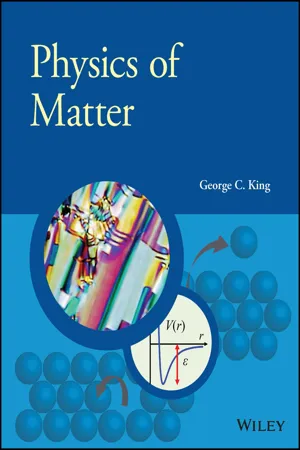
5.5 Phase diagrams The particular phase, gaseous, liquid, or solid, that a substance is in depends on the state parameters: vol- ume V, pressure P, and temperature T. For example, water at atmospheric pressure exists in the liquid phase over the temperature range 0–100 C. A phase diagram is a convenient way to display the relationship between the gaseous, liquid, and solid phases of a substance and the state parameters. One kind of phase diagram plots the pressure of the substance as a function of volume. Figure 5.7 is an example of such a phase diagram. Another kind is to plot the pressure of the substance as a function of temperature at constant Real gases 171 volume. Such a phase diagram is shown in Figure 5.13. And the relationship between pressure, temperature, and volume for the substance can be represented as a surface in a three-dimensional space with coordinates P, V, and T. We can construct a phase diagram for a particular substance using an arrangement like that shown in Figure 5.12. This consists of a cylinder/piston arrangement contained in a thermostatically controlled enclosure. The cylinder contains a fixed amount of the substance. The pressure P and the volume V occu- pied by the substance can be varied by moving the piston and the temperature T of the arrangement can also be controlled. These three parameters P, V, and T are related by the equation of state. Hence, in gen- eral, if we set two of the parameters, the third is determined by that equation. In the case of an ideal gas, if we set, for example, the pressure P and temperature T, the volume V is determined by the ideal gas law: PV = RT. Consider first the phase diagram shown in Figure 5.7, and, in particular, the 13 C isotherm. Initially, the substance is in the gaseous phase. As the gas in the cylinder is compressed by pushing the piston into the cylinder, the pressure increases at first, broadly in agreement with Boyle’s law until point B is reached.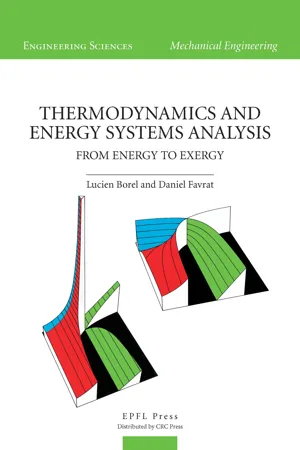
- Lucien Borel, Daniel Favrat(Authors)
- 2010(Publication Date)
- PPUR(Publisher)
δq + = 0 δr σ = T s P d d v σ δ = r P v d σ ∫ d s q T r T = + + δ δ d s r T = ≥ δ 0 Thermodynamic processes and diagrams 351 (8.18) Hence, In fact, Relation (8.16) shows that, in such a case, we generally have (8.19) In other words, the system must be cooled to compensate for the internal energy produced by the phenomenon of dissipation. 8.3 THERMODYNAMIC DIAGRAMS 8.3.1 Introduction In Subsection 2.3.3, we introduced the principle of representing the thermodynamic behavior of a simple system using diagrams. The most frequently employed ther- modynamic diagrams are the following: • P-v (or Watt) diagram; • P-v (or Clapeyron) diagram; • T-s (or entropic) diagram; • h-s (or Mollier) diagram; • lnT-s (or polytropic) diagram; • and lnP-h (or refrigeration) diagram. We will now focus on the main features of these diagrams. 8.3.2 P-v (or Clapeyron) diagram Definition Generally speaking, a P-v diagram is a diagram that involves the pressure P as the ordinate and the specific volume v as the abscissa. Configuration Figure 8.1 represents, by way of example, the P-v diagram relative to water. This graph includes the saturation curve as well as the families of isothermal and iso- quality curves. Figure 8.2 represents a P-v diagram in which are drawn the families A process that is simultaneously adiabatic and without dissipation is a strictly isentropic process. It is important to note that the reciprocal is not true, i.e., an isentropic process is not necessarily adiabatic and without dissipation. δ δ σ q r s + = = ⎫ ⎬ ⎭ = = 0 0 0 0 d δ δ q r + = − ≤ 0 352 Thermodynamics and Energy Systems Analysis: from Energy to Exergy Fig. 8.1 P-v diagram relative to water. . v c = 0 00317 . m kg 3 P c = 221 19 . bar ˆ . T c = ° 374 15 C C Saturation curve gas Fig. 8.2 Typical processes in the P-v diagram. Cst Cst Cst Cst Cst Ideal or perfect gas eBook - PDF
Thermodynamics
Fundamentals and Engineering Applications
- William C. Reynolds, Piero Colonna(Authors)
- 2018(Publication Date)
- Cambridge University Press(Publisher)
For this reason the modeling of fluids is our main focus, while solid or other states or phases of matter are not included in this treatment. Nowadays fluid models are implemented in com-puter programs and the use of tables or other man-ual procedures is obsolete. Thermodynamic charts, which are usually available as a graphical output of these computer programs – have a look at the Sample Thermodynamic Diagrams subfolder in the F LUID P ROP installation folder – are often useful in preliminary studies and for general thermodynamic assessment because they can provide visual information which, with some experience, can be related to the ther-modynamic performance of energy conversion cycles and other technical processes. The correct choice of the fluid model is an important task when deal-ing with system modeling and analysis, therefore relevant models are illustrated in some detail here. Often, an important requirement for a fluid model is that it should consistently describe the liquid and vapor phases, the so-called supercritical region, and enthalpy differences between states, also across phases. This implies the use of one single thermo-dynamic model for all the thermodynamic regions of interest, that is, for subcooled, saturated, super-heated, and supercritical states. Figure 6.9 shows the P – v state diagram for water, indicating the sub-cooled liquid, vapor–liquid, superheated, and super-critical regions. The points forming the diagram have been calculated with the so-called Industrial Formulation 97 (IF97) model issued by the Interna-tional Association for the Properties of Water and Steam (IAPWS). IAPWS is an international not-for-profit association of national organizations concerned with the properties of water and steam. More specifically, thermophysi-cal properties and other aspects of high-temperature eBook - PDF
- Anton A. Kiss, Carlos A. Infante Ferreira(Authors)
- 2016(Publication Date)
- CRC Press(Publisher)
• Work ( dW = − PdV ): compression is positive (volume decreases, dV < 0), while expan-sion is negative (volume increases, dV > 0). • Capital letters designate molar values of properties, such as volume V , internal energy U , enthalpy H , entropy S and free energy functions A , G . Consequently, extensive values for a system containing n moles are noted by ( nV ), ( nU ), and so on. 2.2.1 Laws of Thermodynamics Zeroth law of thermodynamics: If two systems are each in thermal equilibrium with a third, they are also in thermal equilibrium with each other. Thermodynamics of Heat Pump Cycles ◾ 25 Note that two systems are considered to be in the state of thermal equilibrium if they do not change over time and are linked by a wall permeable only to heat. This law helps to define the notion of temperature. Another statement of the zeroth law is that all diathermal walls are equivalent. Note that a diathermal wall between two thermodynamic systems allows heat but not matter to pass across it. This law is important for the mathematical for-mulation of thermodynamics, which needs the assertion that the relation of thermal equi-librium is an equivalence relation. This information is in fact needed for the mathematical definition of temperature that will agree with the physical existence of valid thermometers. First law of thermodynamics: The increase in internal energy of a closed system is equal to the difference of the heat supplied to the system and the work done by it. Basically, the first law postulates the conservation of energy , which states that energy can be transformed (changed from one form to another) but cannot be created or destroyed. The system is the part of the space where the process occurs. Everything not included in the system is considered surroundings . eBook - PDF
- Russell Monson, Dennis Baldocchi(Authors)
- 2014(Publication Date)
- Cambridge University Press(Publisher)
25 Thermodynamics, work, and energy 2.5 Pressure, volume, and the ideal gas law Pressure results from mass with kinetic energy and the resultant collisions that occur as particles of mass collide with each other and with any surfaces they contact, thus transferring momentum. In the case of gases, pressure and volume are described as con- jugates in relation to one another according to the ideal gas law: PV ¼ nRT; ð2:8Þ where P is pressure (Pa), V is volume (m 3 ), n is the number of moles of gas constituents, R is the universal gas constant (8.314 m 3 Pa mol −1 K −1 ), and T is temperature (K). Most gases approximate an “ideal gas” meaning that transitions in their properties can be adequately described by Eq. (2.8). However, at extremely low temperatures or extremely high pressures, collisions among gas molecules may not be completely “elastic”; an often unstated condition of the ideal gas law. In those conditions, the molecular masses and inter-molecular interactions involving atomic charge (e.g., charge attraction or repulsion) can influence the thermodynamic behavior of the gas and Eq. (2.8) may be inadequate to quantitatively describe all behaviors. In most cases, the behavior of gases in the atmosphere, which is the topic of this book, can be adequately described by the ideal gas law. The ideal gas law is an example of an equation of state, which provides quantitative relations among the state variables used to describe matter. The ideal gas law governs the distribution of internal energy in a system of gas. For example, Eq. (2.8) makes it clear that any decrease in the pressure of a gas not accompanied by a proportional decrease in volume or increase in molar abundance must be accompanied by a proportional decrease in temperature. In another application, Eq. (2.8) can be rearranged to show that molar density (n/V) increases in direct proportion with pressure and decreases in inverse proportion with temperature.
Index pages curate the most relevant extracts from our library of academic textbooks. They’ve been created using an in-house natural language model (NLM), each adding context and meaning to key research topics.

