Politics & International Relations

Anarcho-Syndicalism
Anarcho-syndicalism is a political theory that advocates for the organization of society through decentralized, worker-controlled trade unions. It seeks to abolish the state and capitalism, and instead promote a system of direct action, solidarity, and self-management. Anarcho-syndicalists aim to create a society based on voluntary cooperation and mutual aid, with a focus on workers' rights and economic equality.
Written by Perlego with AI-assistance
Related key terms
1 of 5
8 Key excerpts on "Anarcho-Syndicalism"
 eBook - ePub
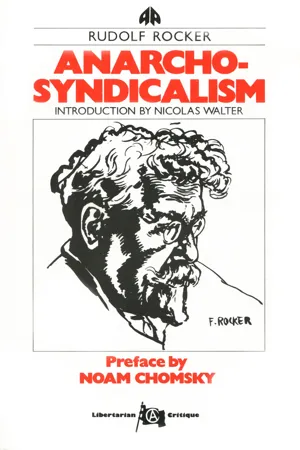
- Rudolf Rocker(Author)
- 1998(Publication Date)
- Pluto Press(Publisher)
All the educational work of the Anarcho-Syndicalists is aimed at this purpose. Education for Socialism does not mean for them trivial campaign propaganda and so-called “politics of the day,” but the effort to make clear to the workers the intrinsic connections among social problems, by technical instruction and the developmeat of their administrative capacities, to prepare them for their role of re-shapers of economic life, and give them the moral assurance required for the performance of their task. No social body is better fitted for this purpose than the economic fighting organization of the workers ; it gives a definite direction to their social activities and toughens their resistance in the immediate struggle for the necessities of life and the defence of their human rights. This direct and unceasing warfare with the supporters of the present system develops at the same time the ethical concepts without which any social transformation is impossible: vital solidarity with their fellows-in-destiny and moral responsibility for their own actions.Just because the educational work of the Anarcho-Syndicalists is directed toward the development of independent thought and action, they are outspoken opponents of all those centralizing tendencies which are so characteristic of political labour parties. But centralism, that artificial organization from above downward which turns over the affairs of everybody in a lump to a small minority, is always attended by barren official routine ; and this crushes individual conviction, kills all personal initiative by lifeless discipline and bureaucratic ossification, and permits no independent action. The organization of Anarcho-Syndicalism is based on the principles of Federalism, on free combination from below upward, putting the right of self-determination of every member above everything else and recognizing only the organic agreement of all on the basis of like interests and common convictions.It has often been charged against Federalism that it divides the forces and cripples the strength of organized resistance, and, very significantly, it has been just the representatives of the political labour parties and of the trade unions under their influence who have kept repeating this charge to the point of nausea. But here, too, the facts of life have spoken more clearly than any theory. There was no country in the world where the whole labour movement was so completely centralized and the technique of organization developed to such extreme perfection as in Germany before Hitler’s accession to power. A powerful bureaucratic apparatus covered the whole country and determined every political and economic expression of the organized workers. In the very last elections the Social Democratic and Communist parties united over twelve million voters for their candidates. But after Hitler seized power six million organized workers did not raise a finger to avert the catastrophe which had plunged Germany into the abyss, and which in a few months beat their organizations completely to pieces. eBook - ePub
- Bertrand Russell(Author)
- 1996(Publication Date)
- Perlego(Publisher)
What is perhaps most remarkable in regard to both Socialism and Anarchism is the association of a widespread popular movement with ideals for a better world. The ideals have been elaborated, in the first instance, by solitary writers of books, and yet powerful sections of the wage-earning classes have accepted them as their guide in the practical affairs of the world. In regard to Socialism this is evident; but in regard to Anarchism it is only true with some qualification. Anarchism as such has never been a widespread creed, it is only in the modified form of Syndicalism that it has achieved popularity. Unlike Socialism and Anarchism, Syndicalism is primarily the outcome, not of an idea, but of an organization: the fact of Trade Union organization came first, and the ideas of Syndicalism are those which seemed appropriate to this organization in the opinion of the more advanced French Trade Unions. But the ideas are, in the main, derived from Anarchism, and the men who gained acceptance for them were, for the most part, Anarchists. Thus we may regard Syndicalism as the Anarchism of the market-place as opposed to the Anarchism of isolated individuals which had preserved a precarious life throughout the previous decades. Taking this view, we find in Anarchist-Syndicalism the same combination of ideal and organization as we find in Socialist political parties. It is from this standpoint that our study of these movements will be undertaken.Socialism and Anarchism, in their modern form, spring respectively from two protagonists, Marx and Bakunin, who fought a lifelong battle, culminating in a split in the first International. We shall begin our study with these two men—first their teaching, and then the organizations which they founded or inspired. This will lead us to the spread of Socialism in more recent years, and thence to the Syndicalist revolt against Socialist emphasis on the State and political action, and to certain movements outside France which have some affinity with Syndicalism— notably the I. W. W. in America and Guild Socialism in England. From this historical survey we shall pass to the consideration of some of the more pressing problems of the future, and shall try to decide in what respects the world would be happier if the aims of Socialists or Syndicalists were achieved.My own opinion—which I may as well indicate at the outset—is that pure Anarchism, though it should be the ultimate ideal, to which society should continually approximate, is for the present impossible, and would not survive more than a year or two at most if it were adopted. On the other hand, both Marxian Socialism and Syndicalism, in spite of many drawbacks, seem to me calculated to give rise to a happier and better world than that in which we live. I do not, however, regard either of them as the best practicable system. Marxian Socialism, I fear, would give far too much power to the State, while Syndicalism, which aims at abolishing the State, would, I believe, find itself forced to reconstruct a central authority in order to put an end to the rivalries of different groups of producers. The BEST practicable system, to my mind, is that of Guild Socialism, which concedes what is valid both in the claims of the State Socialists and in the Syndicalist fear of the State, by adopting a system of federalism among trades for reasons similar to those which are recommending federalism among nations. The grounds for these conclusions will appear as we proceed. eBook - ePub
Film and the Anarchist Imagination
Expanded Second Edition
- Richard Porton(Author)
- 2020(Publication Date)
- University of Illinois Press(Publisher)
3. Anarcho-Syndicalism versus the ”Revolt against Work” Anarchism and the ”Degradation of Work”If any proof is needed that anarchism is far from a monolithic creed, the continuing conflict between anarcho-syndicalists and proponents of the “refusal of work” provides evidence of the animating tensions within contemporary anarchism. To a certain extent, debates between the inheritors of an anarcho-syndicalist tradition, pioneered by Rudolf Rocker and Diego Abad de Santillán, and contemporary anarchists and neo-Luddites represent a schism between nineteenth-century “workerism” and a late-twentiethcentury skepticism concerning the advisability of promoting the workplace as the only possible locus for direct action and social change. Yet the tensions between syndicalists and advocates of a militant “anti-work” position, which have intensified since the late 1960s, can be traced back to what the historian Paul Avrich calls the “classical phase” of the anarchist movement—the period “bounded by the Paris Commune of 1871 and the Spanish Revolution of the 1930s.”1 The First International’s exhortation—the “emancipation of the workers must be achieved by the workers themselves”—has an indisputably anarchist resonance, but anarchists have always questioned whether the possibility of emancipation could be promised only to skilled workers. In many respects, the Industrial Workers of the World (IWW), the most radical trade union that has ever flourished on American soil, encapsulates these contradictory currents. The IWW’s goal of “one big union” could be considered hyper-syndicalist, while its concurrent amenability to strategies of sabotage (“the conscious withdrawal of efficiency”) and hospitable attitude to marginal individuals (itinerant workers, hobos, and so on) who were rarely unionized has many affinities with a recent resurgence of anti-work ideology.2
- Cécile Laborde(Author)
- 2000(Publication Date)
- Palgrave Macmillan(Publisher)
II. Syndicalist society: contractual anarchism Syndicalist society was designed to embody anti-state principles: autonomy instead of authority; libertarianism instead of democracy; manual work instead of intellectualism; functional co-ordination instead of coercive integration. How far syndicalist principles under- mined the foundations of the French state is further evidenced by the striking popularity of the concept of contract in syndicalist circles in the early twentieth century, most spectacularly epitomized by the con- temporary debate over the issue of civil servants’ unionization. The thrust of syndicalist political theory was to substitute contractual rela- tions for the relations of authority believed to be inherent in the very idea of the state, thus giving syndicalist socialism a distinctively liber- tarian twist. The syndicalist ideal Syndicalists did not produce a clear picture of their utopian society. In fact, the utopian strand of socialism was the chief casualty of Sorel’s anti-dogmatic, intuitivist, pragmatic and pluralist approach to social- ism. Utopias were dismissed by the leader of the Nouvelle Ecole as ratio- nalist blueprints which would merely involve the reintroduction of the state and of intellectuals in the new society. Yet if Sorel himself Berth and Leroy: Anarchist Pluralism 27 guarded against predicting the future, fellow syndicalists did not neces- sarily share his epistemological misgivings. It was agreed by all that, in syndicalist society, loosely connected associations should replace the state – for associations, in Leroy’s words, were ‘a denial of the state and at the same time a condition of order’. 40 The type of association favoured by syndicalists was the occu- pational group, the syndicat grouping manual workers and born out of a ‘real’ solidarity. 41 Syndicats would be the cell of an original social order, a new ‘polity’ which, ‘instead of being founded on the state … must be founded on … the workshop’. eBook - PDF
The Spanish Labyrinth
An Account of the Social and Political Background of the Spanish Civil War
- Gerald Brenan(Author)
- 2014(Publication Date)
- Cambridge University Press(Publisher)
And since the war has delayed such projects indefinitely, it is doubtful if this will ever see the light. Meanwhile I have to thank him for having answered various questions I put to him. The salient feature of the period is the attempted introduction from France of ‘anarchist commun- ism’ with its conception of a centralized organiza- tion and secret directing group. This conflicted so violently with the large but loose federations of the ‘collectivists’ that after bitter disputes the Anarch- ist movement in Spain practically broke up. One group of the ‘anarchist communists’ then took to terrorism. This conflict illustrates the fundamental dilemma of anarchist organization. When the local federations were left to themselves they tended to isolated action and to reformism and when they were controlled by a small central body, then the revolutionary pace became too hot and most of the members fell off. A compromise solution was found in Anarcho-Syndicalism, but the disputes that attended the setting up of the Federación Anarquista Ibérica or F.A.I. in show that even this was not entirely satisfactory. The Anarchists VIII The Anarcho-Syndicalists u Recommençons maintenant. . .. . .la marche vers la délivrance. Georges Sorel. The word ‘syndicalism’ is simply French for trade unionism. The Syndicalist movement of a generation ago (Revo- lutionary Syndicalism, as it is usually called) had, how- ever, a special character. It grew up in France during the nineties as a reaction against the parliamentary socialism that allowed such men as Millerand to repre- sent the workers in the Chamber and to lead them along paths acceptable to the bourgeoisie. The figure chiefly associated with it was an Anarchist, Fernand Pelloutier, and, though he died prematurely in , the reorganization of the Confédération Général du Travail (or C.G.T.) in the year following his death completed his work. eBook - PDF
Understanding Democratic Politics
An Introduction
- Roland Axtmann(Author)
- 2003(Publication Date)
- SAGE Publications Ltd(Publisher)
This was known as ‘Anarcho-Syndicalism’ – an anarchism based among syndicates (the French and Spanish term for trade unions). Such bodies differed radically from the now-standard model of an institution to negotiate rates of pay and con-ditions of work with management. To cite an anarchist slogan, anarchist unions were not looking for a bigger slice of the cake; they wanted to take over the whole bakery. As well as defending their members’ immediate interests, they aimed at the deeper goal of the revolutionary seizure of production from the management. From the start, such militants were suspi-cious of bureaucracies. As in the example of the Greek Assembly, their ideal was that there should be no difference between the body of workers and the union. In a sense, they remained true to this ideal: in 1936, the Span-ish anarcho-syndicalist CNT (National Con-federation of Labour) had between half a million and a million members, and could boast that there was only one paid union official. The CNT depended on the voluntary activities of its members rather than on the specialized knowledge of a few experts. How-ever, economic conditions worked against these anarchist principles. In late nineteenth-century and early twentieth-century Europe, any known union activist could expect trouble from the boss. Where possible, bosses would simply fire activists. This meant that simply in order to survive, union activists needed some alternative source of income. In some cases they might set up pubs and cafés; elsewhere a salaried position, paid for by the union was considered. The CNT remained true to its opposition to paid bureaucracy by finding jobs for activists within the anarcho-syndicalist press. Anarcho-syndicalist unions reflected the entirety of their members’ lives. As well as fighting for better rates of pay, they also sponsored campaigns on housing conditions (leading bitterly fought rent strikes in Barce-lona). No longer available |Learn more
Anarchism Volume Two
A Documentary History of Libertarian Ideas, Volume Two – The Emergence of a New Anarchism
- Robert Graham(Author)
- 2021(Publication Date)
- Black Rose Books(Publisher)
Chapter 7 Forms Of Freedom 58. Philip Sansom: Syndicalism Restated (1951) Philip Sansom (1919-1999) was one of the English anarchists tried in 1945 with Marie Louise Berneri, Vernon Richards and John Hewetson for causing “disaffection” among the armed forces. He was a long time advocate of Anarcho-Syndicalism associated with the Freedom press group in London. The following excerpts are taken from his 1951 Freedom Press pamphlet, Syndicalism: The Workers’ Next Step . Noteworthy is his point that anarcho-syndicalists looked to workers’ councils answerable to the rank and file, not bureaucratic trade union orga-nizations, as the basic unit of industrial organization, and to the commune or municipality as the basis for local organization, within a network of freely federated and decentralized groups. ALTHOUGH SYNDICALISM AIMS AT THE organization of all the workers in industry, it does not do so in terms of the mass to the exclusion of the individual. The socialist, totalitarian, conception of the collectivity being more important than the individuals composing it, of the majority having the right to override the minority, have nothing in common with the Syndicalist conception of voluntary co-operation. This begins with the individual worker, at his place of work, coming together with his fellows to organize the job in hand. And the smaller the unit of cooperation can be, the greater will be the control the workers have over it... The first unit of organization, then, should be the works council… This council would consist of delegates chosen by the workers to do whatever organizational work is necessary for the smooth running of the works. If the productive unit is large and several processes are involved, each workshop, designing office or laboratory could send its delegate to the works council, instructed to carry out the wishes of the rank-and-file. This council must never be allowed to assume managerial powers. eBook - PDF
Peasants and Protest
Agricultural Workers, Politics, and Unions in the Aude, 1850-1914
- Laura Levine Frader(Author)
- 2023(Publication Date)
- University of California Press(Publisher)
Team workers had a reputation for independence; they thus brought their own self-emancipatory style to Audois syn- dicalism. 22 Third, the unions emerged from the same traditions of asso- ciational life that inspired the secret démoc soc societies of the 1850s and the cercles d'études sociales and libre pensée societies of the early Third Republic. The urban village community and local sociability facilitated the development of worker solidarity. Vineyard workers, artisans, and small vineyard owners who lived close to one another in protourban villages shared a social life in cafés and clubs that easily became transformed into cen- ters of syndicalist activity. 23 Skill, the work setting, and community life all reinforced peo- ple's consciousness of collective interests and were conducive to the development of syndicalist unions. But as Ronald Aminzade has noted, "Class entails more than a rational awareness and identification by workers of their own class interests. It also Revolutionary Syndicalism, and Direct Action 121 involves a recognition that those interests are in conflict with the class interests of the owners of capital and employers of their labor power." 24 The importance of syndicalism was precisely that: it provided workers with a discourse of conflict and re- sistance and ultimately brought them into the streets. Workers Take Action Between 1903 and 1905, thousands of agricultural workers in the Aude struck for higher wages and better working conditions. These strikes, beginning with the walkout at Peyriac de Mer, shared two characteristics. First, they were preeminently expres- sions of the moral economy of vineyard villages; second, they relied on the solidarity of whole winegrowing communities. The notion of a moral economy, as historians E. P. Thompson, Louise, Charles, and Richard Tilly and the anthropologist James C. Scott have observed, was a fundamental component of pre- capitalist peasant societies.
Index pages curate the most relevant extracts from our library of academic textbooks. They’ve been created using an in-house natural language model (NLM), each adding context and meaning to key research topics.

