Politics & International Relations

Debate on Environmental Issues
The debate on environmental issues encompasses discussions and disagreements surrounding policies, regulations, and actions aimed at addressing environmental challenges such as climate change, pollution, and conservation. Key points of contention often revolve around the balance between economic interests and environmental protection, the role of government intervention, and the allocation of responsibility among nations for global environmental issues.
Written by Perlego with AI-assistance
Related key terms
1 of 5
8 Key excerpts on "Debate on Environmental Issues"
 eBook - ePub
- Costas M. Constantinou, Pauline Kerr, Paul Sharp, Costas M. Constantinou, Pauline Kerr, Paul Sharp, Author(Authors)
- 2016(Publication Date)
- SAGE Publications Ltd(Publisher)
Distribution conflicts (C): with scarce natural resources, there is bound to be a ‘zero sum’ aspect to some environmental conflicts (where one party loses for another to win). How scarce resources get allocated, especially water resources in the context of riparian communities based on some norms of social justice, is the most challenging aspect of environmental diplomacy. The classic case in this regard is one of downstream versus upstream riparian communities, within nation-states or across borders. For example, does Ethiopia deserve to keep its water since most of the rainfall occurs on its land that feeds the Nile or does Egypt deserve a greater share of the water since Egyptian societies first found means of harnessing the water for broader commerce and are most dependent on it? Colonial agreements and voluntary standards such as the 2004 Berlin Rules from the International Law Association offer a backdrop for such diplomacy but are rarely consequential on their own. Such matters usually require linkage with other non-environmental diplomatic efforts as well in order to augment the bargaining spectrum (Islam and Susskind, 2012).Key Points
- There is definitional variance in using term ‘environmental diplomacy’ by disciplinary background of scholarship.
- It is important to note an expansive and inclusive definition given the development of diplomatic discourse to include both Track 1 and Track 2 processes.
- Despite different disciplinary backgrounds there is a shared focus on negotiation in studies on environmental diplomacy.
The evolution of environmental diplomacy and emergent themes
Environmental diplomacy had its origins in conventional views of diplomatic processes whereby nation-states negotiated with each other on bilateral or multilateral agreements. However, since environmental issues have multiple levels of engagement and the connections between local and global are more inextricable, we argue that environmental diplomacy is part of a broader genre of discourse on environmental conflict resolution. As J. Gustave Speth (2005), the former head of the United Nations Development Program, points out, the emergence of environmental concern in the 1960s had several distinguishing features. Initially this concern was local and state-driven in scope; the drivers at first were not global – local air and water pollution, strip-mining, highway construction, noise pollution, dams and streams channelization, clear-cutting, hazardous waste dumps, local nuclear power plants, exposure to toxic chemicals, oil spills, and suburban sprawl. In the US these concerns culminated in the passage of the US National Environmental Policy Act in 1969 and in the first Earth Day a few months later.At the state level a policy window had emerged and government action, which had once been impossible, became inevitable and part of the electoral process (Speth, 2005). The US Environmental Protection Agency (EPA) and the Council on Environmental Quality (CEQ) were established, the Clean Air and Water Acts were passed, and federal courts were overwhelmed with lawsuits brought by a new generation of environmental advocacy organizations. This led to Congress establishing far-reaching and tough deadlines for industry. eBook - ePub
- Mark Imber, John Vogler, Mark Imber, John Vogler(Authors)
- 2005(Publication Date)
- Routledge(Publisher)
fait accompli . The misrecognition of environmental concerns is now remedied through an approach which attempts to bring the environment into international relations. Such an approach is inherently limited, however, because it fails to account for the previous exclusion. Studying the political economy of the environment necessitates an attempt to understand why environmental issues had been hitherto neglected. That is, a past failure to include environmental concerns in the discipline cannot simply be regarded as a fact with no implications for the theorisation of the global system. Accelerated environmental degradation raises crucial questions concerning humanity’s relationship with the natural world, and with other species. Analyses of the global ecological crisis therefore require a rethinking of fundamental concepts and assumptions. Unless international relations theory sets out explicitly to tackle the set of questions which arise from the interaction between the economy and the ecosystem, it will instead merely find itself co-opting environmental analysis and accommodating ‘green’ issues within the prevailing conception of international relations. It is not in fact the case that international relations theory had previously ignored environmental issues altogether, but rather that (like all social sciences) by internalising environmental issues, it had rendered them invisible. International relations theory had traditionally removed from critical view the ways in which, historically, environmental issues had been silenced.The crucial question now becomes: how is the new-found visibility to be articulated? And it is important, indeed, to recognise which approaches will provide the best starting point for assessing the politics and economics of global environmental degradation. Before examining the contribution of IPE, it is necessary to look at the manner in which conventional international-relations theory has approached this task of assessment. eBook - ePub
Rio
Unravelling the Consequences
- Caroline Thomas(Author)
- 2014(Publication Date)
- Routledge(Publisher)
1992 ] for examples from international relations). In this article I examine whether the seeming centrality of environmental concerns is not in fact mistaken by reference to two dimensions of the role of environmental politics: within international relations as practice, and within the academic subject of international relations. I argue that there are powerful reasons, essentially political, that may keep the environment on the periphery in each setting.Such a view may well seem heretical to those who work within the environmental politics area. However, my overall claim is that too often practitioners and academics alike fall into the trap of being drawn by the ethical, moral or even common-sense logic of their argument or position without sufficient attention being paid to the ‘realities’ of political and economic power. As someone who works in probably the most conservative academic discipline, one which reifies the state as the centre-piece of political and economic analysis, I want to put forward a set of reasons why environmental politics may be destined to stay on the periphery of international relations (and of the discipline of international relations).Perhaps an historical precedent is to be found in the politics and study of European integration. In the 1950s and early 1960s, the logic of integration as a practice and as an (often interrelated) academic field, forecast the end of the states-system. Whether by functional stealth or by neo-functional co-option the state was to be overtaken by other actors. Arguably a similar neglect of high politics is present in most contemporary environmental work as was present in the heady days of European integration. Moreover, the states-system has faced many challenges before, and since, that posed by European integration. Yet for all its faults, and crucially for all its constraining and silencing of alternative notions of political community, the states-system remains the dominant political structure of international relations. eBook - ePub
- Helge Jörgens, Christoph Knill, Yves Steinebach, Helge Jörgens, Christoph Knill, Yves Steinebach(Authors)
- 2023(Publication Date)
- Routledge(Publisher)
Global Environmental Politics (since 2000), but constitutes a key topic in all major journals in the fields of Comparative Politics and Public Policy. A broad literature has developed that studies the making of environmental policies across different stages of the policy cycle, including problem definition, agenda-setting, decision-making, implementation, and evaluation. At the same time, scholars have analyzed various factors that determine national variation in environmental policy ambitions, including the role of political parties, social movements, and political institutions. Significant advances have been made in assessing cross-national interdependencies and drivers that affect the diffusion and convergence of environmental policies across national borders. Related to these developments, scholars of International Relations have studied the emergence and impact of international environmental regimes and organizations. More recently, students have turned to investigating the role of the bureaucratic bodies of these organizations and their influence on environmental policy beyond the nation state.This general trend has been reinforced by the rapid increase of public and scholarly attention to climate policy and the corresponding rise in scholarly activities and publications dedicated to this topic, especially in the forms of journal articles, monographs, edited collections, and the so-called “grey” literature.1 Environmental policy has also received much and growing attention in graduate level programs in Environmental Policy and Politics, Environmental Studies, Political Science, Public Administration, and International Relations.1.2 State of the Art
At this point in time, a general review and assessment of existing knowledge and future research priorities is highly warranted. Yet, although various handbooks and edited volumes exist in the field of Environmental Policy and Politics, most of these differ from this volume in at least one of three ways. First, most of the more recent handbooks emphasize the global dimension of environmental policy and politics (e.g. Dauvergne, 2012 ; Falkner, 2013 ; Harris, 2014 ; Kalfagianni et al., 2020 ). This is due to the predominance of the climate change issue but neglects the ongoing relevance of the nation state and its domestic policies, as well as environmental policies at the regional and sub-national levels, in all areas of environmental policy-making. Second, many of these books are mainly concerned with the politics side, lacking a systematic examination of environmental problems, policies, and processes (e.g. Schelly and Banerjee, 2018 ). Third, most of the handbooks focusing on the policy side of environmental governance were published ten or more years ago (e.g. Meijer, 2010 ; Dauvergne, 2012 ; Wijen et al., 2012 ). They are often characterized by a compartmentalized structure, focusing very much on the traditional areas of environmental policy-making, such as nature, air, water, soil, and waste, or study environmental policy from the perspective of distinctive academic subfields (e.g. Dauvergne, 2012 ; Wijen et al., 2012 ; Bäckstrand and Lövbrand, 2015 eBook - PDF
Environmental Political Thought
Interests, Values and Inclusion
- Robert Garner(Author)
- 2018(Publication Date)
- Bloomsbury Academic(Publisher)
1 1 INTRODUCTION: THE IDEA OF ENVIRONMENTAL POLITICS This book is about the political ideas current in thinking about the environment. It operates with a broad definition of ‘ideas’, including nor-mative and empirical dimensions, and a broad definition of the ‘political’, focusing not only on the state, but also civil society and the individual. Above all, the aim is to explain how a ‘politics’ of the environment can be distinguished from the coverage of other disciplines and, in particular, from environmental science. To do this, it is necessary to explore, in this introductory chapter, the idea of politics itself. What distinguishes a politics of the environment is the recognition that there are a variety of competing interests and values that need to be identified and explored. Environmental degradation does not affect all currently living humans in the same way. Moreover, the extent to which the goals of the Green movement are embraced depends upon the values adopted and, more specifically, what is regarded as an appropriate ethical position about the relationship between the human and non- human realms. A central component of environmental political thinking is a debate about how far moral entitlements end with currently living humans. Many political thinkers, and not just those with a commitment to environmentalism, hold that we have at least some moral obligations to future generations. Radical Green thinkers want to go even further by suggesting that these obligations extend beyond the human to non- human animals and even non-sentient parts of nature. As a result, future generations and non-humans ought to be included as beneficiaries of decisions currently living humans make, and perhaps also included, too, as members of the polity or political community. The three themes – interests, values and inclusion – therefore form the unifying thread to the chapters in this book. eBook - ePub
- Gary C Bryner(Author)
- 2015(Publication Date)
- Routledge(Publisher)
NDERSTANDING GLOBAL ENVIRONMENTAL POLITICS Theories of International Relations and Political ScienceT here is broad and deep agreement among environmental scientists that climate change, water shortages, and loss of biodiversity combine with other global environmental problems to threaten the future of humankind. They point out that droughts and other extreme weather events, declining fisheries, emerging diseases, and inadequate food production are some of the results of these crises. The evidence of environmental harms is clear, and there is widespread consensus among ecologists that risks are increasing. Yet that scientific knowledge has not resulted in thorough policy responses. This chapter examines the political and behavioral factors that have kept us from developing effective responses to global environmental threats. This means asking why we have been so unwilling to address threats to our well-being, especially as taking timely action seems so clearly in our self-interest.One way to think about these challenges is to lay them out on a continuum. At one end are environmental consequences that can be managed under existing institutions of government; the task at this end is to continue with existing efforts and expand these efforts incrementally to meet new problems. International relations (IR) theories are best suited to address these kinds of consequences, but unfortunately, there is little agreement that consequences will be so limited. At the midpoint in the continuum are consequences that require major changes in the policy-making capacity. These involve creating the ability to bring about needed changes in the way people in the wealthy world consume resources and to foster a type of development in poor countries that dramatically increases their peoples’ well-being without also increasing their environmental impacts. At the other end of the continuum, environmental changes are likely to be chaotic, unpredictable, and catastrophic. IR theory is not well suited to suggesting how far-reaching changes in policy capacity can be fostered, and it has few resources for understanding human behavior in the face of catastrophic environmental change. eBook - ePub
International Environmental Treaties and State Behavior
Factors Influencing Cooperation
- Denise DeGarmo(Author)
- 2013(Publication Date)
- Routledge(Publisher)
83 is one way in which international relations and the international environment may be more easily studied.According to this view, international politics is understood as a “socially constructed institution that varies across space and time, with multiple meanings and practices that are not set in stone.”84 Environmental problems are believed to be influenced by not only the technological instruments through which information is produced and disseminated, but also by the institutional venue in which problems and solutions are debated and decided.85 In other words, different people and groups construct their understanding of the global environment and the implications of environmental changes and processes in different ways. This in turn leads to different assumptions and perceptions of environmental needs and different understandings of global ecological interdependence.86 These competing processes of construction are mediated by a host of social, political and economic institutions.Three models for the resolution of international environmental problems emerge from the social construction framework. The first model, known as global managerialism, proposes that international environmental solutions not only require strong central protection of environments around the world, but the division of labor between governments and international organizations, with NGOs performing an advisory role on the side. International environmental protection, then, would be best achieved through world conservation and global environmental services. The second model, known as redistributive development, pays greater attention toward equity issues. According to this model, past global inequities and the future of environmentally sound development in the developing world requires the “North” to increase financial and technological assistance to the “South.” Finally, the international sustainability model promotes the adoption of global sustainable development practices in the environmental, economic, and social realms to ensure the preservation of the international environment and the continuation of environmentally sound development into the future.87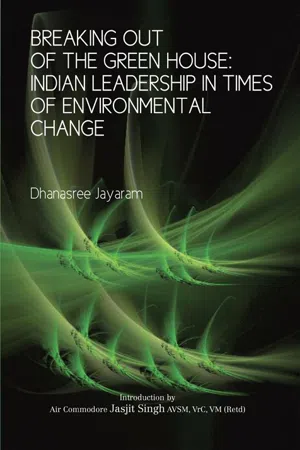 eBook - ePub
Breaking Out of the Green House
Indian Leadership in Times of Environmental Change
- Dhanasree Jayaram(Author)
- 2012(Publication Date)
- KW Publishers(Publisher)
While looking at environmental issues from a global perspective, the role of international institutions in global environmental governance is eminent. It is a fact that inter-governmental organisations such as the United Nations Framework Convention on Climate Change (UNFCCC), the Inter-governmental Panel on Climate Change (IPCC) and others have been formed under the aegis of the UN; there are regional organisations that have also been making efforts in the areas of adaptation to and mitigation of climate change. Yet, these organisations have proven to be more or less incompetent in dealing with the multifarious, interdependent and political nature of environmental problems. This will be dealt with in the next chapter. The creation of networks of governance has definitely added another layer to global environmental governance, but still the nation states have monopoly over these international institutions. Interests of the States overrule the needs of global environmental governance. Even the Rio Declaration of 1992 plainly defends state sovereignty over natural resources in the Preamble. Neither have certain States relented to the core tenets of the Kyoto Protocol for different reasons. Besides, UN Environmental Programme (UNEP) set up by a resolution of the General Assembly does not have any executive powers; its objectives are completely dependent on persuasive powers. The current governance on global environmental issues is flawed as an enforcement body is absent.The Interactions and Counter-interactions in a World of Multiple Relationships The Prospects for Environmentalism and Diffusion of Governance in a Liberal DemocracyAs one talks about democratisation of institutions by increasing public participation, one also needs to closely analyse the persisting view that maintains that sustainability could be achieved though democratisation. This implies that somewhere down the line, democracy facilitates and probably enhances protection of environment. In fact, principle 10 of the Rio Declaration states that ‘environmental issues are best handled with the participation of all concerned citizens, at all relevant level’.13Environmental politics is one of those rare domains in which the policy-making has indeed witnessed wider participation from the civil society, especially the ENGOs. The role of the ENGOs assumes greater significance in a liberal democracy as they ‘identify risks, assess environmental impacts and design and implement measures to deal with them, and maintain the high degree of public and political interest required as a basis for action’.14 However, the ENGOs have also faced criticism from various quarters on two grounds – first, the ability of the ENGOs in influencing the promotion of environmental sustainability might be overstated though they provide for popular participation, and second, the democratic nature of the ENGOs has been viewed by many with scepticism primarily because of the fact that with increasing institutionalisation of these ENGOs, the participatory tradition is giving way for a more elitist or hierarchical tradition. The activities of the ENGOs are multifaceted—first, they might take on the role of agents of policy-makers by carrying out the task of implementing the policy-makers’ agenda in the society. This activity is also aided by the Government through funds; second, the ENGOs could take the views of the citizens of the society to the policy-makers, thus representing either their supporter base or the general public, and third, the ENGOs also play an important role in terms of transforming the behaviour and attitudes of the citizens towards environment. In this regard, besides engaging themselves in creating publicity for their cause and galvanising communities or even joining hands with the existing communities in order to manage local environment, the ENGOs have also begun to promote non-governmental environmental governance by mobilising support for their visible objectives and indirectly influencing the government policy. As James Rosenau said, “It is possible to conceive of governance without government—of regulatory mechanisms in a sphere of activity which function effectively even though they are not endowed with formal authority.”15
Index pages curate the most relevant extracts from our library of academic textbooks. They’ve been created using an in-house natural language model (NLM), each adding context and meaning to key research topics.

