Politics & International Relations

Federal Bureaucracy
The federal bureaucracy refers to the administrative organization of the executive branch of the government, responsible for implementing and enforcing laws and policies. It includes various departments, agencies, and employees who carry out specific functions such as regulating industries, providing public services, and managing government programs. The federal bureaucracy plays a crucial role in the functioning of the government and the delivery of public services.
Written by Perlego with AI-assistance
Related key terms
1 of 5


10 Key excerpts on "Federal Bureaucracy"
 eBook - PDF
Government in the Federal Republic of Germany
The Executive at Work
- Nevil Johnson(Author)
- 2013(Publication Date)
- Pergamon(Publisher)
All this is not to deny that in the Federal The Bureaucracy in the Federal Republic 153 Republic there is still a fair a m o u n t of respect for bureaucratic norms, and even for the official as the representative of authority. But the situation is n o w very fluid and the older picture of the G e r m a n bureaucracy as a socially exclusive corps dominating a deferential society has become merely an historical reminiscence. T h e public service remains important and in-fluential for m o r e instrumental reasons, because it possesses m u c h of the knowledge and administrative skill which are required for managing the contemporary activities of government, and because it has become en-meshed in and subordinate to the politics of the Federal Republic. P O L I T I C S , P O L I C Y -M A K I N G A N D P A T R O N A G E W e have already alluded several times to the manner in which the bureaucracy has become subject to party political influences. Clearly this is one w a y in which a bureaucracy m a y be made responsive to the needs of political leaders. Equally, the extension of the influence of politicians on bureaucratic appointments will usually strengthen their position, giving t h e m scope for pressing their views or consolidating their p o w e r which otherwise w o u l d not be available. At the level of policy-making the re-lationship between bureaucracy and political leadership must always present difficulties and ambiguities, even w h e n an attempt is made to keep the t w o spheres apart. But w h e n no such attempt is made, the problem of assessing the role of the bureaucracy in the shaping of policy becomes peculiarly intractable. In this subsection it is intended to look rather m o r e closely at the links in the Federal Republic between politics and public service, and then to consider h o w they affect the formation and execution of public policy at the federal level. eBook - PDF
The Irony of Democracy
An Uncommon Introduction to American Politics
- Louis Schubert, Thomas Dye, Harmon Zeigler, , Louis Schubert, Thomas Dye, Harmon Zeigler, , Louis Schubert, Thomas Dye, Harmon Zeigler(Authors)
- 2015(Publication Date)
- Cengage Learning EMEA(Publisher)
The courts rarely reverse the decisions of federal regulatory commissions, and bureaucrats win most court cases challenging their regulations. THE Federal Bureaucracy A N E LITIST I NTERPRETATION The Federal Bureaucracy is a major base of power in the United States, largely inde-pendent of the other branches of government and not responsive to public pressure. Bureaucracy pervades every aspect of modern life, and its power continues to grow. T HE F EDERAL B UREAUCRACY 289 Copyright 2016 Cengage Learning. All Rights Reserved. May not be copied, scanned, or duplicated, in whole or in part. Due to electronic rights, some third party content may be suppressed from the eBook and/or eChapter(s). Editorial review has deemed that any suppressed content does not materially affect the overall learning experience. Cengage Learning reserves the right to remove additional content at any time if subsequent rights restrictions require it. Bureaucratic elites both formulate and implement public policy. Elitism in bureau-cracy takes several forms: 1. Bureaucratic power increases with the size and technological complexity of modern society. Congress sets forth only general policy statements, so bureaucrats write tens of thousands of rules and regulations and actually undertake the tasks of government. 2. Bureaucratic power increases because (a) Congress and the president do not have the time or expertise to master policy details; (b) Congress and the president deliberately pass vague laws for symbolic reasons, then turn over actual governance to bureaucracies; and (c) the bureaucracy has amassed suf-ficient power to influence the president and Congress.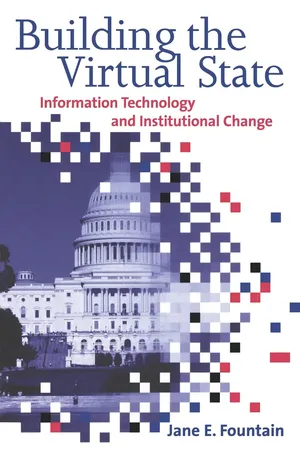 eBook - PDF
Building the Virtual State
Information Technology and Institutional Change
- Jane E. Fountain(Author)
- 2004(Publication Date)
- Brookings Institution Press(Publisher)
CHAPTER FOUR Bureaucracy The reduction of modern office management to rules is deeply embedded in its very nature. Max Weber, Economy and Society INGE THE INDUSTRIALIZATION of the United States in the late nineteenth century, government has required a complex administrative and policymaking machinery in order to manage its day-to-day operations and implement legislation. The rhetoric of 'J3ost-bureaucracy notwithstanding, this administrative machinery, and the career public servants within it, continues to be an essential intermediary between elected officials and society. It transforms the often vague and ambiguous decisions and judgments of the executive, the legislature, and the judiciary into operational and organizational rules and programs. Its attributes and vitality are more than ever of crucial concern to govern-ment and, ultimately, to citizens. In an industrialized society and economy, the state is central to contemporary political life. 1 This chapter develops ideas first published in 'The Virtual State: Toward a Theory of Federal Bureaucracy in the Twenty-First Century,in Elaine Ciulla Kamarck and Joseph S. Nye Jr., eds., democracy.com? Governance in a Networked World (Hollis, N.H.: Hollis, 1999). I am grateful to the Visions of Governance in the Twenty-First Century Project at the Kennedy School of Government, Harvard University, for finan-cial support and to the faculty associated with that project for early comments on many of the points discussed in this chapter. 44 S BUREAUCRACY 45 It is commonplace to claim that information technology changes the structure of organizations. Attention to network organizations signals one significant move away from bureaucracy. The reduction of red tape and flattening of hierarchies in government over the past decade have signaled further change. Yet few researchers interested in technology have addressed the bureaucratic structure, or the modern state, in much detail. eBook - ePub
American Government
Conflict, Compromise, And Citizenship
- Christopher J Bosso, John Portz, Michael Tolley(Authors)
- 2018(Publication Date)
- Routledge(Publisher)
Externally, the bureaucracy is always under pressure from Congress, the president, and the public. Members of Congress place demands on bureaucrats to meet their constituents’ needs, demands that may force bureaucrats to make decisions contrary to longstanding rules and procedures. The president looks to the bureaucracy to implement the administration’s new policies and programs, even if those policies challenge existing relationships among bureaucratic units or disrupt connections between bureaucrats and external clienteles. And the public expects efficient and effective service delivery, even as it also demands that bureaucrats remain sensitive to their fears of rigid rules or heartless decisions. Public demands for efficiency conflict with such fears of bureaucratic facelessness, forcing numerous compromises between these competing needs.In sum, the bureaucracy is no different from the more openly political parts of government. Like Congress and the president, it lives within a world of conflict, and it must seek compromises that help it do its job within a democratic political system. Efforts to reform bureaucracy can never solve its core problem—its image. The bureaucracy is a necessary but unloved part of government. Few Americans hold positive views about the bureaucracy in general, even though they support the agencies responsible for carrying out programs that they like. In short, the debate about the role of the bureaucracy reflects broader ideological views about the role of government, and in this respect the debate is likely to last as long as there is a government to complain about.SUMMARY
- ◗ A bureaucracy is a type of organization characterized by fixed jurisdictional areas, hierarchy of authority, written documents, general rules, career employees, and expertise.
- ◗ Major types of units in the Federal Bureaucracy include cabinet departments, independent commssions, and government corporations. These units provide basic services, support particular groups in society, and implement regulations.
- ◗ Most federal employees are civil servants and are appointed on the basis of merit and expertise. Political appointees serve at the pleasure of the president, and are appointed to oversee the activities of career civil servants. Members of the Senior Executive Service combine the expertise of civil servants with the flexibility of political appointees.
 eBook - ePub
- David McKay(Author)
- 2017(Publication Date)
- Wiley-Blackwell(Publisher)
Chapter 12 Bureaucratic Power Federal Departments and AgenciesOutline
- The Federal Bureaucracy: Organization and Function
- Controversy 11. Privatization: For and Against
- The Bureaucracy: How Uncontrollable?
- The Inherent Power of Bureaucracy
- The Bureaucratic Hydra: A Uniquely American Phenomenon?
- Reform Attempts
- Concluding Remarks
- Summary
- Questions for Discussion
- Glossary
- Notes
- Further Reading
The fully developed bureaucratic mechanism compares with other organizations exactly as does the machine with the non-mechanical modes of production. Precision, speed, unambiguity, knowledge of the files, continuity, discretion, unity, strict subordination, reduction of friction and of material and personal costs: these are raised to the optimum point in the strictly bureaucratic administration.– MAX WEBER, ESSAYS IN SOCIOLOGYOur Government has no special power except that granted it by the people. It is time to check and reverse the growth of government which shows signs of having grown beyond the consent of the governed. It is my intention to curb the size and influence of the federal establishment.– RONALD REAGANFew areas of federal government activity come in for as much opprobrium as does the bureaucracy. As the Weber quote suggests, bureaucracies are supposed to work efficiently. Hierarchy, order, responsibility and professionalism are implied by the model of the ‘rational’ bureaucrat, yet, according to public folklore, typical federal administrators are the very opposite of this. They are overpaid, inefficient and wasteful. Worse, they are often the creatures of special interests, and occasionally they are simply corrupt. Surveys have shown, indeed, that the federal government is considered easily the most inefficient of all the major institutions in American society. And the public’s regard for the federal government steadily declined after reaching a peak in the wake of 9/11 (figure 12.1 ).Figure 12.1 eBook - PDF
Keeping a Watchful Eye
The Politics of Congressional Oversight
- Joel D. Aberbach(Author)
- 2001(Publication Date)
- Brookings Institution Press(Publisher)
Chapter 1 Governing the Bureaucracy T is commonplace these days to acknowledge the tremen-dous power of bureaucracies in modern governments. Max Weber, in a classic essay, contended that the specialization endemic to a fully developed bureaucracy normally puts it in an overtowering position of power relative to its nominal political masters, who often find themselves mere dilettantes confronting the expert officials of the state administration. 1 More recently, Robert D. Putnam introduced an insightful article on the political attitudes of senior civil servants with the following question and answer: Can there really be much doubt who governs our complex, modern societies? Public bureaucracies . . . are responsible for the vast majority of policy initiatives taken by governments. . . . Bureau-crats, monopolizing as they do much of the available information about the shortcomings of existing policies, as well as much of the technical expertise necessary to design practical alternatives, have gained a predominant influence over the evolution of the agenda for decision. 2 Putnam's article analyzes signs of a trend toward a more political bureaucracy in several Western European nations. Political bureau-cracies are composed of officials who recognize the need to bargain and compromise, yet at the same time [do] not necessarily shrink from advocating or even fighting for [their] own preferred policies. In closing, Putnam notes some of the dangers accompanying this trend, including the danger that as a politically aware bureaucracy comes to play a more active role in the policy-making process, the i i 2 Keeping a Watchful Eye ability of the representative institutions of government to control that bureaucracy may be weakened. eBook - ePub
- David Mckay(Author)
- 2018(Publication Date)
- Routledge(Publisher)
10The Federal BureaucracyThe fully developed bureaucratic mechanism compares with other organizations exactly as does the machine with the non-mechanical modes of production. Precision, speed, unambiguity, knowledge of the files, continuity, discretion, unity, strict subordination, reduction of friction and of material and personal costs—these are raised to the optimum point in the strictly bureaucratic administration.—Max WeberOur Government has no special power except that granted it by the people. It is time to check and reverse the growth of government which shows signs of having grown beyond the consent of the governed. It is my intention to curb the size and influence of the federal establishment…—Ronald ReaganOur principles are clear. The government service is a noble calling and a public trust.… There is nothing more fulfilling than to serve your country and fellow citizens and to do it well.—George BushReinventing government requires ending overregulation and micro-management. That implicitly demands that Congress give up its penchant for tinkering with bureaucracy and leave more of management to the managers.—Report of the National Performance Review [on Reinventing Government], 1993Few areas of federal government activity come in for as much opprobrium as does the bureaucracy. As the Weber quote suggests, bureaucracies are supposed to work efficiently. Hierarchy, order, responsibility, and professionalism are implied by the model of the “rational” bureaucrat, yet, according to public folklore, typical federal administrators are the very opposite of this. They are over-paid, inefficient, and wasteful. Worse, they are often the creatures of special interests, and occasionally they are simply corrupt. Surveys have shown, indeed, that the federal government is considered easily the most inefficient of all the major institutions in American society. Moreover, the public’s regard for Washington and public officials has been steadily declining since the 1960s (Figure 10.1 eBook - PDF
Governance.com
Democracy in the Information Age
- Elaine C. Kamarck, Joseph S. Nye, Elaine C. Kamarck, Joseph S. Nye(Authors)
- 2004(Publication Date)
- Brookings Institution Press(Publisher)
8 Toward a Theory of Federal Bureaucracy for the Twenty-First Century THE INTERNET PROMISES vast changes in American government that range from Internet voting to interactive online services for the public to virtual diplomacy. As a vehicle for disjunctive change in communication, coordination, and control, the Internet and related information technolo-gies make possible new and exciting developments in operations, regula-tion, and enforcement. In spite of its revolutionary power, the potential benefits of the Internet, and its potential perils, will be strongly influenced by the current organizations and institutions of government, for it is within the constraints posed by these structural arrangements that government actors make decisions and information networks that connect to form the World Wide Web are designed, developed, and used. 1 One of the most intriguing and important questions for scholars and practitioners concerns the structural transformation currently taking place within and across government agencies, the part of government political scientists refer to as the bureaucracy. The intrigue stems from the potential for developing new organizational arrangements that will use the information-processing potential of the Internet and related infor-mation technologies. The importance for government arises because such a fundamental change in the structure of bureaucracy bears on central concepts of governance such as accountability, task specialization, and jurisdiction. 117 JANE E. FOUNTAIN Il8 JANE FOUNTAIN Some theorists and futurists have suggested replacements for bureau-cracy, including networks, markets, and even self-organizing systems. Approximately a decade ago, as the Internet began to be widely used, oth-ers suggested that the nation-state itself would be replaced by a variety of subnational, supranational, and transnational forms of governance. No longer available |Learn more
- Bruce Miroff, Raymond Seidelman, Todd Swanstrom, Tom De Luca(Authors)
- 2014(Publication Date)
- Cengage Learning EMEA(Publisher)
Chapter 14 Bureaucracy: Myth and Reality 338 lifting people out of poverty. Their missions are more extensive and complicated than the simpler objective of businesses to produce and sell products. Yet even as public expecta-tions of federal problem-solving remain high, the resources provided to the federal work-force, as well as the size of that workforce, have been shrinking. Even the technology with which federal agencies are supplied tends to lag behind the up-to-date equipment of the corporate sector. 37 Political leaders who scapegoat bureaucracy are a third contributing factor to the cur-rent difficulties of the federal service. Citizens who only hear harsh comments from elected officials about federal workers are likely to echo these negative judgments in opinion surveys. Bureaucracy-bashing by leaders lowers the morale of the individuals who currently work in federal agencies and increases the difficulty of recruiting talented young people to join the federal service. Fourth, some of the most notorious cases of governmental incompetence or abuse have occurred during Republican administrations that have been ideologically committed to a negative view of government. No president made as great a contribution to mistrust of government as Richard Nixon with his Watergate scandal. More recently, President George W. Bush made the U.S. government appear incompetent abroad with the Iraq fiasco and at home with the Hurricane Katrina fiasco. Ironically, conservative critics of “big government” get to prove their own case when they are the ones in charge of the administrative state. While aiming to withdraw the Federal Bureaucracy from some areas in which it oper-ates today (e.g., by eliminating such cabinet agencies as the Department of Energy and the Department of Education), critics of “big government” acknowledge the legitimacy of many public purposes. Yet they insist that these public purposes often don’t need to be accom-plished by bureaucratic agencies. eBook - PDF
Foreign Policy Analysis
New approaches
- Chris Alden, Amnon Arran(Authors)
- 2016(Publication Date)
- Routledge(Publisher)
Second, bureaucracies tend to develop common attitudes and shared images. These conventional Bureaucracies and foreign policy 47 attitudes and images play a role in framing how a particular foreign policy issue or event is perceived by foreign policy makers. Bureaucracies often will employ the prism of their common attitudes and shared images to study the implications of a foreign policy event for policy making. For example, when considering a security issue, the Treasury tends to focus on the budgetary implications, the Department of Defence on the repercus- sions for national security, while the Foreign Office most likely focuses on the diplomatic and international political ramifications. 10 Bureaucracies also derive influence over foreign policy from their posi- tions in the power-sharing structure comprising state and government, in which these large organizations and political actors have individual interests. These interests include enhancing the bureaucratic influence in the domestic political arena, augmenting their resources, furthering their ability to fulfil their stated missions and maintaining morale among their personnel. 11 Those interests, which reflect the organizational health and position of a given bureaucracy within government, often may not coin- cide with the ‘national interest’. In fact, because each bureaucracy manip- ulates foreign policy in the direction that corresponds to its particular interests, bureaucratic considerations may override the national interest. 12 Allison and Halperin explain that the BPM tries to capture this complex dynamic, demonstrating that foreign policy is messier than the rational policy model would concede: [The] bureaucratic model sees no unitary actor but rather many actors as players – players who focus not on a single strategic issue but on many diverse intra-national problems as well.
Index pages curate the most relevant extracts from our library of academic textbooks. They’ve been created using an in-house natural language model (NLM), each adding context and meaning to key research topics.

