Politics & International Relations

Parliamentary Sovereignty
Parliamentary sovereignty is a principle in the UK political system that asserts the supremacy of Parliament in making and unmaking laws. It means that Parliament has the ultimate legal authority and can enact, amend, or repeal any law. This concept also implies that no other body or institution can override or set aside legislation enacted by Parliament.
Written by Perlego with AI-assistance
Related key terms
1 of 5

10 Key excerpts on "Parliamentary Sovereignty"
 eBook - ePub
- Mark Ryan, Steve Foster(Authors)
- 2023(Publication Date)
- Routledge(Publisher)
section 5.7.2 ). Finally, although the principle of a legislature with the legal power to make any law that it chooses is very unusual, it is not unique. New Zealand also has an uncodified constitution, which comprises a Parliament (a unicameral legislature called the House of Representatives) which possesses the constitutional characteristic of sovereignty. As in the United Kingdom, it too is able to pass any law that it chooses.7.2 Terminology
The term Parliamentary Sovereignty (which denotes that the Queen in Parliament has unlimited legislative power) is arguably apt to mislead, because the term ‘sovereignty’ can have another meaning. Sovereignty is also used in the context of international law, relations and politics to indicate that a state is independent and sovereign (for example, France or Italy). As a consequence, a number of legal academics prefer to use the term ‘the legislative supremacy of Parliament’. Notwithstanding this, as Parliamentary Sovereignty (at least in historic terms) is closely associated with Dicey, and as he used this term, this book will do likewise. This should not be problematic providing we understand the sense in which the term is being used, namely to denote the legal and constitutional principle that Parliament can in theory pass any law that it chooses.As indicated earlier, Dicey argued that the constitution was founded on the following twin pillars:- The rule of law and
- Parliamentary Sovereignty.
- Legal sovereignty and
- Political sovereignty.
7.2.1 Legal sovereignty
In essence, legal sovereignty is concerned with the legislative power of the Queen in Parliament (the principle that any legislation can be made on any subject). Legal sovereignty is concerned with the constitutional relationship between the courts and the legislature (hence it is therefore necessarily an issue of constitutional significance). It is with legal sovereignty that this chapter is specifically concerned. Legal sovereignty relates to Bills which have been consented to (and therefore have become Acts of Parliament) by the following three constitutional elements: eBook - PDF
- Roger Masterman, Colin Murray(Authors)
- 2022(Publication Date)
- Cambridge University Press(Publisher)
PART II The Theory and Practice of the UK Constitution 6 Parliamentary Sovereignty The concept of Parliamentary Sovereignty which has been fundamental to the constitution of England and Wales since the 17th Century . . . means that Parliament can do anything. Jackson v Attorney-General [2005] UKHL 56, [159] (Baroness Hale). CHAPTER OUTLINE This chapter examines the doctrine of Parliamentary Sovereignty, the commonly used shorthand for the legal supremacy attributed to Acts of Parliament within the internal hierarchy of norms in the UK’s constitutional system. The characteristics of the doctrine will be examined, alongside its historical origins and the crucial distinction between the idea of legal sovereignty and that of political or popular sovereignty. We will then go on to examine potential limitations on Parliament’s legislative power, before examining and assessing contemporary challenges to the orthodox model of legal sovereignty. While the doctrine of legal sovereignty undoubtedly forms the backbone of the UK’s Constitution, it should be considered alongside the principle of the rule of law and – to a lesser extent – that of separation of powers. Parliamentary Sovereignty is also closely aligned with the idea of political accountability. Each of these additional constitutional principles is considered in the chapters which follow. INTRODUCTION The opening chapter to this book outlined how the idea of limited government was central to an understanding of constitutions, and of constitutionalism. Examining the constitution of the UK on these terms presents us with something of a paradox, for its most fundamental principle – the principle of Parliamentary Sovereignty – is representative of unlimited legal power.
- Helen Fenwick, Gavin Phillipson, Alexander Williams(Authors)
- 2020(Publication Date)
- Routledge(Publisher)
1 This chapter therefore considers how far traditional understandings of sovereignty can and should remain applicable today. It does so in three main sections: the nature of Parliamentary Sovereignty; possible legal limitations on sovereignty; and the question of whether Parliament is able in any way to entrench legislation, so as to make it impossible or more difficult for subsequent Parliaments to repeal any given Act. The next chapter will consider the impact of European Union law on the traditional doctrine of Parliamentary Sovereignty. The main concern will be the extent to which the legislative competence of Parliament has been restricted by the impact of EU law.The Nature of Parliamentary Sovereignty
The Basic Idea of Sovereignty
The notion of ‘Parliamentary Sovereignty’ or the ‘legislative supremacy of Parliament’, as it is sometimes termed, can be seen to have both political and legal aspects. Given that the dominant body in Parliament, the Commons, is democratically elected, the notion can be seen as representing a description of the democratic basis for legislation in the UK. As used by constitutional lawyers, however, it means something much more specific: ‘By the legislative supremacy of Parliament is meant that there are no legal limitations upon the legislative competence of Parliament.’2As AW Bradley has summed up the doctrine:The sovereignty of Parliament describes in formal terms the relationship which exists between the legislature and the courts. As analysed by Dicey, the Queen in Parliament (the legislature) has ‘the right to make or unmake any law whatever’ and no person or body outside the legislature ‘is recognised by the law of England as having a right to override or set aside the legislation of Parliament’ [AV Dicey, An Introduction to the Study of the Law of the Constitution, 10th edn (1959), p 40]. In other words, there are no legal limits to the legislative authority of Parliament. When that authority is exercised in the form of an Act of Parliament, no court or other body has power to hold such an Act to be void or invalid or in any respect lacking in legal effect.3Notes
1. It will be seen that two distinct notions emerge from the above quotations. The first is the lack of legal, as opposed to conventional or moral, constraints on Parliament. Lord Reid has expressed this idea thus:
- John McGarry(Author)
- 2016(Publication Date)
- Routledge(Publisher)
European Constitutional Law Review 379– ‘The Principle of Parliamentary Sovereignty in Legal, Constitutional, and Political Perspective’ in Jeffrey L Jowell, Dawn Oliver and Colm O’Cinneide (eds), The Changing Constitution (8th edn, OUP 2015)Forsyth C F, ‘Showing the Fly the Way Out of the Flybottle: The Value of Formalism and Conceptual Reasoning in Administrative Law’ [2007] Cambridge Law Journal 325– and Elliott M C, ‘The Legitimacy of Judicial Review’ [2003] Public Law 286Goldsworthy J, The Sovereignty of Parliament: History and Philosophy (OUP 1999)Gordon M, ‘The Conceptual Foundations of Parliamentary Sovereignty: Reconsidering Jennings and Wade’ [2009] Public Law 519Hart HLA, The Concept of Law (3rd edn, OUP 2012)Jowell J L, ‘Of Vires and Vacuums: The Constitutional Context of Judicial Review’ [1999] Public Law 448Lakin S, ‘Debunking the Idea of Parliamentary Sovereignty: The Controlling Factor of Legality in the British Constitution’ (2008) 28 Oxford Journal of Legal Studies 709Laws Sir John, ‘Is the High Court the Guardian of Fundamental Constitutional Rights?’ [1993] Public Law 59– ‘Law and Democracy’ [1995] Public Law eBook - PDF
- John Laws(Author)
- 2021(Publication Date)
- Hart Publishing(Publisher)
116 The Sovereignty of Parliament 19 Lord Neuberger (n 4). 20 See ch 7, section I.D. parliament in wholly exceptional cases’ 19 – suggesting that the touchstone of sovereignty is the (perhaps relative) immunity of statutes from being overruled. But this says nothing of the very real constraints on parliamentary power imposed by our constitutional fundamentals. These constraints, imposed by the courts through the medium, perhaps the euphemism, of statutory construction, amount to an important qualification of the very idea of Parliamentary Sovereignty. The legis-lators have to respect them. If they do not, they may find that the Act as interpreted by the courts integrates constitutional principle with the text. This recalls what I said in chapter 2, dealing with democracy: ‘[T]he foundational principles that give life to the Rule of Law are the very guardians of democracy’s integrity. Democratic government, then, lends itself to the Rule of Law.’ The importance of the refutation of parliamentary intent (and ultra vires ) on which I embarked in the last chapter is that it helps remove inhibitions to the process of integration, and in doing so reveals the intimacy between the power of constitutional fundamentals and the power to legislate. Parliamentary Sovereignty, then, does not rest merely on the immunity of stat-utes from being overruled. It is no less concerned with the practical business (and sometimes difficulty) of making law where constitutional fundamentals are integral to the process. If we understand Parliamentary Sovereignty in this way we shall reduce the tension, such as it is, between political and judicial power, and at the same time serve the constitutional balance. The process is greatly assisted by the refutation of parliamentary intent and the ultra vires doctrine. An acceptance of legislative purpose (as opposed to intent) has a linked benign effect. eBook - PDF
- Ursula Smartt(Author)
- 2016(Publication Date)
- Routledge(Publisher)
On one side of the debate are those scholars, like Professor Adam Thomkins, who argue that the absolute Supremacy of the UK Parliament as understood by Dicey remains unqualified, or at least should remain unqualified, by recent constitutional reforms (see: Thomkins, A., 2005, Our Republican Constitution). So Parliament can legislate however it chooses, for example to stop Judicial Review (see Chapter 9). On the other side of the debate are those constitutional writers whose view is that the Sovereignty of Parliament is a construct of the common law. As such it is open to revision by the courts in circumstances where, say, a court has to reconcile contradictory statutory provisions, or a higher law, such as a fundamental human right, is violated. This view is represented by Professor T.R.S. Allan (The Limits of Parliamentary Sovereignty, 1985). Professor Paul Craig shares Professor Allan’s belief that Parliamentary Sovereignty is a ‘construct of the common law’ (see: Craig, P., 1990, Public Law and Democracy in the United Kingdom and the United States of America and Craig, P., 1991, The Sovereignty of the United Kingdom Parliament After Factortame). Professor Craig’s view is that legislative supremacy of Parliament is ultimately decided by the courts as being ‘derived 50 Optimize Public Law Parliament cannot bind its successors Another doctrine you will need to understand is the subject to the limitation that Parliament is unable to bind its successors. We now know that the UK Constitu- tion is underpinned by the doctrine of Parliamentary Supremacy according to Dicey. This means that any Parliament has legally unlimited legislative authority and can make and unmake laws. eBook - PDF
Sovereignties
Contemporary Theory and Practice
- R. Prokhovnik(Author)
- 2007(Publication Date)
- Palgrave Macmillan(Publisher)
The wider resources of sovereignty can play a part in transforming domestic and international pol- itics and overcoming privileged positions and inequalities in contemporary politics. This section of the chapter ends by drawing attention to some of the ways that sovereignty is political. The focus here on the ‘politics and own- ership of the sovereignty concept’ leads to a recognition of what a political perspective can offer, the view that sees politics (in the sense of operating with power relations and interests, bargaining, making side deals, distri- buting resources, negotiating intractable differences, managing contesta- tion, holding accountable) as central, to highlight and reinstate the political nature of current sovereignty relations. This is separate from the way in which the history of political thought canon and the political theory 12 Sovereignties discourse has been largely apolitical (seen itself as politically neutral) in recent years. In the discourse of external politics, sovereignty is seen as much more political. ‘Sovereignty’ is a technical concept for political theory, international relations and law, though its meaning varies across each of these fields according to which general features of the term are being highlighted. But alongside those technical meanings, ‘sovereignty’ as a political, rhetorical term is used with a political purpose to support interests. Sovereignty is political in that it is a counter to be traded. Sovereignty is also political because it is not just an intangible ‘concept’, a way of conceptualising political order and the relations between ruled and ruler. Sovereignty is also, as Zizek puts it, a ‘concrete network of the material conditions of existence of an ideological edifice’. It is ‘that which ideology itself has to misrecognise in its “normal” functioning’ (Zizek 1999, 76). The given ‘theoretical meaning’ and the institutional expression of sovereignty can both be contested, and in this way both are political. eBook - PDF
A.V. Dicey and the Common Law Constitutional Tradition
A Legal Turn of Mind
- Mark D. Walters(Author)
- 2020(Publication Date)
- Cambridge University Press(Publisher)
For our purposes, however, the main point to take from this debate is Dicey’s position on a basic point of constitutional theory. Wade would later conclude that in relation to the 1886 Irish home rule bill ‘several great constitutional lawyers’, he named Anson and Dicey in particular, slipped into ‘unguarded remarks’. 72 Wade thought that once we appreci- ate that Parliamentary Sovereignty is ‘a political fact for which no purely legal authority can be constituted’, we may avoid the confusion into which (he thought) Dicey had lapsed. The solution, said Wade, is not found in the terms of the law, ‘but by looking at the courts and discover- ing to whom they give their obedience’. 73 This critique only makes sense, however, if one adopts the distinctive position of legal positivism implicit in his and explicit in Hart’s characterisation of law’s political or social foundations. Dicey did not adopt any such position. Dicey thought that Parliamentary Sovereignty is an ordinary legal concept susceptible to ordinary legal interpretation by the ordinary courts. From his perspec- tive, a constitutional lawyer cannot wait around to see what judges will do, but rather must engage in an interpretive and, therefore, a normative exercise to see what, as a matter of law, judges should do. Parliament may be sovereign and its statutes unreviewable, but that proposition begs the question: Who or what is Parliament? For Dicey, this was a thoroughly legal question to be answered in the ordinary legal way. Sovereignty as a Legal Concept Dicey insisted that Parliament is a legal concept. Dicey also insisted that Parliament’s sovereignty is a legal concept. Indeed, one of the critical junctures in Law of the Constitution – perhaps the most critical – was Dicey’s decision to characterise Parliamentary Sovereignty as legal rather than political sovereignty. The law defining Parliament’s sovereignty, to be clear, is not in his view some special or extraordinary law. eBook - PDF
The Adventures of the Constituent Power
Beyond Revolutions?
- Andrew Arato(Author)
- 2017(Publication Date)
- Cambridge University Press(Publisher)
72 In order to present the concept, in its two major forms, let me start with what is common to all these approaches. From the sixteenth century onwards and in the synthesis of Jean Bodin, the modern concept of sovereignty affirms two things: first, that there is a supreme center of authority in the territorial state that has no domestic equal, nor, secondly, an international superior. Earlier, as many have narrated, domestic supremacy has been vitiated by the complex relations within feudal sub and super-ordination, 73 and later by the dualistic system of ruler and estates; 74 while international equality has been opposed by various claims of imperial 72 For a more comprehensive history of the different forms of the concept see, most recently, Dieter Grimm, Sovereignty, chapter B. For the analysis from which I have learned the most, Jean Cohen, Globalization and Sovereignty (Cambridge: Cambridge University Press, 2012), chapter 1. 73 Dieter Grimm, Sovereignty, chapter B. 74 Gianfranco Poggi, The Development of the Modern State (Stanford: Stanford University Press, 1978). 24 Introduction and papal supremacy. With the medieval foundations of rule in persons rather than territories, the very distinction between internal and external, crucial for classical sovereignty, could not exist. Sovereignty is the active principle behind the notion of the modern state as an organization that monopolizes the legitimate (here = legal) forms of violence within a territory and over its inhabitants. Since all states capable of mutual recognition were as such supposed to have the same monopoly they were legally equal. Evidently that does not mean and has never meant equality in power, in military capacity, in prestige, or economic potential. As it is clear from the above definition of the state, sovereignty is a legal, rather than an empirical concept. No factual monopoly is possible empirically, indeed even legitimate monopoly is possible only if we identify legal and legitimate.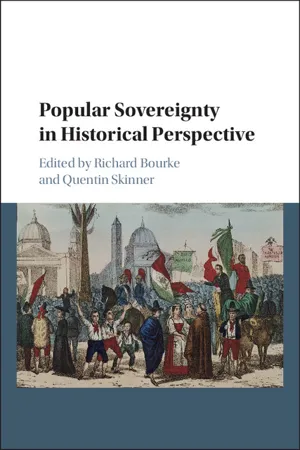
- Richard Bourke, Quentin Skinner(Authors)
- 2016(Publication Date)
- Cambridge University Press(Publisher)
6 Parliamentary Sovereignty, popular sovereignty, and Henry Parker’s adjudicative standpoint Alan Cromartie A common way of thinking about popular sovereignty is to begin by making a distinction between the kind of language that makes claims to ‘sovereignty’, understood as an unfettered power to alter the law of the land, and language that merely interprets an existing legal system.When this distinction is applied to early Stuart England, it yields an impor- tant empirical finding: from the accession of King James in 1603 to the outbreak of the Civil War in 1642, English debates about the way the country should be governed were almost always focused on interpreting the law; to modern eyes, few features of the period are more striking than the pervasive dominance of an appeal to law at the expense of an appeal to powers above or beyond it. In the eventful Parliament of 1628, one member actually remarked that ‘the words “sovereign power” are like some words in logic that are in no predicament’ 1 – in other words, that ‘sovereign’ or supra-legal powers had no intelligible place within the form of discourse within which such discussions were conducted. To use a formulation that still shapes most scholarship, public debate was ‘legal’ or ‘constitutional’. This finding has encouraged (though it does not justify) a further and more questionable judgement: if early Stuart thinking was ‘consti- tutional’, it must have been unequal to the intellectual task of grasping what was really at issue; constructive ‘political’ thinking is sovereignty- focused. Margaret Judson’s classic monograph The Crisis of the Constitu- tion: An Essay in Constitutional and Political Thought in England 1603–45 (1949) is still the best expression of the relevant assumptions: as its subti- tle suggests, her book was concerned with the process by which ‘political’ thought emerged from ‘constitutional’ confusion.
Index pages curate the most relevant extracts from our library of academic textbooks. They’ve been created using an in-house natural language model (NLM), each adding context and meaning to key research topics.

