Politics & International Relations

Peter Kropotkin
Peter Kropotkin was a Russian anarchist, geographer, and political theorist known for his influential writings on mutual aid, anarchism, and the concept of voluntary cooperation. He advocated for a decentralized society based on voluntary associations and mutual support, and his ideas have had a lasting impact on anarchist and socialist thought.
Written by Perlego with AI-assistance
Related key terms
1 of 5
8 Key excerpts on "Peter Kropotkin"
 eBook - ePub
Anthropology, Ecology, and Anarchism
A Brian Morris Reader
- Brian Morris(Author)
- 2015(Publication Date)
- PM Press(Publisher)
14The Revolutionary Socialism of Peter Kropotkin (2010)
1. Introduction
In the opening pages of my book on Michael Bakunin (1993) I offered a quote from the Ghanaian writer Ayi Kwei Armah. It reads: “The present is where we get lost—if we forget our past and have no vision of the future.”Drawing on the past does not entail that we engage in a kind of ancestor worship, any more than envisioning a better future for humankind entails that we become lost in utopian dreams. Nobody chides biologists for having an interest in the work and theories of Charles Darwin, nor should socialists feel embarrassed in examining and drawing on the work of an earlier generation of socialist theorists—not as historical curiosities, but as a source of inspiration and ideas. In this article I want to critically explore the writings of Peter Kropotkin (1842–1921), focusing on his politics and his critique of the Marxist theory of the state as an agency of revolutionary transformation. The writing of the essay has been provoked by the numerous self-styled anarchists—though they are invariably Stirnerite individualists, anarcho-primitivists, or anarcho-capitalists—who join forces with Marxists and liberals in declaring that the ideas of Bakunin and Kropotkin are “obsolete” or have no relevance to present-day political struggles. In fact, anarchism, revolutionary socialism, is the only tenable political alternative to neoliberalism.2. Kropotkin and Anarchism
As a political philosophy, anarchism has had perhaps the worst press. It has been ignored, maligned, ridiculed, abused, misunderstood, and misrepresented by writers from all sides of the political spectrum: liberals, Marxists, democrats, and conservatives. Theodore Roosevelt, the American president, famously described anarchism as a “crime against the whole human race” (Tuchman 1966, 71), and in common parlance anarchy is invariably linked with disorder, violence, and nihilism. A clear understanding of anarchism is further inhibited by the fact that the term “anarchist” is applied to a wide variety of different philosophies and individuals, as can be seen from Peter Marshall’s (1992) well-known history of anarchism. Thus Gandhi, Spencer, Tolstoy, Berdyaev, Stirner, Ayn Rand, Nietzsche, along with more familiar figures such as Proudhon, Bakunin, and Kropotkin, have all been described as anarchists. This has enabled liberal and Marxist scholars to dismiss “anarchism” as a completely incoherent philosophy. It isn’t. For what has to be recognised is that anarchism is fundamentally a historical movement and political tradition that emerged only around 1870, mainly among the working class members of the International Working Men’s Association, widely known as the First International. Although they did not initially describe themselves as anarchists but rather as “federalists” or as “anti-authoritarian socialists,” this group of workers adopted the label of their Marxist opponents and came to describe themselves as “Anarchist Communists.” Anarchism as a political movement and tradition thus emerged among the workers of Spain, France, Italy, and Switzerland in the aftermath of the Paris Commune, and among its more well-known proponents were Elisée Reclus, François Dumartheray, Errico Malatesta, Carlo Cafiero, Jean Grave, and Peter Kropotkin.1 eBook - ePub
Political Economy from Below
Economic Thought in Communitarian Anarchism, 1840-1914
- Rob Knowles(Author)
- 2017(Publication Date)
- Routledge(Publisher)
80 In sum, access to most of the writings by Kropotkin on any topic is accessible in the English language, although comprehensive research on particular aspects of Kropotkin’s life and thought would require a concerted examination of geographically disparate historical archives, in English, French, and Russian languages.Peter Kropotkin was a Prince of the Russian nobility whose family roots could be traced back to the ‘first rulers of Russia.’ His upbringing and education was that appropriate to a child of the highest nobility. He was destined for a military career and began life in that direction by being accepted into the Corps of Pages of the Tsar’s Palace at an early age. His subsequent military training led to his appointment as an officer but when the time came for Kropotkin to choose a military posting, he surprised his father and his friends by choosing a Cossack regiment in the Amur region of Siberia that had recently been annexed by Russia. His brother Alexander, with whom he was very close, had a substantial influence in encouraging him to read dissenting philosophical and political material, which he avidly absorbed. Kropotkin claimed that it was during his period of observation and experiences in Siberia that he eventually and fundamentally found he was unable to come to terms with a reformist approach to the state. It was also during this period that he observed and studied the human and animal behavior that later informed his writings on ‘mutual aid.’ The years 1867–70 were spent studying and exploring geography in St Petersburg and he had some geographical reports published.81 In 1870 the Franco-Prussian war and the Paris Commune which followed it in 1871 were events of great interest in Russia. The story of the Commune had an especially profound effect on Kropotkin.82 eBook - ePub
Kropotkin, Read, and the Intellectual History of British Anarchism
Between Reason and Romanticism
- M. Adams(Author)
- 2015(Publication Date)
- Palgrave Macmillan(Publisher)
Fundamental to this project was reading contemporary conflicts with Marxists back into this complex history, seeing Jacobins ‘at all times’ in an obvious broadside at the ‘abominable tactics’ of those pursuing socialism through the state. 43 His intervention may have been an important act of self-definition, but Kropotkin’s understanding of history was not isolated to the realm of ideas. Indeed, the most significant feature of his historical writing was its exploration of the concrete systems of social organisation that had flowered throughout history. The latter sections of Mutual Aid offer an analysis of the varying social forms that have defined human life: the tribe, the village community, and the medieval city-state. In pointing to these social institutions, Kropotkin was challenging the idea that the birth of the modern state was axiomatically progressive, and presenting instead the multiple social forms that had made the struggle-for-life winnable. Just as his dalliances with the history of ideas offered a narrative of European history that was fluid, his history of these entities, while highlighting their great achievements, also emphasised the areas in which they fell short of securing expansive freedom. Importantly, he also insisted that while the growth of solidarity was an essentially organic reaction to pressing needs, the birth of authoritarianism was a similarly organic product. This was a foreboding lesson of history, of which anarchists had to be aware. The tribe and the village community feature prominently in Mutual Aid and The State: Its Historic Role, but the most revealing passages are devoted to the medieval commune. Principally this was a consequence of Kropotkin’s emphasis on communalism as the basis of a future anarchist society, albeit shorn of the deficiencies that had undermined previous experiments eBook - PDF
- Steven A. Peterson, Albert Somit, Steven A. Peterson, Albert Somit(Authors)
- 2013(Publication Date)
- Emerald Group Publishing Limited(Publisher)
One example is the anarchist prince, Peter Kropotkin ( Kropotkin, n.d. ). And his work is the take-off point for this essay. In the anarchist tradition, there are a number of variants, two of which are anarcho-communism (with Kropotkin as an exemplar) and individualist anarchism (featuring thinkers such as Benjamin Tucker and Max Stirner). Relations among thinkers in these two camps have not always been cordial. For instance, some individualist anarchists essentially say that anarcho-communists are not really anarchists ( Tucker, 1893 ). Interestingly, evolutionary theory may fit into the debates among individualist and community anarchists. That is the focus of this chapter. We explore the work of one representative from each orientation – Peter Kropotkin and Max Stirner. The point of departure is their view of cooperation. Both assert that cooperation is important for a successful anarchist society. But they come at this from very different pathways. However, contemporary evolutionary theory suggests that evolutionary impulses associated with cooperation and altruism may underlie each. In this sense, then, evolutionary theory might suggest that the two distinct anarchist visions might be compatible with aspects of human nature, as derived from evolutionary theory. This thesis is pursued in several steps: (a) a summary of relevant evolutionary approaches to cooperation and altruism; (b) a thumbnail sketch of Kropotkin’s and Stirner’s work, with special emphasis on cooperation; (c) an examination of the linkage of evolutionary theory and the theorists’ analysis of cooperation; and (d) a final summation. STEVEN A. PETERSON 186 EVOLUTION AND COOPERATION The evolution of cooperation is an important issue in evolutionary theory. Cooperation, as Nowak defines it, in terms of individuals involved ( 2006, p. 1560 ): ‘‘A cooperator is someone who pays a cost, c, for another individual to receive a benefit, b.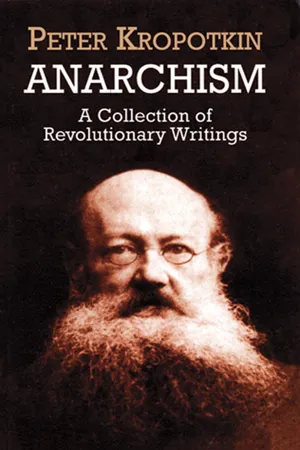 eBook - ePub
Anarchism
A Collection of Revolutionary Writings
- Peter Kropotkin(Author)
- 2012(Publication Date)
- Dover Publications(Publisher)
He found a congenial group of friends in James Guillaume, an intellectual, a highly educated man who was the author of serious works, in Elisée Réclus, the distinguished French geographer, then in exile, and in Enrico Malatesta, Italian anarchist and follower of Bakunin. Most of the Russians in Switzerland he found had become Marxists, and so his friends were among the Latins. He met at this time a young Russian student, Sophie Ananieff, living also in virtual exile in Switzerland. Shortly after they were married there.As Kropotkin studied the forces about him he came to see that anarchism needed a deeper interpretation than its significance to politics and economics. His philosophical and scientific outlook moved him to probe for a synthesis, a unity which should establish it as a principle of life. This conception colored practically all his thinking, all his work in social ethics, and led him to ceaseless activity in research and interpretation to the day of his death. Even his writing in the natural sciences, notably his Mutual Aid, a classic reply to the school of the “survival of the fittest,” was impelled by this desire to prove on a scientific basis the case for voluntary cooperation and freedom. Of this period of growth he says:“I gradually came to realize that anarchism represents more than a new mode of action and a mere conception of a free society; that it is part of a philosophy, natural and social, which must be developed in a quite different way from the metaphysical or dialectic methods which have been employed in sciences dealing with man. I saw that it must be treated by the same methods as the natural sciences; not, however, on the slippery ground of mere analogies such as Herbert Spencer accepts, but on the solid basis of induction applied to human institutions. And I did my best to accomplish what I could in that direction.”With the exception of a trip back to England and to Paris, Kroptkin lived in Switzerland for five years, until he was thirty-nine,—doing what he describes as his best work, with the help of his wife and Elisée Réclus. It was chiefly in the form of articles and editorials for a fortnightly paper, Le Révolté, which he started at Geneva in 1879, and which he continued for many years, despite persecution and suppression, under the later names of La Révolte and Les Temps Nouveaux. Most of the material in the pamphlets reprinted in this volume was first published in his paper. The pamphlets achieved large editions in a dozen languages. Elisée Réclus collected the best of his early writing in the paper into a book, Paroles d’un Revolté, eBook - ePub
Political Economy from Below
Economic Thought in Communitarian Anarchism, 1840-1914
- Rob Knowles(Author)
- 2013(Publication Date)
- Routledge(Publisher)
Chapter Eight Elisée Reclus and Peter Kropotkin: Evolution and Revolution Every general evolution brings in its wake corresponding revolutions. It must be so, and we cannot alter the course of history … Elisée Reclus, Anarchy, 1896. 1 The ideal of the anarchist is … a mere summing-up of what he considers to be the next phase of evolution. It is no longer a matter of faith; it is a matter for scientific discussion. Peter Kropotkin, Anarchist Communism, 1887. 2 Elisée Reclus (1830–1905) and Peter Kropotkin (1842–1921) reside comfortably together in this chapter just as they lived fraternally and collaborated closely in their lives. The basic common intellectual thread, apart from a shared commitment to anarchism as politics and as socio-economic thought, was their commitment to science and in particular to evolutionary science as fundamentally informing human individual and social development. From the late 1870s for about a decade their lives were so tightly woven together that it is difficult to give an account of one without reference to the other. After Kropotkin was forced to live in exile, and chose England, from 1886, their personal contact was less frequent, although the mutual respect and friendship they had for each other did not diminish. Reclus spent most of his later life in Switzerland and Brussels. Equally, their socio-economic ideas also did not materially diminish in similarity after that time. There were some differences between them in terms of revolutionary politics but those differences are not the focus of this study and in any event they were not substantial in terms of their overall visions of society. 3 This account of their economic ideas will begin with Reclus, as he had direct personal links with both Herzen and Bakunin, whose ideas have been discussed in the previous chapter. Kropotkin, whilst well aware of the published writings and revolutionary influences of both Herzen and Bakunin, never met either man
- Jim Mac Laughlin(Author)
- 2016(Publication Date)
- Pluto Press(Publisher)
Like other nineteenth century anarchists he believed that we should avoid ‘setting up the general good … as something above or outside individuals’. 76 He preferred democracy to monarchy and aristocracy, regarding it as a system of government in which ‘every member is considered as a man and nothing else’. Democracy, he believed, ‘restores to man a consciousness of his value, teaches him by the removal of authority and oppression to listen only to the dictates of reason, gives him confidence to treat other men as his fellow beings, and induces him to regard them no longer as enemies against whom he must be upon guard, but as brethren whom it becomes him to assist’. 77 Yet he condemned electioneering as ‘a trade so despicably degrading, so eternally incompatible with moral and mental dignity that I can scarcely believe a truly great mind capable of the dirty drudgery of such vice’. 78 As an uncompromising critique of the iniquity of government he wrote: Above all we should not forget that government is an evil, an usurpation upon the private judgment and individual conscience of mankind, and that, however we may be obliged to admit it as a necessary evil for the present, it behoves us, as friends of reason and the human species, to admit of it as little as possible and carefully to observe whether, in consequence of the gradual illumination of the human mind, that little may not hereafter be diminished. 79 Meanwhile at the other end of Europe, Peter Kropotkin was to become an even harsher critic of democracy and the rising power of the centralized nation-state. Unlike Winstanley, Godwin and Proudhon, he looked to the sciences, including the newly emerging social sciences, in order to provide anarchism with a rational foundation eBook - PDF
- John Horton(Author)
- 2017(Publication Date)
- Red Globe Press(Publisher)
They believe that once private property has been eliminated people will be motivated to work without material incentives and that social problems, particularly crime, will significantly diminish. The Russian anarchist, Peter Kropotkin, provides a good example of a communal anarchist’s approach to the problem of antisocial behaviour: ‘Man is a result of those conditions in which he has grown up. Let him grow in habits of useful work; let him be brought by his earlier life to consider humanity as one great family, no member of which can be injured without the injury being felt by a wide circle of his fellows, and ultimately by the whole of society; let him acquire a taste for the highest enjoyments of science and art – much more lofty and durable than those given by the satisfaction of lower passions – and we may be sure that we shall not have many breaches of those laws of moral-ity which are an unconscious affirmation of the best conditions for life in society.’ (Quoted in Woodcock, 1977, pp. 362–3) 118 Political Obligation Elsewhere, Kropotkin sharply distinguishes custom from law and accepts the need for political organization, allowing even that it might properly be called ‘government’, so long as it emerges naturally from social life (Kropotkin, 1970). For Kropotkin, law is an essentially arbi-trary and coercive imposition of the will of a minority, whereas custom is the coagulation of the spontaneous cooperation among people in response to their common needs. The state is institutionalized coercion, ‘government’ is a natural process of social coordination. Proudhon, who was rather less optimistic about human nature, seems to allow even greater scope for institutions of coordination within his idea of ‘mutual-ism’, which to some degree sought to reconcile property with commu-nism, and through his conception of ‘federation’ (Proudhon, 1979).
Index pages curate the most relevant extracts from our library of academic textbooks. They’ve been created using an in-house natural language model (NLM), each adding context and meaning to key research topics.

