Politics & International Relations

Supreme Court Appointment Process
The Supreme Court appointment process refers to the procedure for nominating and confirming justices to the highest court in the United States. The President nominates a candidate, who then undergoes a confirmation process in the Senate. This process is highly political and can have significant implications for the ideological balance of the Court.
Written by Perlego with AI-assistance
Related key terms
1 of 5
12 Key excerpts on "Supreme Court Appointment Process"
 eBook - ePub
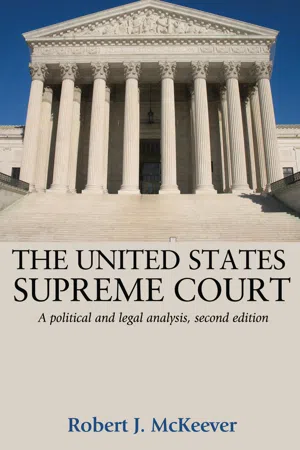
The United States Supreme Court
A political and legal analysis, second edition
- Robert J. McKeever, Robert McKeever(Authors)
- 2016(Publication Date)
- Manchester University Press(Publisher)
5 Advice and consent: the politics of Supreme Court appointments In this chapter we analyse one of the most controversial aspects of the modern Supreme Court: the process of appointing new Justices. Among other things, we will explore such questions as who becomes a Supreme Court Justice and why? Who influences the selection of the Justices and how? And what effect does the selection process have upon the subsequent behaviour of the Justice once seated upon the Court? In short, we shall examine the power and politics of Supreme Court appointments. The constitutional framework The broad framework for the appointment of Supreme Court Justices is delineated in Article II, Section 2 of the Constitution. This states that the President ‘shall nominate, and by and with the Advice and Consent of the Senate, shall appoint … Judges of the Supreme Court’. Like most constitutional clauses, Article II, Section 2 is open to varied and even conflicting interpretation, as we shall see shortly. Yet certain things are clear. First, it is important to note that there are two distinct phases of the process: nomination and confirmation. Nomination involves proposing someone for a seat on the Court, whereas confirmation entails approving or rejecting that nominee as a Justice of the Supreme Court. Second, two institutions of the federal government are given a role in the process: the President and the Senate. Their roles, however, are different. The President has sole power over the nomination process, but the Senate has sole power over the confirmation process. In practice, this means that the President sends the name of a candidate for the Court to the Senate, and the Senate then decides whether to confirm or reject the President’s nominee. If the nominee is confirmed, then he or she takes up the vacant seat on the Court eBook - ePub
The State and Federal Courts
A Complete Guide to History, Powers, and Controversy
- Christopher P. Banks(Author)
- 2017(Publication Date)
- ABC-CLIO(Publisher)
Justices, Presidents, and Senators: A History of U.S. Supreme Court Appointments from Washington to Bush II . 5th ed. Lanham, MD: Rowman & Littlefield.Batta, Anna, Paul M. Collins, Jr., Tom Miles, and Lorie A. Ringhand. 2012. “Let’s Talk: Judicial Decisions at Supreme Court Confirmation Hearings.” Judicature 96(1): 7–15.Collins, Paul M., Jr., and Lori A. Ringhand. 2013. Supreme Court Confirmation Hearings and Constitutional Change . New York: Cambridge University Press.Maltese, John Anthony. 1995. The Selling of Supreme Court Nominees . Baltimore: The Johns Hopkins University Press.Ringhand, Lori A., and Collins, Paul M., Jr. 2011. “May it Please the Senate: An Empirical Analysis of the Senate Judiciary Committee Hearings of Supreme Court Nominees, 1939–2009.” American University Law Review 60(3): 590–641.Wedeking, Justin, and Dion Farganis. 2010. “The Candor Factor: Does Nominee Evasiveness Affect Judiciary Committee Support for Supreme Court Nominees?” Hofstra Law Review 39: 329–368.Wittes, Benjamin. 2006. Confirmation Wars: Preserving Independent Courts in Angry Times . Lanham, MD: Roman and Littlefield.Yalof, David A. 1999. Pursuit of Justices: Presidential Politics and the Selection of Supreme Court Nominees . Chicago: The University of Chicago Press.Yalof, David A. 2008. “Confirmation Obfuscation: Supreme Court Confirmation Politics in a Conservative Era.” Studies in Law, Politics, and Society 44: 141–171.IMPEACHMENT AND REMOVAL OF FEDERAL JUDGESImpeachment is a process for removing from office top government officials and judges. For federal officials and judges, the impeachment process is defined in the U.S. Constitution in Article II, Section 4, and in Article III. For state governors, top officials, and judges, the impeachment process is spelled out in state constitutions and statutes. Impeachment is a process, which means several constitutionally mandated steps must be followed in sequence in order to remove the officeholder. eBook - PDF
The Federal Appointments Process
A Constitutional and Historical Analysis
- Michael J. Gerhardt, Neal Devins, Mark A. Graber, Neal Devins, Mark A. Graber(Authors)
- 2001(Publication Date)
- Duke University Press Books(Publisher)
Recognizing the potential political accountability of the major gov-ernmental actors in the federal appointments process leads one to con-sider the extent to which the public’s understanding of this system may be enhanced. Several notable critics of the modern confirmation process, such as Stephen Carter, believe that the public’s attitudes help explain one of the system’s biggest defects: the apparently increasing ‘‘politici-zation’’ of the judicial selection process. 47 Carter, for instance, suggests 47 that judicial confirmation hearings have become overly contentious in re-cent years because of the growing popular conception of the Court as a national policymaker whose authority as such can be controlled through the appointments process. Carter and others suggest that one possible solution to this dilemma is to depoliticize judicial selection by changing the attitudes of the general public or those who serve in the Senate, find-ing justices capable of exercising their duties more responsibly, or perhaps all of these. The perception of the Supreme Court as an institution capable of in-fluencing or shaping national policy is hardly new. The stakes in Supreme Court confirmation hearings have always been high. For instance, in 1857 the Senate barely confirmed Nathan Clifford as an associate justice after debating the propriety of his strong proslavery views. 48 Surely the deci-48 sion a year earlier in Dred Scott v. Sandford 49 had taught the nation a last-49 ing lesson about the Court’s potential to shape society (particularly so-The Need for Reform 281 cial relationships and the relationships between people and government) through rulings inextricably linked to its ideological composition. The critical question is whether the perception of the Court as a na-tional policymaker is amenable to change or is an inevitable consequence of its having judicial review over the Constitution and state and federal statutes. eBook - ePub
- Robert M. Howard, Kirk A. Randazzo(Authors)
- 2017(Publication Date)
- Routledge(Publisher)
The Supreme Court selection process is a high-profile event with much at stake for a variety of actors. Presidents put their reputations and legacies on the line since their nominees are almost assured to serve for decades after the presidents leave the White House. Senators are given the opportunity to provide a democratic check on president’s appointment authority, in addition to using the confirmation process in an attempt to increase their statures in the eyes of the public and their political parties. The lives of nominees are perhaps most dramatically affected, as they are thrust into the spotlight to undergo intense scrutiny from the public, the media, the White House, and the Senate. Outside of government, interest groups leverage the hearings to mobilize support for their causes, while trying to influence the outcome of the confirmation.Given the importance of Supreme Court selection, it should not be surprising that academics have devoted a substantial amount of attention to investigating this process. The purpose of this chapter is to critically examine the state of scholarship regarding the Supreme Court nomination and confirmation process. To do that, we follow the general temporal order of the process, focusing on its three major aspects: nomination by the president, the Senate Judiciary Committee hearings, and the confirmation vote by the full Senate. In addition to reviewing extant scholarship in those areas, we examine this research for the purpose of shedding light on the theoretical and methodological limitations of that scholarship, while offering directions for future research on this important subject.Presidential Nominations
When a vacancy opens on the Supreme Court,1 the president is charged with nominating a new justice under Article II, §2, cl. 2 of the Constitution (the “Appointments Clause”). Though the president alone holds that nomination power, the Senate is tasked with confirming presidential nominations under its authority to provide its “advice and consent.”2 In the event that the Senate is unavailable for deliberation, the president is authorized to make recess appointments under Article II, §2, cl. 3. These recess appointments do not require Senate approval and expire at the end of the following congressional session, which usually last about two years. Although the recess appointment process is seldom used—the last justice to initially reach the Supreme Court through a recess appointment was Potter Stewart in 1958—the power continues to generate debate (e.g., National Labor Relations Board v. Noel Canning eBook - ePub
The Path to and From the Supreme Court
The Supreme Court in American Society
- Kermit L. Hall(Author)
- 2018(Publication Date)
- Routledge(Publisher)
EV . 633, 643–44 (1987).5 Although several recent nominations to the Court have received more scrutiny than did most nominations before the Reagan-Bush era, many earlier nominations also attracted considerable controversy. See HENRY J. ABRAHAM , JUSTICES AND PRESIDENTS : A POLITICAL HISTORY OF APPOINTMENTS TO THE SUPREME COURT (3d ed. 1992).6 Professor Silverstein recently has pointed out that the transformation of the Senate during the past few decades into “a more open and effective forum for the expression of diverse interests” has increased “the likelihood of contentious battles over any Presidential nomination.” Mark Silverstein, The People, the Senate and the Court: The Democratization of the Judicial Confirmation System , 9 CONST . COMMENT . 41, 52 (1992). As Silverstein has observed:The apparent decorum of the past was achieved at the expense of participation and accountability. Few who viewed the agony and personal tragedies of the Clarence Thomas proceedings can avoid the almost instinctive desire to return to less visible and contentious proceedings, but the stakes are too high and involve the vital interests of too many forces to seek refuge in the ways of the past.Id. at 58.7 As Senator Simon pointed out, “examination of the base from which justices emerge is essential because of the Court’s immeasurable impact upon the future of the nation.” Paul Simon, The Exercise of Advice and Consent , 76 JUDICATURE 189 (Dec. 1992-Jan. 1993). Similarly, Professor Eades wrote:The nature of the judiciary itself may be the strongest reason for substantial review of judicial nominees. The federal judiciary, especially the United States Supreme Court, holds a unique position in our form of government. The power of any one legislator is diluted by the fact that there are so many of them. The power of the executive is filtered through the political process which requires that the President receive the approval of numerous people before being placed into office. The members of the judiciary have neither of these criteria for authority. One Supreme Court Justice, on a closely divided Court, however, can hold great power.
- Paul M. Collins, Lori A. Ringhand(Authors)
- 2013(Publication Date)
- Cambridge University Press(Publisher)
We begin by discussing how vacancies occur on the Supreme Court, followed by an analysis of the president’s role in the process, including the factors influencing the president’s decision of whom to nominate. Next, we discuss the considerable role played by the Senate Judiciary Committee, as well as that of the full Senate. To illustrate the process in action, we con- clude the chapter with a case study of President Obama’s nomination of Elena Kagan. SUPREME COURT VACANCIES The nomination of a Supreme Court justice is a major milestone in a pres- ident’s career, particularly in the modern era. Because the Court is a pol- icymaking institution, nominations provide presidents with the opportunity 5 Epstein, Walker, Staudt, Hendrickson, and Roberts, “The U.S. Supreme Court Justices Database,” supra, n. 3; Denis Steven Rutkus, “CRS Report for Congress, Supreme Court Appointment Process: Roles of the President, Judiciary Committee, and Senate” (2010). Retrieved from: http://www.fas.org/sgp/crs/misc/RL31989.pdf (Accessed December 13, 2011). 6 Lee Epstein and Jeffrey A. Segal, Advice and Consent: The Politics of Judicial Appointments (New York: Oxford University Press, 2005) at 99; Wendy L. Martinek, Mark Kemper, and Steven R. Van Winkle, “To Advise and Consent: The Senate and Lower Federal Court Nominations, 1977–1998,” 64 Journal of Politics 337 (2002). 7 Jon R. Bond, Richard Fleisher, and Glen S. Krutz, “Malign Neglect: Evidence That Delay Has Become the Primary Method of Defeating Presidential Appointments,” 36 Congress & the Presidency 226 (2009). 18 Supreme Court Confirmation Hearings and Constitutional Change to shape public policy long after they leave office: although presidents now can serve a maximum of eight years, the average tenure of a Supreme Court justice has been fifteen years. Since 1970, justices have served for an average of twenty-four years. 8 Of course, before the president can nominate an individual to the Court, a vacancy must occur. eBook - PDF
- Bruce J. Schulman(Author)
- 2010(Publication Date)
- CQ Press(Publisher)
How Does the President Nominate a Supreme Court Justice? Choosing Supreme Court justices is one of the most power-ful tools available to the president of the United States to shape the country’s long-term political and social landscape. The nomination process is also one of the most visible ex-amples of the principles of separation of powers and checks and bal-ances built into the American political system. Although Supreme Court justices do not have to face election (or reelection), they owe their positions to the presidents who nominate them, and a presi-dent’s choice of nominee typically is constrained by larger political considera-tions. Among the more important of these is awareness of how members of Congress will react to the nominee. For while the president can nominate any candidate for the Court, the Senate has the power to confirm or reject the president’s selection. The president’s need to satisfy several different interest groups—both within and outside of government—makes the nomination process a tricky business. The president hopes to pick a candidate who will please the adminis-tration’s political allies, while offering his political opponents as little as possi-ble to criticize. However, despite going to great lengths to determine how a nominee will rule once he or she is appointed, many justices defy the expecta-tions of those who appointed them to the Court. Constitutional Requirements . . . [T he president] shall nominate, and by, and with the advice and consent of the Senate, shall appoint ambassadors, other public ministers and consuls, judges of the Supreme Court, and all other offi-cers of the United States, whose appointments are not herein otherwise provided for, and which shall be established by law . . . Advice and Consent Senate consent to executive appointments was a unique innovation incorpo-rated into the Constitution. eBook - ePub
- David McKay(Author)
- 2017(Publication Date)
- Wiley-Blackwell(Publisher)
Chapter 15 The Supreme Court And Judicial PoliticsOutline
- The American Legal System
- The Supreme Court: Decision-Making
- The Supreme Court and Political Power
- Controversy 13. The Supreme Court: An Active or a Passive Role?
- Briefing: The Supreme Court and the Guantánamo Bay Detainees
- The Polarized Rehnquist and Roberts Courts
- Conclusions: The Court and American Democracy
- Summary
- Questions for Discussion
- Glossary
- Notes
- Further Reading
We are very quiet there but it is the quiet of a storm centre.– OLIVER WENDELL HOLMES, ASSOCIATE JUSTICE OF THE SUPREME COURT, 1902–32In a democracy, politics is a process of popular education – the task of adjusting the conflicting interests of diverse groups … and thereby to the hostility and suspicion and ignorance engendered by group interests … toward mutual understanding.– FELIX FRANKFURTER, ASSOCIATE JUSTICE OF THE SUPREME COURT, 1939–62In all societies, the courts play some political role. In liberal democracies, where the independence of the judiciary is regarded as essential to prevent the exercise of irresponsible executive (and sometimes legislative) power, the political role of the courts as interpreters of the law and as defenders of individual freedoms is well established. In despotic and one-party states, courts are political in the quite different sense that they are the instruments of a dominant executive. However, there are also important distinctions within liberal democratic states, the most crucial being the presence or absence of judicial review. As noted in chapter 4, judicial review is long established in the United States, the Supreme Court being the final arbiter of the meaning of the Constitution. Hence, all laws passed by the state and national legislatures, together with all executive actions, are subject to review by the courts, which judge their compatibility with the Constitution. As the final court of appeal, therefore, the Supreme Court has the legal power to declare any action by any other branch of government as unconstitutional. As we develop below, this apparently formidable power is tempered by a number of factors, but in contrast to many other liberal democracies, there can be no disputing the evidence of what is enormous potential judicial power. In the United Kingdom, for example, the courts can review executive actions – but only by testing them in relation to the content of Acts of Parliament. This can produce sharp rebukes for governments when the courts judge that the government has acted ultra vires eBook - ePub
- Kevin T. McGuire(Author)
- 2012(Publication Date)
- Routledge(Publisher)
If this happened a lot, the appointment process, for all the attention it generates, would give departing justices the ability to help craft the Court. This has led some legal scholars to propose 18-year fixed terms for each justice; this would ensure a new appointee every two years so that every president elected to a full term would get at least two nominations (avoiding the situation of President Carter who did not make a single appointment to the Supreme Court in his four years in office). While this situation would defuse the kind of manipulation discussed above, it would also dramatically increase Court turnover, a potentially destabilizing development. And, Bailey and Yoon (2011) show in simulations that even if justices do try to time their retirements for political reasons, liberal and conservative justices more or less offset each other, meaning that the net effect of politically-timed retirements on the Court is modest.Once a seat opens up, the Court is at the center of one of its most public phases: the appointment process. Earlier chapters in this volume have gone into great detail on this process, so we focus largely on what the process means for the ability of elected branches to influence the Court. Political scientists Bryon Moraski and Charles Shipan (1999) offer a widely-used and incredibly useful framework for thinking about the process. They build on the observation of one of the great scholars of the appointment process, Henry Abraham, who concluded that “political and ideological compatibility has arguably been the controlling factor” behind nominations (1999, 3). Following standard models of the Supreme Court, they characterize the ideology of justices in terms of “ideal points” in policy space, which are numeric characterizations of the political preferences of justices. Some justices, such as Justices Breyer or Sotomayor, are liberal and have ideal points that are negative numbers (on the left if you draw them on a line); other justices, such as Justices Scalia and Thomas, are conservative and have ideal points that are positive numbers (on the right if you draw them on a line). The median justice can dominate the Court and get outcomes he or she wants because he or she can be the decisive vote for either the liberal or conservative outcome. In this view, if either side wants to win it must do what the median justice wants lest the other side gets there first. eBook - PDF
- Neal Devins, Keith Whittington, Neal Devins, Keith Whittington, Mark A. Graber(Authors)
- 2005(Publication Date)
- Duke University Press Books(Publisher)
They reflect the Senate’s final, nonreviewable judgments about the scope of its authority within the federal appointments process. How the Senate handles such matters, including informal arrangements both within it and reached between senators and presidents, 20 defines sig-nificant phases of the constitutional path—the crucible—through which presidential nominees have to maneuver to be confirmed. No one seriously believes that a judicial challenge to the Senate’s final or procedural judg-ments on appointments is possible, even its practice of empowering one or only a few senators to make effectively final decisions about the fate of nominees. Second, the Senate’s practices and procedures for handling judicial nominations reflect both recognition and vindication of the constitutional principle of judicial independence. The Constitution largely leaves this principle to the federal appointments process for safeguarding. Within the Senate, the questioning of judicial nominees and debates over them fre-quently (but not always) reflect remarkable sensitivity to the preservation of this principle. For instance, senators are often careful not to ask judicial nominees, including those to the Supreme Court, how they would rule in particular cases; and the Senate has yet to reject any judicial nominees be-cause of their refusal to answer questions about how they would perform as judges or justices. 21 Third, the Senate offers a significant means for popular input on the grounds for opposing or supporting constitutional ideologies as espoused by various nominees. In various ways senators, like presidents, are recep-tive to popular opinion or pressure, which can be and often is mounted for and against different constitutional views. Indeed the Senate, which has a diverse membership of one hundred, can be said to enjoy an insti- eBook - PDF
How Your Government Really Works
A Topical Encyclopedia of the Federal Government
- Glenn L. Starks, F. Erik Brooks(Authors)
- 2008(Publication Date)
- Greenwood(Publisher)
Other factors affecting the president’s nomination are a potential judge’s race, sex, and age, taking into account the racial and gender composition of the Court. Senators consider these same factors during public confirmation hearings. Once a judge is chosen, neither the Senate nor the president can reduce his or her salary or remove the justice without due cause (i.e., legal justification). This ensures judges are able to make decisions impartially and without fear of political reprisal. 100 How Your Government Really Works The appointment process begins with the collection of the names of qualified judges from which the president and presidential advisors derive a short list of top candidates for a vacant Supreme Court seat. This collection of names is provided to the president from congressional representatives, governors, other politicians, mem- bers of the federal court system, members of the legal profession, legal experts, and people professionally associated with possible nominees. The list may include both retired and active judges. If the vacant seat is for that of the chief justice, the Supreme Court associate justices are also on the list. A great deal of information is collected about each person on the list of candidates. This information includes a thorough background check of their personal and professional lives, including a check of their personal background by the Federal Bureau of Investigation. The president and a se- lection committee carefully consider the qualifications of each candidate. Once a Supreme Court nominee is announced by the president, the Senate Judi- ciary Committee holds hearings to consider the candidate. The nominee may be called before the Senate committee to answer questions on his or her past court decisions and ideologies on specific issues. These issues may include capital punishment, abor- tion, and the torture of war criminals. eBook - PDF
Studies in Law, Politics and Society
Special Issue: Interdisciplinary Legal Studies - The Next Generation
- Austin Sarat(Author)
- 2010(Publication Date)
- Emerald Group Publishing Limited(Publisher)
Strategic accounts of judicial decision-making contend that they consider the preferences of their A More Global Court? 133 greater social and political environment when deciding a case, including those of the public and politicians, to maintain their legitimacy and reach an outcome that is likely to be both accepted and enforced. As Epstein and Knight (1997, p. 18) describe it, ‘‘law, as it is generated by the Supreme Court, is the result of short-term strategic interactions among the justices and between the Court and other branches of government.’’ Furthermore, they reject the assumption that a politically responsive court is counter-majoritarian or undemocratic. Instead, the relationship between the Court and these other actors is depicted as a natural and legitimate part of our political system, because it provides it, as an unelected body, with the accountability that is necessary to command authority in a democracy. When the Supreme Court is ‘‘constrained by the actions of others and by social and political institutions y the legitimacy of the system of law may be sustained even if judges act in political ways’’ ( Epstein & Knight, 1997, p. 184 ). Other scholars have also acknowledged the accountability that is created by the Supreme Court’s responsiveness to coordinate political branches but have depicted that relationship from an institutional perspective rather than a strategic one (including Graber, 1993 ; McMahon, 2004 ; Gillman, 1999, 2002 ; Pickerill & Clayton, 2004 ; Keck, 2004, 2007a ; Whittington, 2007 ). The design of the Constitution allows numerous opportunities for political actors to influence the direction of the Court: Presidents can nominate like-minded individuals to the bench when there is a vacancy, while the Senate has the ability to block undesirable candidates with enough votes.
Index pages curate the most relevant extracts from our library of academic textbooks. They’ve been created using an in-house natural language model (NLM), each adding context and meaning to key research topics.

