Psychology

Cultural Considerations in Therapy
Cultural considerations in therapy involve recognizing and respecting the influence of a client's cultural background on their beliefs, values, and behaviors. It requires therapists to adapt their approach to be culturally sensitive and to understand how cultural factors may impact the therapeutic process. This includes acknowledging and addressing potential cultural biases and stereotypes that may affect the therapeutic relationship.
Written by Perlego with AI-assistance
Related key terms
1 of 5

10 Key excerpts on "Cultural Considerations in Therapy"
 eBook - PDF
Critical Issues in Psychotherapy
Translating New Ideas into Practice
- Brent D. Slife, Richard N. Williams, Sally H. Barlow(Authors)
- 2001(Publication Date)
- SAGE Publications, Inc(Publisher)
All therapists have to engage in culture learning with a client because there are significant cultural, social, religious, and other forms of diversity within groups of common ethnic origins as well as between groups. The field of counseling and psychotherapy has become more sensitive to the need for culturally valid practice. Space does not permit a review of the relevant literature on the subject. Suffice to say that the cultural view of psychotherapy supports culture learning by therapists in assessing the history of acculturation and process of cultural identity development for a given client and in working with other forms of diversity brought by a client. CRITICAL ISSUES IN PSYCHOTHERAPY Another aspect of cultural inquiry that has not been emphasized suffi-ciently consists in using therapy as the vehicle for cultural analysis and critical inquiry on the sociocultural and political context in which therapeutic theory development and practice take place. The therapeutic conversation allows ther-apists and clients to explore cultural meanings and paradigms of living in addi-tion to addressing more obvious social influences. In this process, there is differ-entiation of coconstructed meanings, which if performed with sufficient reflexivity, enables a mutual acknowledgment of their cultural sources such that the therapist may engage the client in evaluating the underlying assumptions and values involved. In other words, both parties become cultural observers and potential cultural critics through reflective conversation. Just as anthropologists have helped to describe the cultural sources and manifestations of psychological dysfunction (e.g., Castillo, 1998), therapists in the role of participant observers can try to comprehend the cultural labyrinth in which clients present with their lived experience.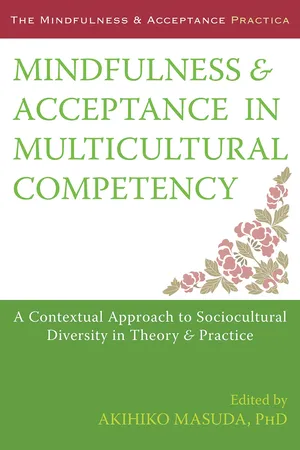
- Masuda, Akihiko(Authors)
- 2014(Publication Date)
- Context Press(Publisher)
As discussed elsewhere (Sue & Zane, 1987), we cannot fully grasp the heart of psychotherapy without considering the cultural context in which it occurs. Nevertheless, understanding the intricate interplay between psychotherapy and cultural context is extremely challenging. Despite extensive triumphs and progress in this area (Sue, 2009), we still have a long way to go. To overcome this challenge, Sue and his colleagues (Sue, Zane, Hall, & Berger, 2009) suggest the adaptation of a bottom-up, prag- matic theoretical framework to systematically organize our knowledge and strategies. As such, the present chapter provides an empirically based conceptual framework, upon which some of the recent accep- tance- and mindfulness-oriented psychotherapies are based. Because every conceptual model is developed from a particular worldview, we first present our essential philosophical assumptions and analytic goals. Subsequently, I will explicate a conceptual account of complex Psychotherapy in Cultural Context 41 human behavior and discuss culture and psychotherapy within this conceptual framework. Finally, we will discuss whether acceptance, mindfulness, and values are culturally biased and delineate the poten- tial contributions of the acceptance- and mindfulness-based approach to the issues of cultural diversity and competence. Our Essential Perspective There are almost infinite ways of viewing culture, psychotherapy and culture, and relevant topics (e.g., cultural competence; Sue et al., 2009). Although having diverse ideas can be viewed as a strength, it may also hinder advancement in the welfare and betterment of indi- viduals (Sue et al., 2009). eBook - PDF
Handbook of Multicultural Mental Health
Assessment and Treatment of Diverse Populations
- Freddy A. Paniagua(Author)
- 2000(Publication Date)
- Academic Press(Publisher)
PART IV Training in Cultural Competence This Page Intentionally Left Blank CHAPTER 21 Limitations of the Multicultural Approach to Psychotherapy with Diverse Clients C HARLES N EGY Department of Psychology University of Central Florida Orlando, Florida Within the field of psychology, the study of culture and how it influences be-havior has blossomed tremendously within the last decade. There appears to be a steady and growing appreciation among psychologists that humans are, in various and in complex ways, influenced by their sociocultural environment. Concomitantly, there is greater awareness of the fact that behaviors considered pathological in one culture may be quite acceptable or even promoted in other cultures (Vacc, Wittmer, & DeVaney, 1988). The recognition that humans are influenced by their sociocultural milieu is not particularly new to the field of psychology (Klineberg, 1980). As early as the 1920s, psychologists were ac-knowledging that sometimes a person’s culture may explain his or her behav-iors, values, and even feelings rather than intrapsychic determinants per se (Betancourt & Lopez, 1993). In the context of therapy, the notions about the influence of culture increas-ingly are becoming incorporated into clinical and counseling psychology (Arre-dondo, 1994). Today, many clinicians and counselors no longer assume that be-haviors manifested by a client—who is of a dissimilar race or ethnicity than that Charles Negy 440 of the therapist—is pathological solely because the behavior in question is con-sidered pathological from the therapist’s cultural standpoint (Vacc et al., 1988). The fact that psychologists in the United States are increasingly recognizing that one’s cultural upbringing may be as much of a contributing determinant to a person’s ‘‘worldview’’ as are noncultural or intrapsychic factors is a step for-ward for psychology and is to be applauded. eBook - ePub
Foundations of Counseling and Psychotherapy
Evidence-Based Practices for a Diverse Society
- David Sue, Diane M. Sue(Authors)
- 2012(Publication Date)
- Wiley(Publisher)
Through the vignettes above, you can begin to get a feel for potential background differences that can affect the client-therapist relationship. Sometimes these differences may be relatively minor, in the sense that they are not salient to the issues discussed or to the therapeutic alliance. In other situations, differences might be quite important to the client or to the therapist. In the multicultural counseling field, attention is often given to “client differences.” However, as emphasized throughout our book, it is equally important to consider therapist background characteristics and reactions. In Chapter 4, we discussed the importance of therapists knowing themselves, their values, their reactions, and their prejudices. As we examine the important topic of diversity considerations in counseling, we hope you will take the time to reflect on these topics as they pertain to you individually. If you think of your classmates or colleagues in the fields of counseling, psychology or social work, you will get a feel for the diversity in backgrounds, values, and beliefs of those in the mental health profession.When individual therapist characteristics are combined with client differences, the potential diversity is immense. Because there is no multicultural therapy, we have decided to use this chapter to present practical issues faced by therapists when working with clients who differ from the therapist in terms of values, or social, cultural, or ethnic background. In the following sections, we will not attempt to provide how-to information, but instead will raise issues that might be important to consider when there are specific differences between therapist and client. We will also discuss issues involved in working with specific diverse populations and conclude with suggestions on how we can improve cultural competence through case presentation and supervision. We will begin by sharing some considerations regarding the perceived effectiveness of therapists regarding cross-racial dyads and the circumstances under which differences should be acknowledged.Acknowledging Differences: Respect and Understanding Are the Key
Multicultural theory would seem to indicate that to be culturally competent, we need to show respect for clients’ ethnicity and background. Should differences between the therapist and client be acknowledged and, if so, when and how? Does recognizing differences increase therapist credibility and strengthen the therapeutic alliance? What kinds of differences should be acknowledged? Should therapists who are ethnically or culturally different from their clients routinely ask questions such as, “How do you feel working with a White (or minority) therapist?” In some cases, it is obvious that differences need to be addressed, such as the case where the woman asked the therapist if he was Jewish. Students, interns, or therapists may also face questions such as “Are you married?” or “Do you have children?” One of our interns was bluntly asked by a 77-year-old widower, “How can you help me? You can’t have any idea of how it feels to lose your wife after fifty years of marriage, let alone how it feels to be getting old and seeing friends and family getting sick or dying.” In these examples, where characteristics such as race, age, or marital status are brought up, the therapist needs to respond directly. eBook - PDF
Clinical Psychology for Trainees
Foundations of Science-Informed Practice
- Andrew C. Page, Werner G. K. Stritzke, Peter M. McEvoy(Authors)
- 2022(Publication Date)
- Cambridge University Press(Publisher)
Culture-Sensitive Practice of Clinical Psychology Acknowledging that each client is a human being entails a recognition that each person must be treated with the dignity they deserve. This will involve appreciating the unique Client problems existing within a sociocultural context, history, etc.) Theoretical & empirical literature Clinical training & experience Assessment & case formulation Treatment planning & measurement Treatment implementation & monitoring Evaluation & accountability Psychologist must respect the humanity of each client and grant them the dignity this affords while maintaining their own humanity and socio-legal obligations Psychologist’s cultural context will influence the perception of information and treatment chosen Client’s cultural and sub- cultural context and individuality needs to be considered Figure 14.1 Influence of social, legal and cultural factors on the practice of clinical psychology. 246 Chapter 14: Respecting the Humanity of Clients qualities of each person and the cultural influences that shape them (Kazarian & Evans, 1998; Ryder, Ban & Chentsova-Dutton, 2011). Before we review some principles of culture-sensitive practice (Sue Sue, Neville & Smith, 2019), it is necessary to consider several caveats. First, a focus on culture as a specific topic in clinical psychology could unintentionally lead to the neglect of other important qualities of an individual when planning treatment (such as their socio-economic status, social class, gender, sexual orientation and so forth). These attributes will vary in their perceived importance among individuals and will vary according to the social context in which they live. eBook - PDF
Culture, Psychotherapy, and Counseling
Critical and Integrative Perspectives
- Lisa Tsoi Hoshmand(Author)
- 2005(Publication Date)
- SAGE Publications, Inc(Publisher)
This still leaves the role of cul-ture as an added factor, rather than at center stage. Before addressing the question of how culture fits into psychotherapy integration, one should consider the possibility of conceptual bridging and integration. Obviously, it is not possible or desirable to try to integrate incompatible theories and systems of practice. The apparent futility of the-oretical rapprochement, however, should not discourage us from seeking a meta-level perspective that provides some commonality and continuity between theoretical models. Short of a complete metatheoretical inte-gration, compatibility of certain basic concepts also permits a kind of syn-cretism rather than unreflective eclecticism. The language of cultural psychology seems to be sufficiently inclusive of diverse theories of psycho-logical practice to serve as a meta-level perspective. Psychotherapy and Culture and the Field of Psychotherapy and Counseling —— 29 counseling have common narrative features, processes, and goals that are culturally appropriated. As some of the proponents of a culture-centered view of psychotherapy have pointed out, there are common processes of healing and problem solving across cultural systems, even if the content and form may vary. The respective roles of practitioner and client are also cul-turally defined. Thinking in cultural terms allows us to see more continuity within the current enterprise, beyond the shared values in the therapeutic culture and its distinct local (in this case, American) character. All of these commonalities should be in clear view as much as the apparent differences between approaches. Common cultural assumptions can then be critiqued, such as when an individualistic worldview is applied to populations with more collectivist worldviews. Fischer, Jome, and Atkinson (1998) conceptualized multicultural coun-seling in terms of universal healing conditions in a culturally specific context. eBook - PDF
- David Matsumoto, Linda Juang(Authors)
- 2016(Publication Date)
- Cengage Learning EMEA(Publisher)
Fourth, if the goal of psychotherapy is to help people to become more func-tional within their society, then functionality itself is culturally determined; that is, different cultures and societies would necessitate different outcomes. In examining the roots and history of the development of psychotherapy, some writ-ers have suggested that psychoanalysis—the basis for contemporary psychotherapy— was developed specifically within a Jewish cultural framework, and that it shares features with Jewish mysticism (Langman, 1997). In fact, the development of other psychotherapeutic approaches, such as behavioral (e.g., cognitive-behavioral therapy) or humanistic approaches (e.g., client-centered therapy), could be considered a “cultural-ization” of traditional psychoanalysis to American culture and society. Viewed in this fashion, psychotherapy can be considered a cultural product, reflecting and repro-ducing a cultural context. Because cultural context is in part composed of moral tra-ditions embedded in political structures, psychotherapy is itself unavoidably a moral cognitive behavioral therapy Interventions that emphasize the devel-opment of strategies for teaching cognitive skills. Underlying these types of therapy is an assump-tion that by changing our thinking we can change our behaviors, and vice versa. Copyright 2017 Cengage Learning. All Rights Reserved. May not be copied, scanned, or duplicated, in whole or in part. Due to electronic rights, some third party content may be suppressed from the eBook and/or eChapter(s). Editorial review has deemed that any suppressed content does not materially affect the overall learning experience. Cengage Learning reserves the right to remove additional content at any time if subsequent rights restrictions require it. Culture and Treatment for Psychological Disorders 313 practice with political consequences embedded within a cultural framework. eBook - ePub
Culture and the Therapeutic Process
A Guide for Mental Health Professionals
- Mark M. Leach, Jamie D. Aten, Mark M. Leach, Jamie D. Aten(Authors)
- 2013(Publication Date)
- Routledge(Publisher)
6
Treatment Planningin a Multicultural Context
Some Suggestions for Counselorsand Psychotherapists
Laura R. Johnson and Daya Singh SandhuIn an increasingly multicultural environment, mental health professionals must develop awareness, knowledge, and skills for creating culturally congruent and effective plans with a broad array of clients. In this chapter we will discuss how clinicians can prepare treatment plans to work effectively with clients from diverse and unique cultural backgrounds, contexts, and perspectives. We will discuss how practitioners can attend to culture as it relates to both the content of the treatment plan as well as the processes involved in developing and negotiating the plan. We have lived, worked, and conducted research internationally, in addition to working with diverse cultural and language groups in the United States. We will draw on our research and clinical work in diverse settings and with diverse individuals to illustrate some of the issues that arise in treatment planning, demonstrate some of the strategies we have used, and also share some of the mistakes we have made in our own efforts toward culturally competent treatment planning.Culturally Competent Treatment Planning
Treatment plans will ideally flow from a thorough case conceptualization based on the clinician’s theoretical orientation that gives due attention to cultural, social, and other contextual factors (including the Diagnostic and Statistical Manual of Mental Disorders [DSM–IV ] cultural formulation; see Chapter 4 ). Additionally, it is crucial to incorporate the client’s goals and expectations into the treatment plan. The question of how, when, and to what extent to bring in culture is not easily answered, as culture’s role and importance will vary from client to client and from one context to another. Finding the right balance between mainstream
- Kanter, Jonathan W., Rosen, Daniel C., Williams, Monnica T.(Authors)
- 2019(Publication Date)
- Context Press(Publisher)
It is important for assessing clinicians to think deeply about acculturation within the context of national origin and generational status, as these can significantly impact clients’ expe- rience of mental health symptoms and the therapeutic context. 174 Eliminating Race-Based Mental Health Disparities Awareness helps guard against the imposition of clinicians’ cultural values, assump- tions, or biases on clients of color. Specifically, awareness facilitates a process of recogniz- ing each client’s cultural context as equally valuable and places importance on working within clients’ values and belief systems in the assessment and diagnostic processes. A commitment to self-reflection and valuing the diverse cultural backgrounds of our clients of color must be unremitting and continuous to effectively develop diagnostic formula- tions and case conceptualizations. An example of the importance of this type of aware- ness can be seen in the case of a thirty-five-year-old Haitian man who came to therapy seeking counseling around his decision to attend college full-time while working sixty hours per week. Since his acceptance to an urban, commuter university one year ago, he enrolled in six courses, withdrew from two, failed two, and earned two Ds. He came to counseling to discuss ways that he can improve his academic performance while main- taining his current employment commitments. In this situation, therapists need to be aware of their own belief systems and values and not impose these beliefs on the client. The therapist, a White female, was born and raised in the United States in an individu- alistic culture, and her parents instilled in her the importance of prioritizing college over employment and familial obligations. eBook - PDF
Counseling and Psychotherapy Theories in Context and Practice
Skills, Strategies, and Techniques
- John Sommers-Flanagan, Rita Sommers-Flanagan(Authors)
- 2018(Publication Date)
- Wiley(Publisher)
Included in this stance, however, is a denial that racism continues to benefit White individuals. (Gushue & Constantine, 2007, p. 323) Unconscious or unintentional racism or sexism is another reason why studying counseling and psychother-apy in context is so important. Context and culture affect everything. REFLECTIONS Does the dominant U.S. culture: • Seek to understand the perspective of nondominant groups by asking them for their opinion—and then listening to their answers? • Step into the alternative culture to deepen mutual understanding and respect? • Consider that minority group members might fear reprisal for speaking openly? The Recent History of Multicultural Competency and Practice Guidelines The multicultural movement in psychology and coun-seling was made possible in part by shifting awareness with the U.S. populace and political changes within the U.S. government. For example, passage of the Civil Rights Act of 1964 led to positive changes in educational, housing, and employment access for many minority groups. The Act bolstered the confidence of persons of color and empowered them to organize (Arredondo & Perez, 2006). Within psychology, the Association of Black Psychologists was formed in 1968, followed by the Asian American Psychological Association, the National Hispanic Psychological Association (now known as the National Latina/o Psychological Association), and the Society of Indian Psychologists. Together, these groups combined to form the Council of National Psychological Associations for the Advancement of Ethnic Minority Interests (CNPAAEMI; see Arredondo & Perez, 2006). The development of guidelines for training counse-lors and psychologists was stimulated by a number of events and people.
Index pages curate the most relevant extracts from our library of academic textbooks. They’ve been created using an in-house natural language model (NLM), each adding context and meaning to key research topics.

