Psychology

Heritability
Heritability refers to the extent to which differences in a trait within a population can be attributed to genetic factors. It is a statistical concept that quantifies the proportion of individual differences in a specific trait that can be attributed to genetic variation. Heritability estimates can help researchers understand the relative contributions of genetic and environmental factors to the development of traits or behaviors.
Written by Perlego with AI-assistance
Related key terms
1 of 5

11 Key excerpts on "Heritability"
 eBook - PDF
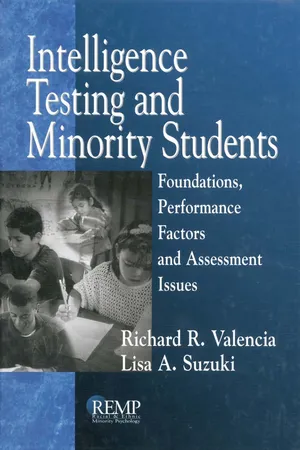
Intelligence Testing and Minority Students
Foundations, Performance Factors, and Assessment Issues
- Richard R. Valencia, Lisa A. Suzuki(Authors)
- 2000(Publication Date)
- SAGE Publications, Inc(Publisher)
First, in the most general sense, Heritability refers to the contribution of genetic differences to observed differences among individuals for a particular trait in a particular population at a particular time ..., not to the phenotype of a single individual (Plomin et al., 1997, pp. 82-83). For exam-ple, the Heritability of intelligence (a particular trait) might be .50 for White, middle-SES, American adults 25 to 50 years of age (a particular population) estimated between 1980 and 1985 (a particular time period). As such, Heritability estimates are protean, depend-ing on how environmental or genetic factors might differ in diverse populations or at different times. Numerous scholars have underscored the point that Heritability is a characteristic of a population, not an individual (Bouchard, 1997; Brody, 1992; Brody & Brody, 1976; Jensen, 1969; Plomin et al., 1997; Taylor, 1980; Tucker, 1994). Unfortunately, this major point that Heritability is a population and not an individual trait is not always understood. For example, Tucker (1994) pointed out that it is not unusual to find misin-terpretations of Heritability in biology texts. A case in point is seen in Biology Today and Tomorrow by Ward and Hetzel (1980, p. 302), who stated that 80 percent of our basic in-telligence is inherited and... the remaining 20 percent determined by our environment (quoted in Tucker, 1994, p. 221). Even Charles Murray, coauthor of The Bell Curve (Herrnstein & Murray, 1994), has demonstrated ignorance about Heritability as shown by a recent CNN interview reported in The New Republic (Wright, 1995). Murray declared, When I—when we—say 60 percent Heritability, it's not 60 percent of the varia-tion. eBook - PDF
Personality, Values, Culture
An Evolutionary Approach
- Ronald Fischer(Author)
- 2017(Publication Date)
- Cambridge University Press(Publisher)
There are two different forms of inheritance: genetic Heritability, which relates to the relative influence of genetics; and social transmission and learning, which link to cultural influences. Determining the relative importance of genes and culture on traits and values is important because the answer will help us understand the relationship between the two. Heritability of values and traits Heritability refers to the estimate of how much variation in a phenotype (e.g., Extraversion as a personality trait) is due to genetic variation among individuals within a specific population (Johnson, Penke, & Spinath, 2011). The most common way to estimate Heritability is through twin studies, which compare similarity in phenotypes among monozygotic (identical) twins, who share 100% of their genes, to those in dizygotic twins and sib- lings, who share 50% of their genes. Twin studies separate the overall vari- ation in phenotypes (expressed as personality traits or values) into genetic and environmental components, depending on how similar monozygotic twins are to dizygotic twins. The genetic component can be further divided into additive effects; that is, direct effects of each gene on a phenotype versus “interactive” gene effects. These include dominance effects (e.g., one allele is dominant over the other allele at the same gene locus, implying that only one allele version is expressed) and epistatic effects (multiple genes inter- act with each other in affecting a phenotype). Environmental components can be distinguished into shared (both twin have similar environmental influences) and nonshared environmental effects (everything else that is not shared by the twins). Heritability estimates can be statistically calculated, (but the interpretation can be complicated due to gene-environment inter- actions, which I discuss in later chapters).
- Philip J. Corr, Gerald Matthews(Authors)
- 2020(Publication Date)
- Cambridge University Press(Publisher)
It is likely that genetic effects associated with these traits will be small and large sample sizes will therefore be required to detect any asso- ciation. By measuring specific traits, studies are able to harmonize phenotypes and pool analyses across cohorts. This will increase the power to detect genetic effects rele- vant to personality traits. With recent advances in both computing and availabil- ity of increasingly rich data sources, there has been a surge in the number of behavioral genetic studies investigating personality traits. Behavioral genetics has the potential to both quantify genetic influences on these traits, in add- ition to indirectly quantifying environmental influences (Munafò, 2009). Here we provide a synthesis of these behavioral genetic studies to date. We begin by reviewing current work investigating the Heritability of personality traits. We also look at the results from genome-wide asso- ciation analyses of these traits to date and discuss the implications of these findings on the potential for applying Mendelian randomization to personality traits. ESTIMATING Heritability In order to investigate the genetic contribution to a pheno- type, it is useful to first estimate its Heritability (Box 1). Heritability is the proportion of variation in a phenotype which can be attributed to genetic differences; these esti- mates are specific to the particular context and the time- point at which they are estimated (Beam & Turkheimer, 2017; Davey Smith, 2011; Matthews & Turkheimer, 2017; Tropf et al., 2017). For example, if a trait has a Heritability of 30%, then 30% of the variation in this trait is assumed to be due to genetic variation. However, although these estimates provide an idea of the size of the genetic com- ponent for a particular trait, they do not give us any infor- mation about which genes are likely to be responsible for it (Cesarini & Visscher, 2017). eBook - ePub
- J.N. Spuhler(Author)
- 2017(Publication Date)
- Routledge(Publisher)
This is, to some extent, what the results show. Exceptions to this rule may be made more understandable if we rephrase the sentence somewhat and think of this continuum as concerned with an increasing involvement of the central nervous system as against more peripheral structures. Structural and more or less permanent functional differences may exist between individual nervous systems, which are themselves genetic in origin and which may affect certain aspects of personality more than other aspects; this would explain apparent departures from the expected progressive decline in importance of hereditary factors as we move “in” and “up.” To avoid awkward circumlocutions I will frequently use the term “Heritability” as shorthand for the statement that a trait is under some degree of hereditary control, even though no precise measure of Heritability exists for man. The conclusion that a trait shows Heritability or some amount of Heritability is based on statistical evidence, so that we encounter the usual questions of whether the sample is representative of the population, whether the mathematical model bears an adequate relation to physical reality, how efficient the statistic is, and so forth. I will not discuss these topics, mostly because I am not competent to do so. I will merely mention here the most frequently used techniques for deciding whether a trait has an important hereditary component. Holzinger devised an Heritability index, h 2, of the proportion of the variance due to heredity based either on subtracting correlations from one another or in another formula subtracting variances from one another. The index has been criticised as statistically and genetically not quite correct. As serious perhaps is the fact (for which the author cannot be blamed) that the index is frequently misinterpreted, so that results of studies that used this index are frequently misquoted No longer available |Learn more
- (Author)
- 2014(Publication Date)
- Academic Studio(Publisher)
________________________ WORLD TECHNOLOGIES ________________________ Chapter- 5 Heritability of IQ The study of the Heritability of IQ is a field of research that includes biology, genomics, psychology, philosophy, sociology, and anthropology. Heritability is an estimate of the genetic and environmental contributions to the variance of any phenotypic measure around the mean for a given population. Heritability refers to the genetic contribution to variance within a population and in a specific environment . . . ; if the environment changes, the Heritability measure changes. Some contend that Heritability does not set any limit on how malleable the trait is under changes of environment, because even highly heritable traits can be strongly manipulated by the environment, so Heritability has little if anything to do with controllability.. However, others argue that Heritability constrains malleability. The debate about IQ Heritability touches on the nature versus nurture divide, and there has been significant controversy in the academic community about it ever since research began in the 19th century. IQ is a polygenic trait under normal circumstances according to recent research. However, destructive mutation of individual genes associated with development can severely affect intelligence, with Phenylketonuria as an example. Estimates in the academic research of the Heritability of IQ have varied from below 0.5 to a high of 0.9. A 1996 statement by the American Psychological Association gave about .45 for children and about .75 during and after adolescence. A 2004 meta-analysis of reports in Current Directions in Psychological Science gave an overall estimate of around .85 for 18-year-olds and older. The New York Times Magazine has listed about three quarters as a figure held by the majority of studies. eBook - ePub
- Arthur Jensen(Author)
- 2012(Publication Date)
- Routledge(Publisher)
Heritability and teachability
Heritability and teachability
It has been said that the Heritability of learning ability or of intelligence is irrelevant to teachability, or as the Bulletin of the ERIC Information Retrieval Center on the Disadvantaged (1969, 4, no. 4) printed in boldface: ‘Teachability is not a function of Heritability’. In support of this statement we see it pointed out that a child or a group of children show some response to training, and this is held up as evidence against the Heritability of intelligence or learning ability.Heritability (h2 ) is a technical term in genetics which refers to the proportion of the population variance in a phenotypic characteristic or measurement that is attributable to genetic variation. It has also been called the coefficient of genetic determination. It can take any value from 0 to 1. It is not a constant but differs for different traits, different measurements, and in different populations. Its value can be estimated by a number of methods in quantitative genetics. Like any population statistic, it is subject to measurement error and sampling error. Since it is based essentially on the analysis of variance, it can tell us nothing at all about the causes of the particular value assumed by the grand mean of the population. It only analyzes the variance (or squared deviations) about the grand mean. And it tells us what proportion of this total variance is genetic variance and what proportion is non-genetic, i.e., due to environmental factors of all kinds and to errors of measurement. Most estimates of the Heritability of IQ in the European and North American populations on which we have good data fall in the range from 0·60 to 0·90 and most of these estimates are in range from 0·70 to 0·80 (not corrected for test unreliability).The fact that IQ has high Heritability surely does not mean that individuals cannot learn much. Even if learning ability had 100 per cent Heritability it would not mean that individuals cannot learn, and therefore the demonstration of learning or the improvement of performance, with or without specific instruction or intervention by a teacher, says absolutely nothing about Heritability. But knowing that learning ability has high Heritability does tell us this: if a number of individuals are all given equal opportunity – the same background, the same conditions, and the same amount of time – for learning something, they will still differ from one another in their rates of learning and consequently in the amount they learn per unit of time spent in learning. That is the meaning of Heritability. It does not say that individuals cannot learn or improve with instruction and practice. It says that given equal conditions, individuals will differ from one another, not because of differences in the external conditions but because of differences in the internal environment which is conditioned by genetic factors. ‘Teachability’ presumably means the ability to learn under conditions of instruction by a teacher. If this is the case, then it is true that Heritability has nothing to do with teachability. But was this ever really the question? Has anyone questioned the fact that all school children are teachable? The important question has concerned differences in teachability – differences both among individuals and among sub-groups of the population. And with reference to the question of differences eBook - PDF
- Tomas Chamorro-Premuzic(Author)
- 2015(Publication Date)
- BPS Blackwell(Publisher)
The truth, as we know it, is that people are different and nobody, not even identi- cal twins, is born the same as anyone else. More importantly, it should be noted (and this will become clear in Chapter 7) that even if there is robust statistical evidence for the Heritability of individual differences, this does not imply that the environment (i.e., education, learning, rearing, nurture) has no influence on our personality or Heritability the extent to which differences between individuals are due to genetic factors. FIGURE 1.6 Genetic and environmental determinants of individual differences Son Are similarities with our parents (e.g., personality, intelligence) inherited or “acquired,” that is, learned? Are they genetically (nature) or environmentally (nurture) determined? Mother Father Daughter INTRODUCING INDIVIDUAL DIFFERENCES 15 intelligence. On the contrary, identifying the degree to which traits are biologically influenced has helped us understand the degree to which nurture may influence indi- vidual differences. In short, then, both views are not incompatible but complementary. In the same way that athletes may inherit a favorable condition for sports from their ancestors (such that a previous history of exercise, good nutrition, and a healthy lifestyle in general may lead to preliminary advantages), individuals may also inherit a specific physiological complexion that may predispose them to behave in certain ways more than others. Even if these processes were clearly outlined, however, it does not imply that factors other than genes may not play a role in shaping these general behavioral tendencies, preferences, and abilities. Just as no person would ever become a professional athlete if they remained locked in a room all their life (“waiting for the genes to do the work”), no person would ever be capable of solving mathematical problems if they had never been taught mathematics, even if their parents were geniuses in that discipline. eBook - PDF
Brain Death of an Idea
The Heritability of Intelligence
- Manfred Velden(Author)
- 2014(Publication Date)
- V&R Unipress(Publisher)
The degree of Heritability of a trait is now defined as that part of the phe- notypic variance which is caused by genetic differences, and it is given in the form of the so-called “Heritability coefficient” (h 2 ) which is written as h 2 ¼ V g V p (5) The coefficient is often multiplied by 100, which results in percentage values for Heritability 5 . Although it is of no significance for subsequent explications it may, for the sake of completeness, be mentioned that V g in formula (5) stands for but a part of the genetically caused variance (the so-called “additive genetic var- iance”), namely the one that determines the resemblance among relatives. As mentioned above, it is by means of this resemblance that the Heritability used for predicting breeding success is determined. 5 Previously h (for Heritability) was the symbol for the Heritability coefficient. At that time, it was defined as a ratio of standard deviations, which, as mentioned, are the square roots of the variances. So when changing to variances h had to be squared. The methods for determining the Heritability of mental traits 12 Formula (5) is just the definition of Heritability. We cannot measure V g , just infer it, namely from the resemblance among relatives. Evidently the resem- blance with respect to some trait among relatives of different degrees of relat- edness tells us something about the Heritability of that trait. If a trait is heritable to some degree, siblings, for example, must resemble each other to a higher degree than half siblings because siblings have 50 % of the genes in common, while half siblings only share 25 %. In this sense, identical (monozygotic) twins and fraternal (dizygotic) twins are of different degrees of relatedness because the monozygotic share 100 % of the genes while the dizygotic share only 50 %, quite like normal siblings. eBook - PDF
- Robert J. Sternberg(Author)
- 2000(Publication Date)
- Cambridge University Press(Publisher)
This formula, however, depicts only the general components of a phenotype. To describe the vari- ability (i.e., individual differences) of a phenotype in a population, the concept of variance is used. The total variance is the phenotypic variance, or the vari- ance of phenotypic values, and is the sum of the sep- arate components. In other words, = (V A + V D + (V s + V N ). This representation, however, requires certain clarifications. First, genotypic and environmental components may be correlated; then V P will be in- creased by twice the covariance of G and E (this term is usually referred to as genotype-environment cor- relation, 2Cov(G)(£)). Second, interactions between genes and environments may occur, introducing yet another additional term to the equation (this term is referred to as genotype-environment interaction, V GXE ). On the basis of this decomposition of variance, the Heritability coefficient is defined as the indicator of the contribution of genes to the variation in a trait (phenotypic variation). If this coefficient is defined as V A / V P , it is called Heritability in the narrow sense. If it is defined as V G /V Pf it is referred to as Heritability in the broad sense. The representation of the phenotypic variance through its components, however, is nothing more than a coherent abstraction. It is handy in allowing us to picture causal influences on the phenotype, but it becomes "alive" only when it is linked to indi- cators of similarities and dissimilarities between rel- atives. An allele is a variant of a gene; in any given gene, an indi- vidual has two alleles, one inherited from a mother and the other inherited from a father. Heritability AND INTELLIGENCE 57 10: Years of Research on Thousands of Pairs of Relatives The literature covering genetic and environmen- tal influence on IQ is immense. eBook - PDF
An Introduction to Genetics for Language Scientists
Current Concepts, Methods, and Findings
- Dan Dediu(Author)
- 2015(Publication Date)
- Cambridge University Press(Publisher)
However, it is important to highlight that, despite their limitations, heri- tability estimates still play important roles in understanding the genetics of complex traits. For example (Section 7.2) they provide the benchmark against which the amount of variation explained by the actually identified loci is evaluated. Moreover, the fact that usually the Heritability estimates tend to agree across studies, populations and different methods reinforces the idea that Heritability reflects a real phenomenon. Finally, these family designs have utilities beyond estimating the Heritability and help in studying the genetic correlation between traits, looking at the effects of the environment and vari- ous types of gene–environment interactions (see Sections 2.4.7 and 2.4.8 for details). 2.4.5 Heritability: what it does and does not mean It is extremely easy to misinterpret and misrepresent Heritability estimates and, unfortunately, these can have profound and real consequences on how groups of people are educated (or not), how they are regarded and discriminated by the larger majority and, consequently, their access to various services. To clar- ify what Heritability as defined above and used in Heritability studies actually means, we will discuss, in no particular order, some of its apparently counter- intuitive properties (see also Visscher et al., 2008, Plomin et al., 2001, and Lynch and Walsh, 1998, among others). Given that Heritability is a ratio of variances, h 2 = var ( A)/var ( P ) or H 2 = var (G)/var ( P ), it cannot be estimated when there is no variation in the phenotype, var ( P ) = 0. However, there are some uniform traits, such as the incapacity to pass through concrete walls or to teleport to Mars and back, that intuitively have nothing to do with genetic inheritance, being simply con- sequences of the fundamental properties of matter, energy and information. Other uniform traits, such as having one heart, intuitively have a lot to do with genetics. eBook - PDF
- Gerald Matthews, Ian J. Deary, Martha C. Whiteman(Authors)
- 2009(Publication Date)
- Cambridge University Press(Publisher)
Once it has been established that traits are in part inherited, we might start to ask how genetic variability in personality relates to the evolutionary processes that have influenced human nature (Buss, 1999). At present, there are no good answers to this question, although it is likely that future research will increasingly inter-relate the genetics and evolutionary psychology of traits. Box 6.1 describes some possible research strategies for making such connections. Three basic designs Genetic and environmental research on personality traits – and on other psycho-logical and physical traits – is based on three simple research designs: twin studies, adoption studies and molecular genetic studies (Plomin et al., 2008 ; Bouchard and Loehlin, 2001 ). Each may be elaborated upon to ask more complex questions. Twin and adoption studies are called ‘genetically informative’ and are carried out 153 154 causes of personality traits Box 6.1 Towards an evolutionary psychology of traits? The human mind contains many complex psychological mechanisms that are selectively activated, depending on cultural contexts (Buss, 2001 , p. 955). Evolutionary psychology is a fairly new approach to the whole of psychology that seeks to explain behaviour in terms of adaptations that have evolved through natural selection (Tooby and Cosmides, 1992 ). An adaptation is a neuropsychological mechanism that confers a selective advantage in some specific situation or set of situations, increasing the likelihood that the organism survives, reproduces or raises offspring that are themselves likely to survive and reproduce. It is assumed that there are many specific adaptations, each one keyed to solving some particular adaptive problem. For example, taste perception mechanisms, such as detecting and liking sweetness, assist the person in eating nutritious items and avoiding those that are non-nutritious or toxic. The evolutionary basis for such basic survival mechanisms is uncontroversial.
Index pages curate the most relevant extracts from our library of academic textbooks. They’ve been created using an in-house natural language model (NLM), each adding context and meaning to key research topics.
