Psychology

Milgram's Variation Studies
Milgram's Variation Studies were a series of experiments conducted by psychologist Stanley Milgram to investigate the factors influencing obedience to authority. These studies involved altering certain variables, such as the proximity of the authority figure or the presence of disobedient peers, to understand their impact on obedience levels. The findings revealed the powerful influence of situational factors on human behavior.
Written by Perlego with AI-assistance
Related key terms
1 of 5
12 Key excerpts on "Milgram's Variation Studies"
 eBook - ePub
Great Ideas in Psychology
A Cultural and Historical Introduction
- Fathali M. Moghaddam(Author)
- 2013(Publication Date)
- Oneworld Publications(Publisher)
2 Imagine living in the seventeenth century rather than the twenty-first century. What are some ways in which you would experience less individual rights and be expected to show greater obedience to authority?THE EXPERIMENTAL STUDY OF OBEDIENCE
Before 1960, two ground-breaking series of studies on conformity were conducted by psychologists, the first initiated by Muzafer Sherif in the 1930s and the second by Solomon Asch in the 1950s. Both of these series of studies were conducted in contexts involving issues that had little real-world significance: estimating the movement of a spot of light (in the case of Sherif’s studies) and estimating lengths of lines (in the case of Asch’s studies). During 1959–60 Stanley Milgram was working in Asch’s laboratory and thinking about what would happen if instead of the movement of a spot of light, judgments of line lengths, or the like, issues of greater human significance were introduced into the laboratory. Would the individual still bend to the will of the majority? This question was the point of departure for Milgram’s studies on obedience to authority, and it eventually led to the question of how far individuals would obey an authority figure.Milgram recruited participants by advertising for volunteers aged 20–50 to take part in a study on the effect of punishment on learning. Participants were told that a goal of the research was to discover how much punishment is good for learning, how much difference it makes whether an older or younger person is giving the punishment, and similar such questions. From the pool of applicants he was able to select a sample of participants with varied ages and backgrounds. In each experiment, the participants were forty percent skilled and unskilled workers, forty percent white-collar, sales, and business, and twenty percent professionals. All those selected had been screened to ensure that they had a normal psychological profile. When the selected participants arrived at Milgram’s laboratory, they were introduced to another person who was supposedly also a participant but was actually a middle-aged accountant selected to act as Milgram’s confederate. It was explained to the participants that this learning experiment required a teacher and a student. The two participants drew lots to decide who would play the role of the teacher and who would play the role of the student, but the outcome was pre-arranged so that the confederate would always play the role of student. There was also a scientist in a white laboratory coat in the room, purportedly in charge of the “learning study.” eBook - ePub
The Use and Misuse of the Experimental Method in Social Psychology
A Critical Examination of Classical Research
- Augustine Brannigan(Author)
- 2020(Publication Date)
- Routledge(Publisher)
de novo without influence from the earlier research. Milgram approached many groups to determine what they thought would be the normal responses to his experimental manipulations, and, especially, what people would estimate the refusal rates would look like. Psychiatrists, college students, and middle-class adults predicted that 100% of the subjects would defy the authority figure and refuse to administer the lethal levels of shock.In the Blackwell Reader in Social Psychology , Hewstone, Manstead, and Stroebe summarized the study: “There is no experimental design as such; no factors are manipulated. No statistics are reported on the data nor are they needed since no experimental variations were compared” (1997:54). This characterization is not entirely fair. Milgram studied a number of different conditions of aggression, the most famous of which was proximity. He argued that the closer the victim to the context of aggression, the lower the levels of compliance. He also tested the effects of group mediation of compliance. Indeed, he reports twenty-three different conditions of obedience, suggesting again that the research was inherently inductive. Milgram found that the majority of subjects in the baseline experiments did administer the maximum level of shock but that this declined the more proximal the victim was to the teacher. He concluded that compliance of individuals in bureaucratic condition results from the force of authority figures on their obedience. His experiment extracted this general human tendency from the reports of the Holocaust killers who reported that their role in genocide was a result of “just following orders.” This has been the dominant view of the obedience studies over the last six decades.Criticisms were raised both in terms of internal and external validity. As for internal validity, contrary to the received view, Orne and Holland (1968), Mixon (1971), and other critics argued that, in psychology experiments, subjects presume that “nothing can go wrong” and that bad things may not be as bad as they seem. Even though subjects are told that the shocking device delivered some 450 volts and are demonstrated through a sample that the volts are, well, electrifying, most presuppose that “this must be OK – no one can really get hurt.” Universities cannot permit that to happen. eBook - PDF
The Art of Followership
How Great Followers Create Great Leaders and Organizations
- Ronald E. Riggio, Ira Chaleff, Jean Lipman-Blumen, Ronald E. Riggio, Ira Chaleff, Jean Lipman-Blumen(Authors)
- 2008(Publication Date)
- Jossey-Bass(Publisher)
An important lesson that Milgram’s experiments teach us is how much of our behavior is a product of the characteristics of the immediate situation, which can override our personalities. As Milgram put it rather strongly, reflecting not only on his own work but on social psychology as a whole, “The social psychology of this century reveals a major lesson: often, it is not so much the kind of person a man is as the kind of sit-uation in which he finds himself that determines how he will act.” 15 And, in fact, the main reason Milgram carried out over twenty different exper-imental variations was to identify the specific alterations in the immediate situa-tion that increase or reduce obedience. One such variation has special relevance The Art of Followership 204 in these times of revelations of massive corporate wrongdoing set into motion by corrupt leadership. In this experiment, the naive subject is part of a three-person teaching team, the other two people being confederates. Their job, like that in the other experi-ments in the series, is to teach the learner a list of word pairs using incremental shocks as punishment for each error. One confederate is given the job of reading the word pairs, the second announces whether or not the learner’s answer is cor-rect, and the real subject administers the shocks. In the midst of the process, the two confederates drop out—one at 150 volts, the other at 210 volts—because of their concern for the learner. The results—first reported in an article aptly titled “Liberating Effects of Group Pressure”—only 10 percent of the subjects ended up being completely obedient. 16 The rebellion of peers dramatically weakened the authority’s grip. Milgram noted, “Of the score of experimental variations com-pleted in this study, none was so effective in undercutting the experimenter’s authority as [this one].” 17 This variation suggests a potentially powerful antidote to objectionable author-ity.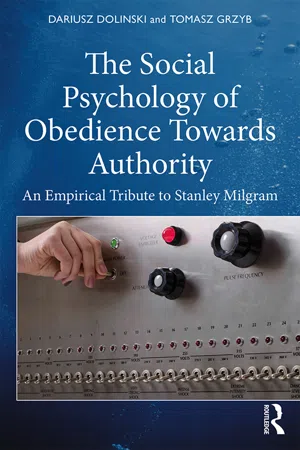 eBook - ePub
The Social Psychology of Obedience Towards Authority
An Empirical Tribute to Stanley Milgram
- Dariusz Dolinski, Tomasz Grzyb(Authors)
- 2020(Publication Date)
- Routledge(Publisher)
10INDIVIDUAL DIFFERENCES AND BEHAVIOR DURING THE EXPERIMENT
When turning their attention to the shocking results recorded by Stanley Milgram, readers of books and students attending university lectures declare with exceptional predictability that those results came about because “there must have been something wrong with the people in those studies.” This belies the assumption that the participants in the experiments done in New Haven were in some way different from the general population, that they possessed some particular collection of characteristics that led them during the course of the experiment to demonstrate obedience towards the experimenter (and cruelty towards the person hooked up to the other side of the electric shock generator). While this was not the case, and while Milgram’s studies represent scholarship in the area of social psychology, they have also exhibited exceptional influence on the development of psychology of personality and individual differences. As Ludy Benjamin and Jeffrey Simpson (2009) point out, in the 1950s psychology was dominated by a focus on exploring how individual psychological characteristics determine what people feel, think, and how they behave in various situations. Milgram’s studies, indicating the tremendous importance of the external situation, made a significant contribution to changes in the way we think about the individual and to research paradigms. In the 1970s, the dominant approach became one in which consideration was given to the complex interactions of psychological traits and the situation facing the individual (Endler & Magnusson, 1976; Magnusson & Endler, 1977).Presentation of Milgram’s studies in the psychological literature generally centers around the argument that submissiveness is a universal human trait. However, it should be pointed out that the group of people who are not entirely submissive is not a marginal one. In the study that is given the greatest attention (Study 5 from Milgram’s Obedience to Authority: An Experimental View, discussed in our presentation of Milgram’s studies in Chapter 3 eBook - PDF
Obstacles to Ethical Decision-Making
Mental Models, Milgram and the Problem of Obedience
- Patricia H. Werhane, Laura Pincus Hartman, Crina Archer, Elaine E. Englehardt, Michael S. Pritchard(Authors)
- 2013(Publication Date)
- Cambridge University Press(Publisher)
In this chapter, we will examine in more detail the Milgram (1974) experiments, the well-known studies that tested whether or not naive participants would engage in unconscionable acts if encouraged or told to do so by a person in authority. We shall also present some new analyses of the original experiments that help to explain not only why so many people obeyed the person in authority in the experiments, but also why some were disobedient. In Chapter 2 we argued that the use of language in various formats, including conversation and discourse, shapes our perspectives and thus our mental models. As we shall see, the ways our mind interprets a discourse affects human choices and actions as well. It will turn out that most disobedience and exits from the Milgram experiments occurred when the teacher administered the 150-volt shock. And it was what the learner said when at 150 volts he cried, “Get me out of here,” and in later iter- ations of the experiment adds, “My heart’s starting to bother me,” that was most decisive in the choices of those few na¨ ıve participants who exited the experiment before the final instruction to administer 450 volts. The Milgram experiments 45 II. The Milgram experiments In the late 1960s a young psychologist at Yale University, Stanley Milgram, began a set of experiments that have come to be called “the obedience experiments.” Milgram (1974) was struck by the fact that so many German citizens went along with Nazi behavior before and during the Second World War even when they knew atrocities were being committed to their Jewish neighbors and friends. He also wondered why ordinarily decent human beings who became guards at the concentration camps turned into monsters in their treatment of inmates, while carrying on seemingly exemplary family, religious, and neighborly lives outside their work. Thus motivated, Milgram created a set of experiments to test whether and how ordinary human beings would react to authority. eBook - PDF
The Prevention of Torture
An Ecological Approach
- Danielle Celermajer(Author)
- 2018(Publication Date)
- Cambridge University Press(Publisher)
He also wanted to discover what types of considerations increased or decreased the likelihood of such obedience. To do so, he varied the experimental conditions to manipulate the independent variables he thought might be important. For example, sub- jects received different types of instructions and, specifically, the explanation of why the shocks were being administered was varied; so, for example, sometimes the scenario was framed as helping the learner and at other times as punishing Henry A Alker, Personality at the Crossroads: Current Issues in Interactional Psychology (Hillsdale, NJ: Lawrence Erlbaum Associates, 1977). 39 The Milgram experiments have been subject to considerable controversy, most surrounding the ethics of the research, but some also questioning the validity of his conclusions. In her 2013 book, Behind the Shock Machine: The Untold Story of the Notorious Milgram Psychology Experiments (Melbourne: Scribe), Gina Perry claimed that her archival research and inter- views with those involved in the original experiments called into question the validity of Milgram’s conclusions. Specifically, she claimed that in many cases, the procedure he had set out, whereby subjects who refused or resisted were given four standard counter-prompts, had not been followed and in fact means of coaxing them to stay had been employed. She also claimed to have found evidence that most subjects had been aware that they were taking part in an experiment. Reviewing 35 years of experimental findings post-Milgram, however, Thomas Blass finds significant variation in the rates of obedience (between 28% and 91% compared with Milgram’s 65%) but in general experimental confirmation of his findings. Thomas Blass, “The Milgram Paradigm after 35 Years: Some Things We Now Know about Obedience to Authority,” Journal of Applied Social Psychology 29, no. 5 (1999). 3 The Situational Hypothesis for Institutional Violence 125 eBook - ePub
Race and Social Change
A Quest, A Study, A Call to Action
- Max Klau(Author)
- 2017(Publication Date)
- Jossey-Bass(Publisher)
The experimenter responds quickly and decisively. “I'll take responsibility. It is absolutely essential that you continue.”Despite his obvious misgivings, the man continues to ask questions and deliver shocks to the increasingly agitated man off-screen. Eventually, the screams and protests stop, and the shocks bring no response. For all we know, the man off-screen is now either unconscious or dead. But the experimenter continues to insist that the man must continue, and so he does…all the way to the last, highest-voltage switch on the machine.The Individual Level of Analysis: Obedience and Conformity
The scene is from a famous (or more accurately, infamous) series of experiments conducted at Yale University in the 1950s by social psychologist Stanley Milgram. The details of the experimental design are explained in the next section, but for now the important point to note is that Milgram's authority experiments were among the first in a series of provocative social psychology experiments that have become classics in the field. Many of these studies have become widely known far beyond the boundaries of social psychology researchers because they compel us to confront the darker shadows of some of the most basic and universal dimensions of human behavior. Because the Separation Exercise that is the focus of this book builds on and extends this tradition in important ways, a review of these classic experiments provides an invaluable context for the insights and perspective that we'll encounter in the pages ahead.Milgram's Obedience Experiments
Social psychologist Stanley Milgram conducted his famous experiments exploring obedience to authority at Yale University in the 1950s. Deeply disturbed by the Nazi genocide of Jews during the recently completed Second World War, Milgram (1974) wanted to understand how ordinary individuals could participate in mass cruelty and violence: eBook - PDF
Reconstructing the Psychological Subject
Bodies, Practices, and Technologies
- Betty M Bayer, John Shotter, Betty M Bayer, John Shotter(Authors)
- 1997(Publication Date)
- SAGE Publications Ltd(Publisher)
He also described a pilot study conducted in the winter of 1960 in which the victim gave no vocal feed-back to the participant. In these sessions virtually all subjects, once com-manded, went blithely to the end of the board, seemingly indifferent to the verbal designations . . . . This deprived us of an adequate basis for scaling 176 Reconstructing the psychological subject obedient tendencies. A force had to be introduced that would strengthen the subject's resistance . . . and reveal indiv idual differences in terms of a distribution of break-off points (1965b: 61). In other words, the pilot studies had already indicated almost complete compliance.23 But without variance, there was litt le that could be said within the experimental tradition of social ps y chology. So Milgram began introducing his many manipulat ions to vary the leve l of compliance. The aim was therefore to obtain a reason-able and varying facsimile of obedience; its demonstration alone was insufficient. Milgram was a master in design ing high-impact experiments. Not only in the case of obedience but elsewhere (e.g., the lost-letter technique) he created engaging situations that would idealize some property of social relations. His research continues to be widely cited and his relationsh ip to social psychology remains central. He remains ident ified as a representative of what constitutes a pre-eminent researcher in the field, precisely because he successfully cloaked a strong moral message in the language of experi-mentation. Yet when we examine a complex and topical question like obedi-ence and it remains an abstract entity to be theorized, and this theorization can only be effectively legitim ized when it is clearly represented in a labora-tory context, then we have lost the capacity to be morally indignant about any of our claims and findings. eBook - ePub
Stanley Milgram
Understanding Obedience and its Implications
- Peter Lunt(Author)
- 2009(Publication Date)
- Bloomsbury Academic(Publisher)
2 Milgram’s Explanation of His FindingsThe experiments that Milgram conducted are fascinating in their own right and the results raise important and worrying questions about human agency and responsibility in the face of authority. However, what motivated Milgram to conduct these experiments and how did he interpret the results? In his book Obedience to Authority , written ten years after he had completed his experiments, Milgram was able to develop a psychological theory of the results, to reflect on the ideas that had influenced him and to elaborate on the broader social, political and moral context of his research.In the preface and first chapter of Obedience to Authority Milgram reviews the theoretical questions and social concerns that led him to design and conduct his obedience experiments. Milgram does not start with psychological theory but blends sociological analyses of power and authority with enduring concerns about the Holocaust and political concerns about post-war American society. Milgram’s acknowledgements give us some clues as to the key influences on his work. The list of authors he cites are from two different academic traditions: research on the social psychology of social influence, including Asch, Lewin and Sherif and a group of writers of social and political theory who influenced the broader intellectual zeitgeist in which Milgram and other social scientists of his day started their careers, including Adorno et al. (1950), Arendt, Fromm and Weber.Milgram starts his discussion with a paradox which he claims is as old as western civilisation; that authority and obedience are necessary for the cohesion and smooth running of society and therefore of tremendous benefit. At the same time, however, under the influence of authority individuals can perform acts that they would otherwise regard as wrong, immoral or evil. This is an important starting point because it suggests that obedience as a basic function of complex societies can be used for both positive and negative ends, and is therefore value neutral. Although Milgram is interested in sociological and political questions, he places the individual at the centre of his enquiry. When an authority figure asks an individual to do something they disagree with there is a conflict between the individual and society. Milgram sees obedience to authority through the eyes of a social psychologist who is concerned with the relationship between individuals and society. eBook - PDF
- Dana S. Dunn(Author)
- 2012(Publication Date)
- Wiley(Publisher)
Reflecting on what became all-too-typical reactions, one observer of Milgram’s study commented that I observed a mature and initially poised businessman enter the laboratory smiling and confident. Within 20 minutes he was reduced to a twitching, stuttering wreck, who was rapidly approaching a point of nervous collapse. He constantly pulled on his earlobe, and twisted his hands. At one point he pushed his fist into his forehead and muttered “Oh God, let’s stop it.” And yet he continued to respond to every word of the experimenter, and obeyed to the very end. (Milgram, 1974, p. 377) 48 Ethical Issues in Social Psychological Research Here are some of the ethical issues to consider regarding this work: Participants genuinely believed they were hurting another person, just as they genuinely believed they had to do so in the interest of the “experiment.” The participants were not told in advance what was going to happen or their role in the proceedings (doing so would have biased their responses). Many learned something unsettling about themselves, that they were entirely capable of obeying authority, of “hurting” someone despite his protests. Others, a minority, learned they were capable of disobeying an authority figure in order to avoid harming another person. Generations of students and fellow social psychologists were moved to ask whether Milgram’s (1963) methods were justified and justifiable. Was the knowledge about behavioral responses to obedience worth it? Did Milgram treat his participants fairly? These and related issues were debated once his controversial work appeared. Milgram had defenders (e.g., Blass, 2004) and critics (e.g., Baumrind, 1964, 1985; Orne & Holland, 1968), and he spent considerable efforts dealing with reactions to the obedience paradigm (Milgram, 1964, 1972, 1977). eBook - PDF
Arguing, Obeying and Defying
A Rhetorical Perspective on Stanley Milgram's Obedience Experiments
- Stephen Gibson(Author)
- 2019(Publication Date)
- Cambridge University Press(Publisher)
And they attribute less responsibility to the learner.’ While cautioning that these are post hoc accounts and should necessarily be treated with caution, Milgram nevertheless suggested that disobedient participants see themselves as primarily responsible for shocking the learner, whereas obedient participants do not. Milgram’s theory thus constitutes an attempt to account for the vari- ation in obedience levels across conditions, and this has important impli- cations for the philosophical and practical way in which we understand agency and responsibility. Notably, and perhaps troublingly, it suggests 26 The Obedience Experiments that ‘just following orders’ may have some basis in the reality of under- lying psychological processes. Critical Reaction Milgram’s experiments provoked an almost immediate critical reaction, and in many respects this continues to the present day (see Chapter 2). Key early criticisms of Milgram’s experiment highlighted a number of important ethical, methodological and theoretical weaknesses, and it is testament to the controversy generated by the obedience experiments that many of these critiques have gone on to be an integral part of the story of the Milgram experiments. Ethics Diana Baumrind’s (1964) seminal article set the tone for much of the criticism of the obedience experiments on ethical grounds. As Miller (2013) has recently noted, Baumrind’s critique has been almost as influ- ential as Milgram’s experiments themselves, both in terms of bringing the experiments to the attention of a wider disciplinary readership, and in framing the terms of the ethical debate at a time when such matters were not the subject of routine discussion in the academic literature. Indeed, it is arguable that the ethical controversy resulting from the experiments played a key role in the debates that led to the more robust codification of research ethics in US psychology a decade later (Stark, 2010). eBook - PDF
- T. Klikauer(Author)
- 2012(Publication Date)
- Palgrave Macmillan(Publisher)
As a consequence, the authority of management is unchallenged. There is no longer any condemnation of the authority (Blass 1992), neither implicit (absenteeism, work-to-rule, etc.) nor explicit (trade unions). Management and with it Managerialism are accepted as given. In addition to Milgram’s obedi- ence experiments, Asch’s (1955) experiments have shown that group-pressure almost predetermines the truth versus conformity dilemma. As Asch (1955) found, conformity to management alone seems to be enough in order to over- ride moral truth. In general, however, management is not about truth but about conformity to so-called organisational goals and shareholder-value, the codeword for profit-maximisation. Asch (1955), Milgram (1974), and Bauman (1989) stressed the importance of situational manipulation. In other words, highly pre-structured environments such as managerial work regimes estab- lish situational manipulation so that individuals are obedient to managerial authority. Combined with the displacement of morality from the self to the structure of management, obedience to authority becomes operational. In sum, Milgram (1974) has shown ‘how easily normal individuals can be made to carry out inhuman commands’ (Blass 1992:304). The subjects in his experiments were normal people who carried out inhuman commands when placed in an authoritarian situation and under authority. According to Milgram (1974) and Bauman (1989) neither the Nazis, nor in Milgram’s experiments, management needs monsters and psychopaths to become ‘Will- ing Executors’ (Goldhagen 1996) to action inhuman commands and immoral acts. Ordinary people will do it in all three cases. Crucial is, however, to place Stage 1: The Management Morality of Obedience and Punishment 77 them inside an authoritarian structure (Migram’s experiments, Germany’s SS, and management) which overrides individual and societal morality.
Index pages curate the most relevant extracts from our library of academic textbooks. They’ve been created using an in-house natural language model (NLM), each adding context and meaning to key research topics.

