Psychology

Ulrich Neisser
Ulrich Neisser was a prominent cognitive psychologist known for his work in the field of cognitive psychology and his influential book "Cognitive Psychology" published in 1967. He is recognized for his contributions to the development of the cognitive revolution, which emphasized the study of internal mental processes such as perception, memory, and problem-solving. Neisser's work significantly impacted the field of psychology.
Written by Perlego with AI-assistance
Related key terms
1 of 5
5 Key excerpts on "Ulrich Neisser"
 eBook - ePub
Cognitive Psychology and Information Processing
An Introduction
- R. Lachman, J. L. Lachman, E. C. Butterfield(Authors)
- 2015(Publication Date)
- Psychology Press(Publisher)
esprit de corps among many of the psychologists who eventually identified with the information-processing paradigm resulted from their common rejection of, and often downright hostility toward, neobehaviorism. Neobehaviorists, in turn, had great difficulty accepting the new commitments of information-processing psychology; many never have. However, several generations of psychologists have received their graduate education in the period following the neobehaviorists' loss of dominance. They are not particularly interested in the paradigm clash that preceded their own professional training, and consequently the clash between the two paradigms has muted as the balance has tipped toward the new cognitive psychology. It is not clear whether information processing will become as prevalent as neobehaviorism was in the 1950s, permeating other areas such as social psychology, industrial psychology, and child psychology. However, it is currently in a period of normal science, guiding the research activities of a large community of psychological scientists whose primary area is human cognition.III. The Contributions of Verbal Learning
During the heyday of neobehaviorism, verbal learning was already a clearly defined psychological subdiscipline with many highly productive practitioners. Even though their subject matter was the learning of verbal materials by human subjects rather than animal learning, verbal-learning psychologists shared many commitments with neobehaviorism. However, the relationship between verbal learning and information processing developed quite differently from that between information processing and neobehaviorism. For reasons we give presently, many verbal-learning psychologists found it relatively easy to accept the new commitments of the information-processing approach. Today, most verbal-learning researchers consider themselves information-processing psychologists as well.We have already mentioned the work of Hermann Ebbinghaus, the indisputable father of the study of verbal learning. This master scientist brought the best traditions of Newton and Galileo to the study of learning and memory. He not only learned many thousands of nonsense syllables and tested his own memory for them, but also devised new quantitative measures of memory and new ways of eliminating errors from memory experiments. He advocated the use of constant experimental conditions and rigorous statistical analyses of the resulting data, and he invented procedures to accomplish these objectives. Many of his methods are still in use today, which gives his writing a strikingly modern tone. His influence has been altogether profound. eBook - ePub
An Introduction to Cognitive Psychology
Processes and Disorders
- David Groome(Author)
- 2021(Publication Date)
- Routledge(Publisher)
- Cognitive psychology is the study of how information is processed by the brain. It includes the study of perception, learning, memory, thinking, and language.
- Historically there have been four main strands of research which have all contributed to our present understanding of cognitive psychology. They are experimental cognitive psychology, cognitive neuroscience, cognitive neuropsychology, and computer modelling of cognitive processes.
- Experimental cognitive psychology has provided theories to explain how the brain interprets incoming information, such as the schema theory which postulates that past experience is used to analyse new perceptual input.
- Computer modelling has provided models of human cognition based on information-processing principles, and it has introduced important new concepts such as feature-detector systems and processors of limited channel capacity.
- Cognitive neuropsychology provides knowledge about brain function, based on the study of people who have suffered cognitive impairment as a result of brain injury.
- Cognitive neuroscience makes use of brain-imaging techniques to investigate the relationship between brain function and cognition.
- Scientific studies of cognitive psychology have generated new concepts and theories, such as the distinction between top-down and bottom-up processing, and the distinction between automatic and controlled processing.
- The study of consciousness has yielded some interesting findings, but at present we have no real understanding of what consciousness is, or how it arises from neural activity.
Further reading
Eysenck, M.W., & Groome, D. (2015). Cognitive Psychology: Revisiting the Classic Studies. London: Sage. For this book we selected what we considered to be the 14 most important and influential studies of cognitive psychology ever published, and we then asked leading researchers in those fields to explain the impact those classic studies have had on subsequent research.Eysenck, M.W., & Keane, M.T. (2020). Cognitive Psychology: A Student’s Handbook eBook - ePub
Psychology in Historical Context
Theories and Debates
- Richard Gross(Author)
- 2017(Publication Date)
- Routledge(Publisher)
Chapter 7 People as information processors Cognitive PsychologyAs we noted in Chapter 1 , there’s a common misperception regarding the relative dominance of Behaviourism and its replacement by Cognitive Psychology as the paradigmatic approach. Behaviourism became dominant in the US (but not until the 1930s), while ‘mentalism’, in one form or another, in particular, Gestalt Psychology, remained influential, especially in Germany.Conversely, even in the 1880s, ‘the mind’ was being studied in a way that has more in common with Behaviourism than with how it was subsequently conceived: Ebbinghaus’ pioneering study of memory was based on Associationism, while the so-called ‘cognitive revolution’ of the mid-1950s translated ‘mind’ into ‘cognition’/cognitive processes, seeing the person as an information processor, with the computer analogy at the centre of the paradigm. Like Behaviourism, this ‘revolution’ was a largely US phenomenon.However, as we saw in Box 1.9 (page 17), the English Psychologist Donald Broadbent was a key figure in this move back towards the mind and the attributes of conscious experience. While Broadbent’s (1958) Perception and Communication referred frequently to Hull’s work, he conceptualized learned motor habits as residing in a long-term store. Items entered long-term memory usually by first entering consciousness. While an attention process filtered out the important from the unimportant material, the more the individual ‘processed’ or rehearsed the material in consciousness, the more likely it was to enter the long-term store. These processes were represented by a flowchart, including feedback systems; this was, for the time, a novel way of scientifically representing psychological functioning.Broadbent’s attempts to explain selective attention represents an information-processing approach; he also helped to popularize analogies between human memory systems and (other) physical storage systems. One of the best-known and, arguably, most debated and controversial, is that between humans as information processors and computers (see Gross, 2014). Broadbent’s model of selective attention has become a key feature of mainstream Cognitive Psychology, along with alternative models and accounts of divided attention eBook - ePub
Functions of the Brain
A Conceptual Approach to Cognitive Neuroscience
- Albert Kok(Author)
- 2019(Publication Date)
- Routledge(Publisher)
Indeed, the computer invented by two brilliant pioneers, Alan Turing and John von Neumann, now emerged as a powerful tool that allowed to formulate more precisely theories of brain functioning. A device invented by Turing called ‘Turing machine’ provided the basic ingredients of a computer program. A Turing machine is an idealized and amazingly simple computing device consisting of a read/write head (or ‘scanner’) with a paper tape passing through it. The tape is divided into squares, each square bearing a single symbol ‘0’ or ‘1’. The machine changes symbols by deleting or changing its content. The tape is the machine’s general-purpose storage medium, serving both as the vehicle for input and output and as a working memory for storing the results of intermediate steps of the computation. Turing’s abstract conceptualization of a computing system also formed the framework of von Neumann’s design of the architecture of the electronic digital computer with parts consisting of a processing unit, and mass storage unit and input and output mechanisms. This system contained all the elements necessary to describe a basic information processing system as implemented in cognitively oriented models.Another area of research becoming an essential element of cognitive psychology from the 1950s onwards was the information processing approach. The main focus of information processing theories in psychology concerned isolating information processing stages that reflected successive transformations of information, flowing from stimulus to a motor response. Its principal initiators were Broadbent (1958), Sternberg (1969) and Atkinson and Shiffrin (1968). Sternberg’s approach focused primarily on the analysis of choice reaction task measures, with no direct reference to the brain. The statistical relationship between task variables affecting performance, in fact, served as the primary tool to isolate stages as independent (‘additive’) factors. Information processing paradigms, typically accompanied by diagrams of ‘arrows and boxes’ stimulated a renewed interest in mental chronometry, as initially conceived by the Dutch optical physiologist Donders (1869). This held in particular for the timing of processes, like early and late selection in selective attention tasks, and processes like stimulus evaluation, decision and memory search and response preparation in choice reaction and memory search tasks (Sternberg, 1969; Sanders, 1983; Shiffrin & Schneider, 1977).Cognitive neuroscience
At the end of the 20th century cognitive experimental psychologists started using a new version of the choice reaction task called ‘conflict’ task, supplemented with physiological measures like the electromyogram (muscle activity) of the involved lower arm, and the Lateralized Readiness Potential (LRP; an electrophysiological scalp-recorded measure of the brain reflecting motor preparation). In the conflict paradigm the target (for example a central arrow or bracket sign) is flanked by non-target stimuli which correspond either with the same directional response as the target (congruent flankers, e. g. > > > > >), or with the opposite response (incongruent flankers < < > < <), or with neither (neutral flankers, e.g. x x > x x) (Eriksen & Eriksen, 1974). Incongruent targets typically elicited longer Rts than neutral or congruent trials. Physiological results obtained with the paradigm provided additional insights into the serial versus parallel nature of information processes. Incongruent stimulus elicited ‘incorrect’ muscle and motor activity of the brain, before the occurrence of the overt correct button press response. The combined use of behavioral and psychophysiological measures thus suggested a parallel activation of stimulus and response related information channels.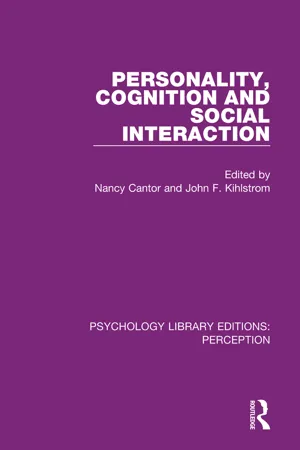 eBook - ePub
- Nancy Cantor, John F. Kihlstrom, Nancy Cantor, John F. Kihlstrom, John F Kihlstrom(Authors)
- 2017(Publication Date)
- Routledge(Publisher)
VI Discussion Passage contains an image
14 General Discussion of Issues: Relationships Between Cognitive Psychology and the Psychology of Personality
Sam Glucksberg Princeton UniversityWhat do cognition and personality have to do with one another? Historically, the study of cognition was a specialty within the field of personality psychology This is reflected in the composition of study sections within the National Institutes of Health, where experimental psychology and personality/cognition were, and still are, separate. It is also reflected in the people who are most closely identified with the study of cognition up to the 1950s, Gardner Murphy, Sylvan Tomkins, and Herman Witkin, among others.With the transition from neobehaviorism and verbal learning to information processing and cognitive psychology in the 1960s, modern cognitive psychology developed independently Of the personality and social-psychology movement. This volume reflects the completion of a cycle, wherein social psychology and personality again become integrally involved with cognition, but this time drawing from experimental cognitive psychology rather than leading the way.How has work in personality been informed by cognitive psychology? At the most trivial level, the two fields share a technical vocabulary or jargon. The terms that we use—schema, prototypes, scripts, frames—reflect a second commonality between the two fields, namely, a Zeitgeist that not only permits but encourages speculation about mental life and mental processes. Not unrelated to this is the attention, long overdue, that both fields now pay to such important figures as Jean Piaget, for his powerful conceptions of learning and conceptual development, and Frederick Bartlett, for a rich and useful conception of memorial processes.The chapters in this volume reflect the consensual view that perception, memory, and thinking are active, constructive processes that operate in similar ways across various domains. Perception and categorization of objects involve the same mental activities as do the perception and categorization of persons. Memory' for events, memory for persons, and memory for people's actions and characteristics share important structural and processing mechanisms. In short, we have learned—or at least we all seem to agree—that the way we deal with the world of physical objects shares important characteristics with the way we deal with persons and with ourselves. At the level of conceptual knowledge, common mental processes are used irrespective of the specific domains.
Index pages curate the most relevant extracts from our library of academic textbooks. They’ve been created using an in-house natural language model (NLM), each adding context and meaning to key research topics.

