Technology & Engineering

Mohr's Circle
Mohr's Circle is a graphical method used in engineering to represent the state of stress at a point in a material. It provides a visual representation of the normal and shear stresses acting on a material, allowing engineers to analyze and understand the stress conditions. By plotting these stresses on a circle, engineers can easily determine the principal stresses and maximum shear stress.
Written by Perlego with AI-assistance
Related key terms
1 of 5
6 Key excerpts on "Mohr's Circle"
 eBook - ePub
- K. L. Richards(Author)
- 2017(Publication Date)
- CRC Press(Publisher)
14Introduction to Analytical Stress Analysis and the Use of Mohr’s Circle
14.1 Introduction
Of all the graphical methods used by an engineer for visualizing problems, there is little doubt that Mohr’s circle is the best known; in its various applications it is an aid to visualizing a stress or strain problem.The object of this chapter is to explore with a reasonable thoroughness three important uses of Morh’s circle. These applications confront the engineer and designer in many branches of mechanical and structural engineering.In the development of the circle construction, it has been considered desirable to present a concise account of the underlying theory. It is possible for the reader more interested in applications to accept these results and go straight to those sections dealing with the constructions and applications.Nearly all textbooks, of necessity, deal with the circle in too cursory a manner and leave many detailed questions unanswered. It is hoped that this chapter devoted solely to the circle will answer more of these questions. In illustrating the text with examples of a practical nature, other topics of strength of materials will be quoted, the background of which can be found in the most strength of materials textbooks. eBook - PDF
- Keith L. Richards(Author)
- 2012(Publication Date)
- CRC Press(Publisher)
229 9 Introduction to Analytical Stress Analysis and the Use of the Mohr Circle 9.1 INTRODUCTION Of all the graphical methods used by an engineer there is little doubt that the Mohr circle is the best known; in its various applications it is an aid to visualizing a stress or strain problem. The object of this chapter is to explore with a reasonable thoroughness three important uses of the circle. These applications confront the engineer and designer in many branches of mechanical and structural engineering. In the development of the circle construction it has been considered desirable to present a con-cise account of the underlying theory. It is possible for the reader more interested in applications to accept these results and go straight to those sections dealing with the constructions and applications. Nearly all textbooks, of necessity, deal with the circle in too cursory a manner and leave many detailed questions unanswered. It is hoped that this chapter devoted solely to the circle will answer more of these questions. In illustrating the text with examples of a practical nature other topics of strength of materials will be quoted, the background of which can be found in most strength of materials textbooks. 9.2 NOTATION A = Area a = Circle constant B = Breadth (of beam cross section) D = Depth (of beam section) E = Modulus of elasticity e = Strain (usually with suffix to indicate direction) F = Force h = Distance I = Second moment of area (with suffix of the type xx or cg) J = Polar moment (with suffix of the type xy) M = Moment (with suffix to indicate axis) n = Factor of safety O = Origin of graph P = Force, or pole point P 1,2 = Pole points R = Radius of circle, radius of curvature T = Torque (usually with suffix to indicate axis) y = Distance from neutral axis of a beam to a given point β = Angle γ = Poisson’s ratio, angle eBook - PDF
- George H. Davis, Stephen J. Reynolds, Charles F. Kluth(Authors)
- 2012(Publication Date)
- Wiley(Publisher)
(B) The Mohr stress circle solution. See text for explanation. STRESS 119 The angle between σ 1 and the normal (n) to the trace of this plane is 134 . The values of σ n and σ s for this plane are found by constructing on the Mohr dia- gram a radius of 2θ = 168 , this time measured counterclockwise from the x- axis (Figure 3.37B). The (x,y) coordinates of the point of intersection of this radius with the perimeter of the circle are σ n = 133.7 MPa and σ s = 19.3 MPa (left-handed shear). The anatomy of the Mohr diagram is revealing (Figure 3.38). The center of the Mohr stress circle is a point that represents the mean stress, that is, 1 / 2 (σ 1 1 σ 3 ). This is the hydrostatic component of the principal stresses, and it tends to produce dilation. The radius of the circle represents the deviatoric stress, that is, 1 / 2 (σ 1 σ 3 ). The deviatoric stress is the nonhydrostatic com- ponent, and it tends to produce distortion. The diameter of the circle is called the differential stress, that is, σ 1 σ 3 . The greater it is, the greater the potential for distortion. DETERMINING RELATIONSHIPS BETWEEN STRESS AND STRAIN Objectives and Hurdles Dynamic analysis goes beyond force, traction, and stress. Of ultimate interest is a specific knowledge of the relationships between stress and strain. This is the subject of rheology, the study of the response of rocks to stress (Engelder and Marshak, 1988). We want to know, in the most precise language possible, how a rock of a given lithology responds when it is subjected to forces, tractions, and stresses under different sets of conditions of temperature, confining pressure, pore fluid pressure, rate of loading, and the like. It would be ideal if we could predict the amount of strain any rock body would be forced to accommodate in the presence of any known stress under any given set of geologically reasonable conditions. eBook - PDF
Strain Patterns in Rocks
A Selection of Papers Presented at the International Workshop, Rennes, 13-14 May 1982
- P. R. Cobbold, W. M. Schwerdtner(Authors)
- 2015(Publication Date)
- Pergamon(Publisher)
A line is drawn between these points and a circle is drawn about the fine as diameter. The circle has its center at (a, b) and diameter D, where INTRODUCTION M O H R circles centered on the horizontal axis of Mohr diagrams have been used for many years to provide a geometric representation of symmetric second-order tensor quantities, like the state of stress at a point or the state of strain. Recently Robin (1977), De Paor (1979) and Lister & Williams (1983) have employed Mohr circles that are not centered on the horizontal axis of Mohr diagrams, to represent asymmetric second-order tensors, and De Paor (this issue) has found an antique example of the idea in the work of De La Hire (1685). The aims of this paper are to show why Mohr circles provide vaHd representations of any second-order ten-sor, symmetric or asymmetric, and to explore some applications that arise in the study of bodies that have been inhomogeneously deformed. The discussion is (T22J12) (T11.-T21) T11 T12 2 2 • .T21T22. 1 1 Tij = Fig. 1. Mohr circle for an asymmetric second-order tensor Τ with components as given, (a, b) are the coordinates of the center of the circle and D is its diameter. 279 280 W. D. M E A N S 2a = Γπ + 2b = Tn -(2) (3) (4) (T22J12) This circle turns out to be a Mohr circle representing the tensor T. Before demonstrating this we underscore two steps in the construction. We reverse the sign of Γ21 before treating it as a coordinate value in Mohr space, and we use pairs of values in columns of matrix (1) to locate each point in Mohr space. The sign change will be familiar to those used to the difference between tensor and Mohr circle sign conventions for stresses or strains. Either Τ 12 or Γ21 can be changed. The resulting two Mohr circles are mirror images of each other across the horizontal axis.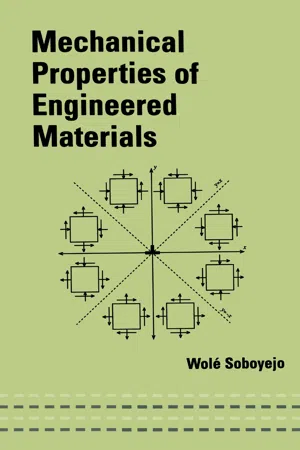
- Wole Soboyejo(Author)
- 2002(Publication Date)
- CRC Press(Publisher)
Note that the locus of the circle describes all the possible states of stress on the element at the point, P, for various values of 0 between 0° and 180°. It is also important to note that several combinations of the stress components (crxx, a yy, zxy) may result in yielding, as the plane angle, 0, is varied. These combinations will be discussed in Chap. 5. When a generalized state of triaxial stress occurs, three M ohr’s circles [Fig. 3.8(a)] may be drawn to describe all the possible states of stress. These circles can be constructed easily once the principal stresses, cr1? o 2 > eBook - PDF
- Robert C. Juvinall, Kurt M. Marshek(Authors)
- 2019(Publication Date)
- Wiley(Publisher)
The circle provides a convenient graphical solution for the magnitude and orientation of principal stresses 1 and 2 . These stresses are shown on a principal element at point A, drawn in Figure 4.28. Note that the #1 principal plane is located by starting with the x plane and rotating counterclockwise half of the 56 ∘ measured on the circle, and so on. y y x A x τ yx = 30.6 ksi τ yx τ xy σ x = 40.8 ksi Direct view of element A y (0, +30.6) x (40.8, –30.6) τ max = 37 ksi σ 2 = –17 ksi +τ +σ τ xy 34° 56° 0 σ 1 = 57 ksi FIGURE 4.27 Mohr circle representation at point A of Figure 4.25. 4.10 Stress Equations Related to Mohr’s Circle 99 y y x A σ 1 = 57 ksi σ 2 = –17 ksi 28° x FIGURE 4.28 Principal element at A (direct view) shown in relation to x and y faces. y y x A σ = 20 ksi τ = +37 ksi τ = –37 ksi σ = 20 ksi 17° x FIGURE 4.29 Maximum shear element at A (direct view) shown in relation to x and y faces. 6. Figure 4.28 shows the magnitude and orientation of the highest normal stresses. It may also be of interest to represent similarly the highest shear stresses. This is done in Figure 4.29. Observe again the rules of a. rotating in the same direction on the element and the circle, and b. using angles on the circle that are twice those on the element. Comment: In support of neglecting the transverse shear stress in step 1, it is of interest to note that its maximum value at the neutral bending axis of the 1-in.-diameter shaft is 4V ∕3A = (4)(2000 lb)∕ [(3)()(1 in.) 2 ∕4] = 3.4 ksi 4.10 Stress Equations Related to Mohr’s Circle The derivation of the analytical expressions relating normal and shear stresses to the angle of the cutting plane is given in elementary texts on strength of materials and need not be repeated here.
Index pages curate the most relevant extracts from our library of academic textbooks. They’ve been created using an in-house natural language model (NLM), each adding context and meaning to key research topics.

