Technology & Engineering

Organizational Strategy Engineering
Organizational Strategy Engineering is a process that involves designing and implementing strategies to achieve organizational goals. It involves analyzing the current state of the organization, identifying areas for improvement, and developing a plan to achieve desired outcomes. This approach helps organizations to align their resources and capabilities with their strategic objectives.
Written by Perlego with AI-assistance
Related key terms
1 of 5

3 Key excerpts on "Organizational Strategy Engineering"
 eBook - ePub
- Thomas J. Day(Author)
- 2022(Publication Date)
- CRC Press(Publisher)
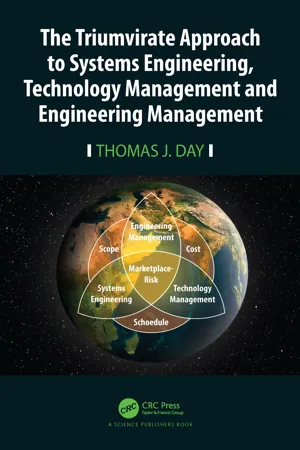
CHAPTER 4 The Technology Strategy ProcessA good execution of any technology undertaking cannot take place without a good technology strategy. The better the strategy, the better the execution will be, the more likely innovation will remain focused and the greater the likelihood success will be the result of the activity. In order to develop a good strategy in technology development, specific considerations must be accommodated unique to this class of projects. The pressures of corporate stockholders, limited resources and other competitive challenges requires that extraordinary means must be taken to ensure prime technology development. By combining the Systems Engineering approach with the reporting function of Project Management, those specific concerns can be addressed to a successful end result.The Technology Strategy
Once a clear vision is generated on how the technology is to be implemented and how it should operate and behave, then a set of requirements can be defined to build and develop the technology use. The next step is to have a strategy to reach the endpoint desired through the development of a plan. Figure 4.1 broadly outlines these areas of development for this stage in the technology activity.Figure 4.1: Defining technology development parametersThe standard Project Management approach would be to develop scope, budget risk and project plan. What is generally not discussed is how such things are created. There are some methodologies included in the various project management training certifications, but few go into depth on how such approaches are to be built, used and analyzed.The three areas in Systems Engineering that need to be considered and addressed at this stage of technology development are:- Analysis of Alternatives (A0A) – Where the best solution is chosen from a short list of identified alternatives. Alternatives are classified by the project management as best practice of cost/scope/time to develop and best solution to the problem or desired goal using the Systems Engineering approach of fit, form and function79
 eBook - ePub
- Benjamin S. Blanchard, John E. Blyler(Authors)
- 2016(Publication Date)
- Wiley(Publisher)
Chapter 7 Organization for System Engineering The initial planning for system engineering commences during the early stages of conceptual design and evolves through the development of the System Engineering Management Plan (SEMP) described in Chapter 6. To implement this plan successfully requires an organizational structure that will promote, support, and generally enhance the application of system engineering principles and concepts. The proper organizational environment must be created that will allow for the accomplishment of system engineering requirements in an effective and efficient manner—that is, the implementation of a top-down, life-cycle-oriented, integrated approach in system design and development. In addition, the organization must be dynamic in response to the many changes that are taking place worldwide. Figure 6.1 (Chapter 6) shows two sides of the spectrum: the technology issues that can be applied to enhance and facilitate the implementation of the system engineering process and the management issues that are necessary to meet the objectives in this area. Inherent in this overall spectrum is the organizational element. Organization is the combining of resources in such a manner as to fulfill a certain need. Organizations constitute groups of individuals of varying levels of expertise, combined in a social structure of some form to accomplish one or more functions. Organizational structures vary with the functions to be performed, and the results will depend on the established goals and objectives, the resources available, the communications and working relationships between the individual participants, the motivation of personnel, and many other factors eBook - ePub
Supply Chain as Strategic Asset
The Key to Reaching Business Goals
- Vivek Sehgal(Author)
- 2010(Publication Date)
- Wiley(Publisher)
For a successful alignment of technology strategy with the functional and business strategies, another important aspect to consider is the organizational structure and the interplay of the three groups in the firm. While a well-articulated technology strategy is definitely helpful in identifying the impact of changes to the technology landscape, the firm's ability to utilize this assessment is limited by its organizational constraints. It is not unusual for companies to have enterprise architecture teams who have the ability to establish and provide such direction, but who do not participate in the decision-making process or have any avenue by which to make any meaningful contributions toward ensuring that the technology strategy stays aligned with the functional and business strategies.Technology Strategy and Organization
Based on the arguments presented so far, it would follow that for optimal organizational performance, the technology strategy must evolve from the business capabilities required by the firm and, correspondingly, the business solution decisions must be made taking the existing technology strategy into account. However logical this may seem, this does not happen very frequently in real-life corporations. For most companies, it is a struggle to keep the two aligned, much less in a position to leverage each other. The two decisions are made almost in complete isolation from each other and the culprit almost always is a broken organizational structure.Typically, the business and technology groups are separate organizations with different objectives and leadership. The business organizations generally have a small group of specialists focused on assessing the business requirements and the gaps in the current functional capabilities to decide what capabilities should the firm build. Based on these gaps, business teams move into the next phase of evaluating the solutions and vendors who would be the potential suppliers of technology to build these enhanced capabilities. Technology teams generally have no active part to play in this process, until after most of the decisions have been made, the solution has been selected, and the fate of the technology required to support that solution has been sealed. While the technology teams may have a strategic road map for the evolution of technology to support a business, these road maps have almost no significant impact on the business team's decisions, due to the broken organizational process that prevents the teams from working together as partners.
Index pages curate the most relevant extracts from our library of academic textbooks. They’ve been created using an in-house natural language model (NLM), each adding context and meaning to key research topics.
