Technology & Engineering

Superconductors
Superconductors are materials that can conduct electricity with zero resistance when cooled below a certain critical temperature. This property allows superconductors to carry large electric currents without energy loss, making them valuable for applications such as MRI machines, particle accelerators, and power transmission lines. The development of high-temperature superconductors has expanded their potential for widespread technological use.
Written by Perlego with AI-assistance
Related key terms
1 of 5
12 Key excerpts on "Superconductors"
 No longer available |Learn more
- (Author)
- 2014(Publication Date)
- White Word Publications(Publisher)
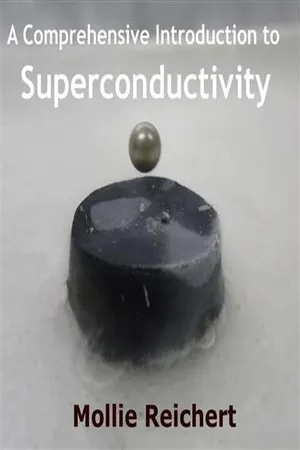
________________________ WORLD TECHNOLOGIES ________________________ Chapter 1 Superconductivity A magnet levitating above a high-temperature superconductor, cooled with liquid nitrogen. Persistent electric current flows on the surface of the superconductor, acting to exclude the magnetic field of the magnet (the Faraday's law of induction). This current effectively forms an electromagnet that repels the magnet. ________________________ WORLD TECHNOLOGIES ________________________ A high-temperature superconductor levitating above a magnet Superconductivity is an electrical resistance of exactly zero which occurs in certain materials below a characteristic temperature. It was discovered by Heike Kamerlingh Onnes on April 8, 1911 in Leiden. Like ferromagnetism and atomic spectral lines, superconductivity is a quantum mechanical phenomenon. It is also characterized by a phenomenon called the Meissner effect, the ejection of any sufficiently weak magnetic field from the interior of the superconductor as it transitions into the superconducting state. The occurrence of the Meissner effect indicates that superconductivity cannot be understood simply as the idealization of perfect conductivity in classical physics. The electrical resistivity of a metallic conductor decreases gradually as the temperature is lowered. However, in ordinary conductors such as copper and silver, this decrease is limited by impurities and other defects. Even near absolute zero, a real sample of copper shows some resistance. Despite these imperfections, in a superconductor the resistance drops abruptly to zero when the material is cooled below its critical temperature. An electric current flowing in a loop of superconducting wire can persist indefinitely with no power source. In 1986, it was discovered that some cuprate-perovskite ceramic materials have critical temperatures above 90 K (−183 °C). No longer available |Learn more
- (Author)
- 2014(Publication Date)
- The English Press(Publisher)
_______________________ WORLD TECHNOLOGIES ______________________ Chapter- 4 Superconductivity A magnet levitating above a high-temperature superconductor, cooled with liquid nitrogen. Persistent electric current flows on the surface of the superconductor, acting to exclude the magnetic field of the magnet (the Faraday's law of induction). This current effectively forms an electromagnet that repels the magnet. _______________________ WORLD TECHNOLOGIES ______________________ A high-temperature superconductor levitating above a magnet Superconductivity is an electrical resistance of exactly zero which occurs in certain materials below a characteristic temperature. It was discovered by Heike Kamerlingh Onnes in 1911. Like ferromagnetism and atomic spectral lines, superconductivity is a quantum mechanical phenomenon. It is also characterized by a phenomenon called the Meissner effect, the ejection of any sufficiently weak magnetic field from the interior of the superconductor as it transitions into the superconducting state. The occurrence of the Meissner effect indicates that superconductivity cannot be understood simply as the idealization of perfect conductivity in classical physics. The electrical resistivity of a metallic conductor decreases gradually as the temperature is lowered. However, in ordinary conductors such as copper and silver, this decrease is limited by impurities and other defects. Even near absolute zero, a real sample of copper shows some resistance. Despite these imperfections, in a superconductor the resistance drops abruptly to zero when the material is cooled below its critical temperature. An electric current flowing in a loop of superconducting wire can persist indefinitely with no power source. In 1986, it was discovered that some cuprate-perovskite ceramic materials have critical temperatures above 90 K (−183 °C). eBook - PDF
- Patrick M. Woodward, Pavel Karen, John S. O. Evans, Thomas Vogt(Authors)
- 2021(Publication Date)
- Cambridge University Press(Publisher)
12 Superconductivity Superconductivity is the phenomenon whereby a significant number of elements and many compounds can conduct electricity with zero resistance below a critical temperature, T c , field, H c and current, J c . There are many technological applications for materials with this remarkable property and therefore a large global research and development effort in the area; around 7000 original research articles are published on superconductivity every year. In this chapter, we will look at the history of superconductivity and its physical origins in so-called BCS or conventional systems. We’ll then focus on the solid state chemistry of five distinct families of superconducting materials: A 3 C 60 alkali-metal intercalates, molecular Superconductors, Ba(Pb,Bi)O 3 perovskites, the cuprate- or “high-T c ” Superconductors, and the LaOFeAs-related “iron” Superconductors. These families will highlight several recurrent themes and show how chemistry is used to prepare and tune superconducting materials. 12.1 Overview of Superconductivity The discovery of superconductivity is a wonderful example of how “blue skies” research can lead to completely unexpected discoveries. In 1908, Heike Kamerlingh Onnes, a Dutch physicist working at the University of Leiden in the Netherlands, succeeded in liquefying helium. Access to liquid He, which boils at 4.22 K, allowed him to perform physical measurements on materials at much lower temperatures than previously possible. At that time, little was known about what would happen to the electrical resistance (R) of metals at very low temperatures. eBook - PDF
- H.P. Myers(Author)
- 1997(Publication Date)
- CRC Press(Publisher)
13 Superconductivity It has been established beyond doubt that certain substances, when cooled below a critical temperature T c , completely lose all trace of electrical resistance in static electric fields: such materials are called Superconductors. In a ring of superconducting material, induced currents persist for times as long as one has the patience to make measurements; the time constant of any decay of the current, which is controlled by L/R, where L is the inductance and R the resistance of the ring, is so large (of order 10 5 years) that we are justified in assuming that the resistance is truly zero. First discovered in 1911 in the metal mercury, we now know that under ordinary conditions of equilibrium, which is to say the ordered crystalline state and normal pressure, some 28 pure metals are Superconductors, and other elements become superconducting under particular circumstances of high pressure (e.g. Ge) or structural disorder (e.g. Bi) (Fig. 13.1). For convenience, we shall use the letters N and S to denote the normal resistive and the superconducting states respectively. The N-S transition is, in pure strain-free single crystals, extremely sharp, occurring over 10 −4 K in some cases (Fig. 13.2). The critical temperature T c that marks the onset of superconductivity in different pure metals ranges from near 0 to 9.2 K (Nb). Some 1000 intermetallic compounds and alloys become superconducting; certain of them have transition temperatures above 20 K and are used to produce powerful electromagnets. In 1986 a new class of superconducting material was discovered. These are mixed oxides of the form La 2−x A x CuO 4; A being an alkaline earth metal (originally Ba or Sr). Transition temperatures up to 125 K have been mea- sured (Table 13.1), and the associated critical magnetic fields are larger than hitherto observed. This discovery is promoting ever increasing activity in the development of such materials for new technical applications. eBook - PDF
- G Libowitz(Author)
- 2012(Publication Date)
- Academic Press(Publisher)
Materials Science in Energy Technology Chapter 10 Superconducting Materials for Energy Related Applications* T. H. GEBALLE DEPARTMENTS OF APPLIED PHYSICS AND MATERIALS SCIENCE STANFORD UNIVERSITY STANFORD, CALIFORNIA AND BELL LABORATORIES MURRAY HILL, NEW JERSEY M . R. BE AS LEY DEPARTMENTS OF APPLIED PHYSICS AND ELECTRICAL ENGINEERING STANFORD UNIVERSITY STANFORD, CALIFORNIA I. Introduction 492 II. The electrical and magnetic properties of Superconductors 495 A. Type-I and type-II Superconductors 496 B. The Ginzburg-Landau theory and the characteristic lengths of superconductivity 500 C. The structure of the vortices and the critical fields of type-II Superconductors 503 D. Surface effects 505 E. Vortex pinning and the critical state 506 F. Instabilities and ac losses 508 * Written under the support of the National Science Foundation, the U.S. Energy Research and Development Administration, and the Institute for Energy Studies at Stanford University. 491 Copyright © 1979 by Academic Press, Inc. All rights of reproduction in any form reserved. ISBN 0-12-447550-7. 492 T. H. Geballe and M. R. Beasley III. Occurrence and properties of important and potentially important Superconductors 511 A. Ductile alloys 514 B. A15 compounds 520 C. Other high temperature and potentially important Superconductors 534 IV. The state of the art 537 A. Composites for high field use 537 B. Superconducting power lines 542 References 547 I. I N T R O D U C T I O N Superconductors embrace a remarkable set of electric and magnetic prop-erties, the most startling being a total lack of dc resistance. Transitions into the superconducting state occur at a temperature T c , which may be from less than 0.01°K to a present-day high of 23°K. The potential of superconduc-tivity for important technological applications has tantalized scientists since the discovery of superconductivity in frozen mercury by Kamerlingh Onnes in 1911.
- Tariq Altalhi, Sayed Mohammed Adnan(Authors)
- 2023(Publication Date)
- Wiley-Scrivener(Publisher)
Depending upon the critical magnetic field, superconducting materials are of two types; type-I Superconductors [2] exhibit a single critical magnetic field and undergo an abrupt change [51] from superconducting to a normal state. These are often called soft Superconductors and include pure metals [8, 9]. In con- trast, type-II Superconductors possess normal superconducting regions that co-occur with two critical magnetic fields. This is attributable to the greater value of the magnetic penetration depth than the coherence length [96] defined as the average electron pair size [10]. Due to possession of the superconducting condensation energy as well as beneficial magnetic field penetration, type-II Superconductors have an upper edge over type-I Superconductors. Usually, high-temperature Superconductors belong to this class. The choice of superconducting material has been limited to com- pounds having Tc lower than 110 K due to difficulty arising because of synthetic procedures [8, 9]. 5.1.2 Superconducting Properties Superconducting materials epitomize the trailblazing prospect for the advancements in electric power generation and energy storage applications such as magnetic energy storage and power transmission lines [7]. Usually, various superconducting materials are fashioned into wires because of the added advantages of improved efficiency and higher electric current density Superconductors for Energy Storage 97 with negligible resistance attributed to the decreased weight and size [11, 12]. These wires are characterized by some fundamental properties [13, 14].
- Wei Gao, Zhengwei Li;Nigel Sammes;;(Authors)
- 2011(Publication Date)
- WSPC(Publisher)
Some people refuse to predict the possible new systems. They argue that if people only follow so called “common sense” to develop Superconductors, we would never find the new high temperature superconducting oxides. They want to develop totally new systems with higher T c . However, there are so many possible chemical combinations and crystal structures. This type of searching will be very costly. Most people in superconductor area study the existing systems, trying to develop new processing methods or optimise old processing techniques, control the microstructures and improve their properties in an effort to put these materials into industrial applications. 10.2 Superconducting Properties and Measurements When a superconductor is cooled below a certain temperature, there is not only an abrupt loss of electrical resistance, many of the other physical properties including specific heat, thermoelectricity and thermal conductivity are also changed abruptly. Superconductivity and Superconducting Materials 301 10.2.1 DC resistivity When electrons flow through a metal conductor, their passage will be resisted by the vibrations and impurities of the lattice. Some kinetic energy of the electrons will lose and becomes heat. For a pure metal with a perfect crystal structure at 0 K, both residual and thermal resistivity should be zero. We called it “perfect conductor”. Superconductors can be alloys and compounds. They have zero resistance at temperatures much higher than 0 K. Therefore, they are not “perfect” conductors. Their electrical conduction mechanism is different. Fig. 10.1 Temperature dependence of various physical properties of a superconductor. (after D. Robins, “Introduction to Superconductivity”, IBC Tech. Serv. Ltd., 1989, p15). When a DC current is applied to a superconductor, there will still be a resistance if the temperature is higher than a certain temperature T c . eBook - PDF
- Vitaly Lazarevich Ginzburg, Eugene A Andryushin(Authors)
- 2004(Publication Date)
- World Scientific(Publisher)
A normal electron liquid possesses the same properties as electrons in a normal metal, while a superconduct- ing one flows without friction. Both liquids are thoroughly mixed; in each piece of a superconductor, there are electrons of both types. The number, or more precisely, the proportion of superconducting electrons, depends only on the temperature. When we cool a metal down to its critical temperature, superconducting electrons appear, while at absolute zero, all the electrons are superconducting. A superconductor through which a constant, current flows can be represented by acircuit diagram (see Fig. 11) with two parallel electric resistances, one of which vanishes under a superconducting transition. Zero resistance shunts the circuit and all the current runs through the “superconducting branch”. So, whatever the density of a supercon- ducting electron liquid, superconductivity does exist - we register zero resistance and cannot notice the “normal branch”. The higher the density of superconducting electrons is, the larger will be the superconducting current which can be conducted by the circuit, Su- perconducting electrons try to take on all the current, but note that at the same time they appear to be unable to conduct heat, i.e. to transfer energy from one end of the sample to the other. This is the task of the normal electrons (the “normal branch”). Fig. 11. A circuit diagram representing a superconductor. PHYSICS OF SUPERCONDUCTIVITY How a Superconducting Thansition pmceeds in a Magnetic Field 27 In describing the phase transition to a superconducting state, we said that it requires no energy expenditure since it represents only a mi- ation in the pattern of electron motion. This is, however, not the cme if the magnetic field is not equal to zero. If a sample is in a magnetic field, the transition requires energy expenditure to expel the magnetic field from the sample. eBook - PDF
- G R Jones(Author)
- 2013(Publication Date)
- Newnes(Publisher)
The phenomenon was first observed in mercury in 1911. Engineering interest in super-conductors became really significant in the early 1960s when materials capable of carrying high current densities (ca.l0 9 A/m 2 ) in high magnetic fields (several tesla) were discovered. These opened the way for high-field electro-magnets. The interest was reinforced by advances (partly spurred by superconductor development) in the technology of large-scale helium refrigeration (hundreds of watts cooling at 4 K) which could produce cold gaseous or liquid helium for cooling purposes. The discovery of the Josephson effect (1962) Table 11.2 Properties of some high-7 c Superconductors Material Critical temperature* (K) YBa 2 Cu 3 0 7 92 Bi 2 Sr 2 CaCu 2 0 8 86 (Bi, Pb) 2 Sr 2 Ca 2 O 3 O 10 106 Tl 2 Ba 2 Ca 2 Cu 3 O 10 122 Critical temperature depends on the exact cation and oxygen stoichiometry. tSintered untextured material. tThin film deposited on MgO or SrTi0 3 substrates—as indication of potential. led to small, low-field, superconducting electronic devices (see Section 11.2.5). Two groups of materials have superconducting properties. The 'classical' or low-T c Superconductors (LTS) are metals or alloys all of which show superconductivity below 23 K. Vir-tually all industrial applications use materials from this cat-egory, in particular, NbTi or Nb 3 Sn. The second group are metal oxide compounds based on copper oxide (-Cu0 2 -) subunits. These are known as ceramic or high-jf c supercon-ductors (HTS) and the compound with the highest known critical temperature (Tl 2 Ba 2 Ca 2 Cu 3 Oi 0 , T c 122 K) belongs to this group. Although certain metal oxides were known for many years to superconduct at a few degrees kelvin, they were only of academic interest until 1986 when a LaSrCuO compound was discovered which had a T c around 30 K, a full 7 K higher than the previously highest known critical temperature. eBook - PDF
- K Fossheim(Author)
- 1991(Publication Date)
- World Scientific(Publisher)
149 SUPERCONDUCTING WIRE AND CABLE TECHNOLOGY HELMUT KRAUTH Vacuumschmelze GmbH D-W 6450 Hanau, Germany ABSTRACT Technical Superconductors for the energy and magnet technology consist of composite wires of superconducting and normal conducting material. To stabilize the superconducting state the superconductor is subdivided into filaments imbedded in a low resistivity normal conducting matrix. At present, only the alloy NbTi and the intermetallic compound Nb 3 Sn are of technical importance and the matrix consists of Cu with low residual resistivity. The filament diameters are between few jim up to about 100 /am. Filament numbers are between 1 up to more than 100 000. Wire diameters are between 0.1 mm up to about 2 mm with current carrying capacities of few A up to more than 1000 A in fields up to about 20 T at 4.2 or 1.8 K. The fabrication includes bundling of the components into a billet and subseguent extrusion and drawing processes. Conductors with higher currents are produced in the form of fully transposed cables, with the option of introducing additional stabilizer material (Cu, Al), mechanical strengthening members and cooling channels. Wires of the ceramic High-T c -Superconductors are preferentially manufactured at present by the powder-in-tube method. The results of BiSrCaCuO/Ag wires and tapes indicate that the first high current applications may be in the area of very high fields (> 20 T) at 4.2 K, whereas applications at 77 K are much farer in the future. 1. General Design Considerations The primary characteristics in the design and fabrication of technical Superconductors may be broken down into three groups: - Properties of the superconducting material [1] • critical temperature T c • upper critical field B p2 • critical current density j c* eBook - PDF
Modern Materials
Advances in Development and Applications
- Bruce W. Gonser(Author)
- 2013(Publication Date)
- Academic Press(Publisher)
B. TRANSFORMERS (21) The application of novel techniques to tasks of engineering requires a clear understanding of the disadvantages accruing from existing tech-niques that can be improved upon. Superconductors 223 The conventional transformer has few disadvantages that can be sig-nificantly improved by the use of Superconductors. In the high power range, above 1 MVA the inefficiency is very low, seldom amounting to more than 1% of rated power. The use of type I Superconductors can, in theory at least, reduce these losses still further, although not to zero. It is doubtful, however, whether the net running cost of a superconducting power transformer would be less than that of a conventional unit. The other aspect of the power transformer which can be improved upon is its size. In view of its essentially passive function of transferring power between networks, it is extremely bulky. The use of supercon-ductors might conceivably solve some of the problems associated with size and weight. One other purpose in developing superconducting trans-formers is to produce a cryogenically efficient link between a conven-tional power network and a superconducting power transmission line. The property of Superconductors which is unique and which must be exploited is their ability to sustain high current densities. This may allow the construction of transformers having small cores and small winding volumes. The superconducting power transformer may, under suitable conditions, use either soft or hard Superconductors. Despite the generally discouraging prospects for superconductive power transformers, small units up to a few kilowatts have been con-structed. One important application for small transformers of up to 1-kw rating is in the flux pump ( see Section V.D ). eBook - PDF
Materials For Sustainable Energy: A Collection Of Peer-reviewed Research And Review Articles From Nature Publishing Group
A Collection of Peer-Reviewed Research and Review Articles from Nature Publishing Group
- David Swinbanks, Vincent Dusastre(Authors)
- 2010(Publication Date)
- WSPC(Publisher)
Broad and significant applications exist and await only the resolution of the vital materials issues that control development of the cheap, high-performance conductor-fabrication technology that underpins all superconducting applications. ■ 1. Berlincourt, T. G. Type-II superconductivity: quest for understanding. IEEE Trans. Magn. 23, 403–412 (1987). 2. Kunzler, J. E., Buehler, E., Hsu, L. & Wernick, J. Superconductivity in Nb 3 Sn at high current density in a magnetic field of 88 kgauss. Phys. Rev. Lett. 6, 89–91 (1961). 3. Gavaler, J. Superconductivity in Nb-Ge films above 22 K. Appl. Phys. Lett. 23, 480–482 (1973). 4. Bednorz, G. & Muller, K. A. Possible high-T c superconductivity in the Ba-La-Cu-O system. Z. Phys. B 64, 189–193 (1986). 5. Wu, M. K. et al. Superconductivity at 93 K in an new mixed-phase Y-Ba-Cu-O compound system at ambient pressure. Phys. Rev. Lett. 58, 908–912 (1987). 6. Schilling, A., Cantoni, M., Guo, J. D. & Ott, H. R. Superconductivity above 130 K in the Hg-Ba-Ca-Cu-O system. Nature 363, 56–58 (1993). 7. Larbalestier, D. C. et al. Power Applications of Superconductivity in Japan and Germany (World Technology and Engineering Center, Loyola College, MD, September 1997). 8. Nagamatsu, J., Nakagawa, N., Muranaka, T., Zenitani, Y. & Akimitsu, J. Superconductivity at 39 K in magnesium diboride. Nature 410, 63–64 (2001). 9. Wilson, M. Superconducting Magnets (Clarendon, Oxford, 1983). 10. Dew-Hughes, D. Physics and Materials Science of Vortex States, Flux Pinning and Dynamics NATO Science Ser. E, Vol. 356 (eds Kossowsky, R., Bose, S., Pan, V. & Durosoy, Z.) 705–730 (Kluwer Academic, Dordrecht, 1999). 11. Hassenzahl, W. V. Superconductivity, an enabling technology for 21st century power systems? IEEE Trans. Appl. Supercond. 11, 1447–1453 (2001). 12. Radebaugh, R. in Advances in Cryogenic Engineering Vol. 44 (eds Haruyama, T., Mitsui, T. & Yamafuji, K.) 33–44 (Elsevier Science, 1997).
Index pages curate the most relevant extracts from our library of academic textbooks. They’ve been created using an in-house natural language model (NLM), each adding context and meaning to key research topics.

