Technology & Engineering

Vibration Problem
Vibration problem refers to the unwanted oscillations or movements of a mechanical system that can cause damage, noise, and reduced performance. It can occur due to various factors such as unbalanced forces, misalignment, wear and tear, and resonance. Vibration analysis and control techniques are used to identify and mitigate vibration problems in machines and structures.
Written by Perlego with AI-assistance
Related key terms
1 of 5
4 Key excerpts on "Vibration Problem"
 eBook - PDF
Vibration
Fundamentals and Practice, Second Edition
- Clarence W. de Silva(Author)
- 2006(Publication Date)
- CRC Press(Publisher)
1 Vibration Engineering 1.1 Introduction Vibration is the repetitive, periodic, or oscillatory response of a mechanical system. The rate of vibration cycles is termed ‘‘frequency.’’ Repetitive motions that are without aberrations and are regular and occur at relatively low frequencies are commonly called ‘‘oscillations’’ whereas any repetitive motion, even at high frequencies, with low amplitudes and having irregular and random behavior falls into the general class of vibration. Nevertheless, the terms vibration and oscillation are often used interchange-ably, as is done in this book. Vibrations can occur naturally in an engineering systems and will be representative of their free and natural dynamic behavior. Vibrations also may be forced onto a system through some form of excitation. The excitation forces may be either generated internally within the dynamic system or imparted on the system through an external source. When the frequency of the forcing excitation coincides with that of the natural motion, the system will respond more vigorously with increased amplitude. This condition is known as ‘‘resonance,’’ and the associated frequency is called the ‘‘resonant frequency.’’ Vibrations can be ‘‘good’’ or ‘‘bad,’’ the former serving a useful purpose and the latter having unpleasant or harmful effects. For many engineering systems, operation at a resonance would be undesirable and could be destructive. It is important to study human’s responses to vibrations. Suppression or elimination of bad vibrations and generation of desired forms and levels of good vibration are the general goals of vibration engineering. This book deals with the analysis , observation , and modification of vibrations in engineer-ing systems. Applications of vibration are found in many branches of engineering such as aeronautics and aerospace, civil, manufacturing, mechanical, mechatronics, and even electrical and electronics. eBook - PDF
Vibrational Mechanics: Nonlinear Dynamic Effects, General Approach, Applications
Nonlinear Dynamic Effects, General Approach, Applications
- Iliya I Blekhman(Author)
- 2000(Publication Date)
- World Scientific(Publisher)
It is only since the beginning of this century that a period of a rapid development of vibrational technology has started. °By vibration we mean here mechanical oscillations whose period is much shorter than that at which the motion of the system is being considered, and whose swing is far smaller than the characteristic size of the system. 4 Chapter 1 Introduction Without that technology, a number of most important industries, such as min-ing, the processing of natural resources, chemical technology, metallurgy, the manufacture of building materials, and the erecting of various constructions would have been absolutely unthinkable. 6 The diversity of trends in using vibration is reflected in the titles of sec-tions of the book [114]: Vibration shifts, Vibration transforms (in Vibrorhe-ology), Vibration separates and classifies, Vibration intensifies the pro-cesses and the treatment of workpieces, Vibration consolidates - vibration destroys, Vibration unites (self-synchronization of unbalanced rotors), Vi-bration maintains rotation - vibration retards rotation, Vibration cancels vibration - vibration intensifies vibration (the generalized principle of auto-balancing), Vibration helps in measuring - vibration hinders measuring, Vibration cures - vibration causes diseases. The title of a popular book by Goncharevich is also remarkable: Vibration as a nonstandard way [209]. The use of vibration made it possible to literally revolutionize many indus-tries, providing a great technical and economical effect. Potentialities, however, have not yet been exhausted. The application of vibrational technology seems to be most promising in the future. Apart from the book [114], there is an extensive literature in Russian (mono-graphs and reference books) devoted to general and special problems of the use of vibration in technology (see, e.g., [46, 84, 145, 192, 207, 208, 209, 215, 226, 259, 301, 302, 306, 315, 323, 364, 400, 402, 420, 417, 440, 443, 445, 454, 475, 550, 159, 227]).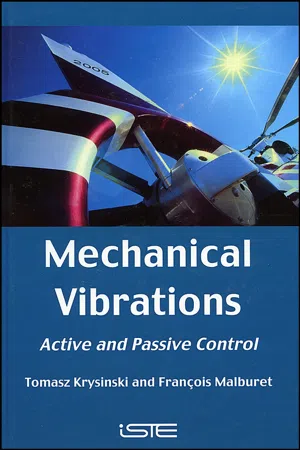 eBook - PDF
Mechanical Vibrations
Active and Passive Control
- Tomasz Krysinski, François Malburet(Authors)
- 2010(Publication Date)
- Wiley-ISTE(Publisher)
xxii Mechanical Vibrations sufficiently important to cause destruction. When mechanical systems are exposed to increasing oscillations, they are referred to as unstable. Hence, it is important to study the stability of mechanical systems. The utilization field of modern mechanical systems is one in which the necessary stability margins are not enough and therefore active controls are needed. Among industrial examples, the helicopter represents one of the most complex systems in terms of sources of vibrations. This fact is the consequence of its architecture and operating mode. This system comprises many swiveling systems with very different speeds of rotation, hence the problems related to unbalance, connections, rotors, aerodynamic excitations, etc. On this type of structure, the excitations stresses are relatively important in relation to the mass of the structure (fuselage). Aeronautical structures are light and therefore flexible. Natural frequencies can be close to excitation frequencies, which may entail problems of vibration comfort and alternate constraints in the mechanical parts. The problems of dynamic optimization of the rotor and structure are very important. This optimization may require the introduction of insulating elements, such as suspensions, anti-vibrators or vibration control systems for the blades. These systems can be passive, self-adaptive or active. Some examples will be developed here. The authors wish to thank: – Eurocopter for being kind enough to allow them to use in this book the knowledge, experience and know-how developed by its employees, – the management of l’Ecole nationale superieure d’arts et metiers and la Societe d’etudes et recherches de l’Ecole nationale superieure d’arts et metiers for their help, – the teachers and students of l’Ecole nationale superieure d’arts et metiers of Aix-en-Provence, who were able to take part in some of these studies. PART I Sources of Vibrations This page intentionally left blank eBook - PDF
Advances in Machine Tool Design and Research 1969
Proceedings of the 10th International M.T.D.R. Conference, University of Manchester Institute of Science and Technology, September 1969
- S. A. Tobias, F. Koenigsberger(Authors)
- 2015(Publication Date)
- Pergamon(Publisher)
Depending on the location, direction, amplitude, and frequency of these disturbing forces, vibrations are generated between tool and workpiece which may render the workpiece wholly unserviceable. Just as frequent are the difficulties caused by self-excited vibrations. These are due to instability in servo-systems—for example, slide travel control, slip-stick effects on sliding motions, where friction is a function of speed, and regenerative chatter in the cutting pro-cess. These vibrations may equally impair machining operations, resulting in rejects and, at high amplitudes, damage to tools and machine. Often their frequency is the only clue to the cause of the fault. This can be determined 382 K. CORBACH by measuring the vibration pattern on the component surface or by fairly simple measure-ments with a vibration pick-up. Where the interference vibration is identical with the re-volving frequency of a shaft, drive belt and the like or with a natural frequency of the machine, the source of the trouble is quickly located. This will mainly be the case where critical frequencies have already been established by investigations on a design prototype. In some cases, however, more extensive measurements will be necessary to clarify the cause of a disturbing vibration. This applies, for example, to the measuring of the ampli-tude distribution over machine and workpiece, comparative phase measurements and measurements of dynamic compliance at various machine components. Where the vibration characteristics and modes of a machine are not yet known, they may have to be determined during the hunt for the fault. An adequate knowledge of dynamic machine properties is invaluable, not only in order to find the fault, but also to decide on suitable means to cure it. (4) In many cases, eliminating the disturbance is as simple as tracing its source: balancing a shaft, replacing a defective gear, belt, bearing, etc. But in others, curing the trouble may pose serious difficulties.
Index pages curate the most relevant extracts from our library of academic textbooks. They’ve been created using an in-house natural language model (NLM), each adding context and meaning to key research topics.

