Postumanesimo, transumanesimo, antropologia
Giuseppe Mari
Riccardo Campa
Markus Lipowicz
Umanesimo, postumanesimo, educazione
Calogero Caltagirone
Cosimo Costa
Juan Luis Fuentes
Juan García-Gutiérrez
Marisa Musaio
Maria Grazia Riva
Giuseppe Savagnone
Pierpaolo Triani
Icone dell’umanesimo pedagogico
José María Barrio Maestre
Carlo Fedeli
Giuseppe Spadafora
Rassegna bibliografica
Monica Crotti
eBook - ePub
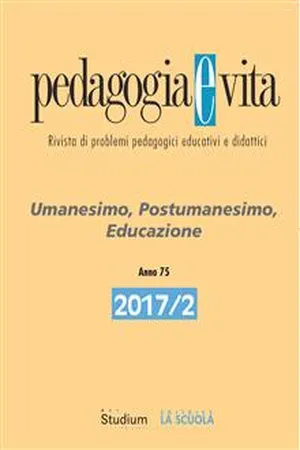
Pedagogia e Vita 2017/2
Umanesimo, Postumanesimo, Educazione
- Italian
- ePUB (disponibile su mobile)
- Disponibile su iOS e Android
eBook - ePub
Pedagogia e Vita 2017/2
Umanesimo, Postumanesimo, Educazione
Informazioni su questo libro
Informazioni
Argomento
EducationCategoria
Education GeneralMarkus Lipowicz
“Playing God” as an Educational Ideal? On the Anti-Christian Foundation of Transhumanism
1. The (post)religious dimension of transhumanism
In general, the secular character of transhumanism – with few exceptions such as, for instance, the Mormon Transhumanist Association – seems to be beyond question: «Transhumanists are generally opposed to the idea of the existence of supernatural forces and regard faith as a narrative of pre-enlightenment» [1] . With reference to a survey conducted in 2007, James Hughes – executive director of the Institute for Ethics and Emerging Technologies ( IEET) – notes that most members of the World Transhumanist Association (since 2008 renamed into Humanity+) confirm that they are atheists or agnostics [2] . Max More, founder of the Extropy Institute, boldly proclaims: «No more gods, no more faith, no more timid holding back. Let us blast out of our old forms, our ignorance, our weakness, and our mortality. The future is ours» [3] . Although not all founders, supporters and followers of transhumanism necessarily endorse such anti-theistic rhetoric, it is quite clear that, as Michael LaTorra puts it, the majority of «transhumanists are atheists or agnostics who tend to reject spiritual practices because of historical linkages with religion» [4] . Also Mike Treder, former managing director of the IEET, states clearly:
Nearly all technoprogressives endorse secularism without hesitation. Most of us are atheists or agnostics and some are believers, but we are unanimous in supporting the need to keep faith apart from governance. That is a central tenet of both progressive and technoprogressive philosophy [5] .
At the same time Steven Goldberg, a Law Professor of Georgetown University, suggests that a closer look at the basic assumptions of transhumanism evoke some legitimate doubts as to whether techno-progressive philosophy does not imply «much more» than a scientifically grounded futurology [6] . Goldberg suggests that a fully developed, self-reflective transhumanist movement should not only cease to resist, but fully embrace the possibility of becoming the ambassador of a new, ultimate “truth” that would compete «with Christianity and other faiths» [7] . What is the “truth” of transhumanism?
Although the «gods», as John G. Messerly indicates, do not play any essential role in the techno-progressive narratives, it is important to stress that the ultimate goal of transhumanists, i.e. the overcoming of suffering and death, can be regarded as an offshoot of the religious notion concerning eternal life [8] . Therefore, from a transhumanist perspective, the main difference between the techno-progressive and the religious mindsets would be rooted in the historical circumstance that the desire to live forever has preceded its technical feasibility and therefore had to be located in the realm of transcendental hopes, fantasies and illusions [9] . If so, than – as Messerly indicates – one «might think of religion as premature transhumanism. Religion is not the opposite of transhumanism but a seed from which transhumanism can grow» [10] . Ray Kurzweil, undeniably one of the most prominent transhumanists of our days, states clearly that transhumanism delivers «new perspectives on the issues that traditional religions have attempted to address: the nature of mortality and immortality, the purpose of our lives, and intelligence in the universe» [11] . In other words: according to the techno-progressive point of view, transhumanism might be the ultimate way to gradually realize religious anticipations, which would then eventually make religion itself expendable. Although Treder does not confirm these assumptions directly, he also doesn’t deny the possibility of transhumanism becoming a spiritual and ethical alternative to traditional religious beliefs [12] .
This vision of transhumanism becoming a post-religion extirpating or, at least, fundamentally altering former religious beliefs and their accompanying ethical systems, carries some very problematic and multi-layered implications. One of them would be that the establishment of a post-religious “truth” that could bring about the necessity of changing the Constitution and, in the long run, eventually undermine the secular principle of dividing state and religion [13] . This in turn would cause serious consequences for the techno-progressive movement, since the «turning over control of global governance to a greater-than-human intelligence» would certainly pose a threat to the secular principles of the modern society [14] . Indeed, the rise of a over-human, godlike, super-intelligent artificial power would not only potentially pose a threat to the political and cultural principles of modern societies, but it might entangle us in a plurality of existential risk factors [15] . However, these will not be discussed in this short contribution but rather I would like to focus on the spiritual aspect of transhumanism, highlighting the issues which are directly linked to the pedagogical problem of religious formation.
In reference to Bogusław Milerski, I would like to stress that there cannot be one universal definition of religious education [16] . However, despite the plurality of both pedagogical paradigms and theological ideas, we may still argue that there seems to be some kind of fundamental consensus on the most basic characteristics of contemporary religious teaching. These, as Milerski points out, rely on the telos of education to support the individual on its way of developing «humanity» and «religious maturity» [17] . In other words: religious education aims at a “renewal of life” through various activities aimed at helping the individual to obtain full maturity on a emotional, cognitive and social level – all realized within the horizon of values, traditions and contemporary practice of the particular religious confession [18] . In that sense religious education should not be conceptualized as ideological indoctrination, but rather as a spiritual aid to develop one’s own subjectivity and personhood [19] . This is what makes religious education a significant part of education in general and simultaneously distinguishes it from the current tendencies to divide and reduce the educational process into rather narrow, yet highly specialized forms of transferring information. It is therefore very important to stress that religious education holds the very traditional position according to which humanity should not be reduced to a certain amount of expertise and technical abilities.
Contemporary educational programs and future scenarios – like, for instance, the McKinsey Report from 2013 – seem to ignore the fact that in a technologically and economically highly developed society the foundation of human life might require the enhancement of social values, fine arts and humanities by far more than specialized individual skills [20] . Economically conditioned specialization, although important and probably unavoidable, should not lead to an attitude of indifference towards the general, fundamental questions concerning human existence and life in general. Taking this position makes religious education seem to be one of the last institutional bulwarks that opposes the reductive tendencies of today’s educational systems and emphasizes the basic human desire to obtain not only knowledge but wisdom. By “wisdom” as a pedagogical telos I mean the human desire to address fundamental existential questions concerning the issue of a “good human life”. Reassuming the (post)religious, however anti-Christian dimension of transhumanism, we may risk the hypothesis that in the near future transhumanism and Christianity might, in one way or the other, compete for the leading role with regard to (post)religious education. No matter on which side we are standing or with whom we tend to sympathize in this rivalry – we most definitely have to agree with the conclusion of Treder that the main task for today is «thinking seriously a...
Indice dei contenuti
- Copertina
- Pedagogia e Vita 2/2017
- Abstracts
- Editoriale
- Postumanesimo, transumanesimo e antropologia
- Giuseppe Mari
- Riccardo Campa
- Markus Lipowicz
- Umanesimo, postumanesimo, educazione
- Calogero Caltagirone
- Cosimo Costa
- Juan Luis Fuentes
- Juan García-Gutiérrez
- Marisa Musaio
- Maria Grazia Riva
- Giuseppe Savagnone
- Pierpaolo Triani
- José María Barrio Maestre
- Carlo M. Fedeli
- Giuseppe Spadafora
- Rassegna bibliografica
- Monica Crotti
- Sommario
Scelto da 375,005 studenti
Accesso a oltre 1,5 milioni di titoli a un prezzo mensile trasparente.
Studia in modo più efficiente con i nostri strumenti dedicati.
Domande frequenti
Sì, puoi annullare l'abbonamento in qualsiasi momento dalla sezione Abbonamento nelle impostazioni del tuo account sul sito web di Perlego. L'abbonamento rimarrà attivo fino alla fine del periodo di fatturazione in corso. Scopri come annullare l'abbonamento
No, i libri non possono essere scaricati come file esterni, ad esempio in formato PDF, per essere utilizzati al di fuori di Perlego. Tuttavia, puoi scaricarli nell'app Perlego per leggerli offline su smartphone o tablet. Scopri come scaricare libri offline
Perlego offre due piani: Essential e Complete
- Essential è l'ideale per chi studia o per i professionisti che amano esplorare una vasta gamma di argomenti. Accedi all'Essential Library con oltre 800.000 titoli affidabili e bestseller nei settori business, crescita personale e discipline umanistiche. Include tempo di lettura illimitato e voce standard per la funzione Leggi ad alta voce.
- Complete: perfetto per studenti avanzati e ricercatori che necessitano di accesso completo e senza restrizioni. Sblocca oltre 1,5 milioni di libri su centinaia di argomenti, inclusi titoli accademici e specialistici. Il piano Complete offre anche funzionalità avanzate come Leggi ad alta voce Premium e Assistente alla ricerca.
Perlego è un servizio di abbonamento a libri di testo online che ti permette di accedere a un'intera biblioteca digitale a meno del prezzo di un singolo libro al mese. Con oltre 1,5 milioni di libri su più di 990 argomenti, qui trovi tutto ciò che ti serve! Scopri la nostra missione
Cerca l'icona Sintesi vocale nel prossimo libro che leggerai per verificare se è possibile riprodurre l'audio. Questo strumento permette di leggere il testo a voce alta, evidenziandolo man mano che la lettura procede. Puoi aumentare o diminuire la velocità della sintesi vocale, oppure sospendere la riproduzione. Scopri di più sulla funzione di sintesi vocale
Sì! Puoi utilizzare l'app di Perlego su dispositivi iOS e Android per leggere quando e dove vuoi, anche offline. È perfetta per gli spostamenti quotidiani o quando sei in viaggio.
I dispositivi con iOS 13 e Android 7 o versioni precedenti non sono supportati. Scopri di più su come utilizzare l'app
I dispositivi con iOS 13 e Android 7 o versioni precedenti non sono supportati. Scopri di più su come utilizzare l'app
Sì, puoi accedere a Pedagogia e Vita 2017/2 di Riccardo Campa,Pierpaolo Triani,Antonio Bellingreri,Calogero Caltagirone,Raniero Regni,Cosimo Costa,Giuseppe Mari,Markus Lipowicz,Juan Luis Fuente,Juan García-Gutiérrez,Marisa Musaio,Maria Grazia Riva,Giuseppe Savagnone,José María Barrio Maestre,Carlo Fedeli,Giuseppe Spadafora,Monica Crotti in formato PDF e/o ePub, così come ad altri libri molto apprezzati su Education e Education General. Abbiamo oltre 1,5 milioni di libri disponibili nel nostro catalogo da esplorare.