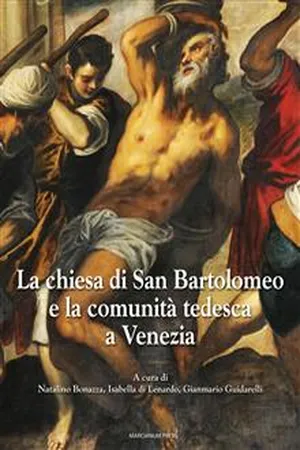
Al centro nevralgico della città di Venezia, laddove per secoli si sono intrecciati rapporti commerciali e culturali mediante l'incontro di genti provenienti da tutta Europa, si trova la chiesa di San Bartolomeo. All'interno di questo luogo di culto fin dal Trecento ebbe il suo punto di aggregazione anche la devozione dei Tedeschi residenti nel vicino Fondaco.
I saggi raccolti nella presente pubblicazione costituiscono un interessante contributo di conoscenze storiche da collocare nell'attuale prospettiva della società plurale.
a cura di: Natalino Bonazza, Isabella di Lenardo, Gianmario Guidarelli
eBook - ePub
La chiesa di San Bartolomeo e la comunità tedesca a Venezia
- Italian
- ePUB (disponibile su mobile)
- Disponibile su iOS e Android
eBook - ePub
La chiesa di San Bartolomeo e la comunità tedesca a Venezia
Informazioni su questo libro
Informazioni
Argomento
ArchitectureCategoria
Architecture religieuseABSTRACT
BERND ROECK
Artists – artisans – merchants: Germans in early modern Venice
The relationship between the German world and Venice is complex and rich in social, economic, cultural and artistic implications. Germans had many motives for their interest in Venice: pilgrims, such as Felix Fabri, for instance, sought out the churches, tombs and relics of a “holy city”. Venice was also the port of departure for pilgrims travelling to the Holy Land. Hu-manists came to see Venice’s libraries, Greek manuscripts, and antiquities. Merchants and bankers were attracted to the city that was the gateway to the Mediterranean economy, a crossroads for trade between the West, Central Europe and the East. Many German merchants lingered in Venice, in the Fondaco dei Tedeschi, to learn the Italian language and commercial practices such as double-entry bookkeeping. Artisans also flocked to Venice, wanting to learn the most innovative artistic techniques, and finding a very rich market in which to sell their works. Artists such as Dürer or Schickhardt came to study the latest developments in the arts and collabo-rated with German merchants in the trade in works of art. The most interest-ing aspect of the relationship between Germans and Venetians, however, is the cultural exchange which took place through the thriving medium of print, particularly in the sixteenth century. The role of German printers in Venice was thus decisive.
For the Germans who came as merchants or pilgrims, Venice was a city of dreams, regarded as a miraculous place of incredible wealth. Diaries and travel accounts describe feelings of endless awe and admiration, above all, a fascination with highly expensive construction materials. For architects in particular, Venice offered unique opportunities to acquire techniques and languages, which once imported to Northern Europe were key factors in the spread of the Renaissance. Venice was a favored theme for cityscapes produced in the German context for these reasons. The city is represented in almost all of the books on European cities (Städtebücher) such as the “Peregrinatio in terram sanctam” by Bernhard von Breydenbach.
ANDREW JOHN MARTIN
Who is who and where is the doge do? The “Feast of the Rose
Garlands”: portraits, no-portraits and the history of the dürer’s masterpiece
In the so-called “Feast of the Rose Garlands” conceived as an altarpiece for San Bartolomeo, where it remained for one hundred years, Dürer reflects on the cult of Mary, the social situation of the Germans in Venice, transalpine trade, international politics and his view of art. After a brief introduction to key events from the work’s commission in 1505 to its sale to Prague in 1606, this paper presents some new insights into the portraits in the Venetian masterpiece by the Nuremberg artist. The main thesis is that the meeting of the faces to the left and right of the Virgin Mary’s throne was not only of great importance for the function of the altarpiece, but also for other commissions entrusted to Dürer, for the painting’s reception after the vic-tory of Lepantoand not least for its in-triguing history.
A new approach to the effigies should b based on a more open system of decodification through which we find portraits drawn ad vivum (also using drawings by other artists), ideal portraits and the representation of particular ‘types’ or anonymous members of the German community in Venice. Further-more the presence of an important con-temporary individual is suggested.
The “Feast of the Rose Garlands” thus depicts a large number of portraits and non-portraits. The painting was not simply a work of devotion, nor a straightforward product of Dürer’s technical virtuosity and intellectual capacity. It was also a diplomatic document in a time of crisis, which was closely connected with its genius loci.
THOMAS ESER
«In honor of the city and its merchant...
Indice dei contenuti
- Copertina
- Colophon
- Indice
- Natalino Bonazza, Isabella di Lenardo, Gianmario Guidarelli Introduzione
- Intorno a san bartolomeo: idee, persone e commerci
- Dallo spazio urbano al luogo di culto: committenze, artisti e opere
- Dentro a san bartolomeo: vita religiosa e pastorale
- Documenti
- Apparati
- Note
Scelto da 375,005 studenti
Accesso a oltre 1,5 milioni di titoli a un prezzo mensile trasparente.
Studia in modo più efficiente con i nostri strumenti dedicati.
Domande frequenti
Sì, puoi annullare l'abbonamento in qualsiasi momento dalla sezione Abbonamento nelle impostazioni del tuo account sul sito web di Perlego. L'abbonamento rimarrà attivo fino alla fine del periodo di fatturazione in corso. Scopri come annullare l'abbonamento
No, i libri non possono essere scaricati come file esterni, ad esempio in formato PDF, per essere utilizzati al di fuori di Perlego. Tuttavia, puoi scaricarli nell'app Perlego per leggerli offline su smartphone o tablet. Scopri come scaricare libri offline
Perlego offre due piani: Essential e Complete
- Essential è l'ideale per chi studia o per i professionisti che amano esplorare una vasta gamma di argomenti. Accedi all'Essential Library con oltre 800.000 titoli affidabili e bestseller nei settori business, crescita personale e discipline umanistiche. Include tempo di lettura illimitato e voce standard per la funzione Leggi ad alta voce.
- Complete: perfetto per studenti avanzati e ricercatori che necessitano di accesso completo e senza restrizioni. Sblocca oltre 1,5 milioni di libri su centinaia di argomenti, inclusi titoli accademici e specialistici. Il piano Complete offre anche funzionalità avanzate come Leggi ad alta voce Premium e Assistente alla ricerca.
Perlego è un servizio di abbonamento a libri di testo online che ti permette di accedere a un'intera biblioteca digitale a meno del prezzo di un singolo libro al mese. Con oltre 1,5 milioni di libri su più di 990 argomenti, qui trovi tutto ciò che ti serve! Scopri la nostra missione
Cerca l'icona Sintesi vocale nel prossimo libro che leggerai per verificare se è possibile riprodurre l'audio. Questo strumento permette di leggere il testo a voce alta, evidenziandolo man mano che la lettura procede. Puoi aumentare o diminuire la velocità della sintesi vocale, oppure sospendere la riproduzione. Scopri di più sulla funzione di sintesi vocale
Sì! Puoi utilizzare l'app di Perlego su dispositivi iOS e Android per leggere quando e dove vuoi, anche offline. È perfetta per gli spostamenti quotidiani o quando sei in viaggio.
I dispositivi con iOS 13 e Android 7 o versioni precedenti non sono supportati. Scopri di più su come utilizzare l'app
I dispositivi con iOS 13 e Android 7 o versioni precedenti non sono supportati. Scopri di più su come utilizzare l'app
Sì, puoi accedere a La chiesa di San Bartolomeo e la comunità tedesca a Venezia di N. Bonazza,I. Di Lenardo,G. Guidarelli (a cura di) in formato PDF e/o ePub, così come ad altri libri molto apprezzati su Architecture e Architecture religieuse. Abbiamo oltre 1,5 milioni di libri disponibili nel nostro catalogo da esplorare.