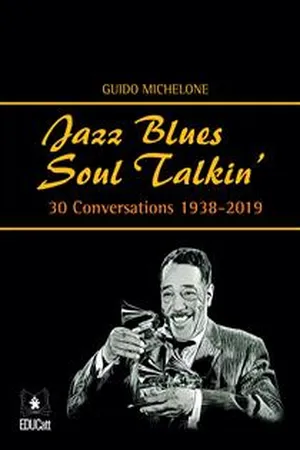
I chose these 30 interviews – sometimes very famous – exclusively for educational purposes. I would like to build a history of afroamerican music through the direct voices of some great protagonists.
This, therefore, is a non-profit anthology that contains the words of black and white musicians in the field of jazz, soul, blues, gospel, r’n’b, rap, fusion. In this way the students will know what some important artists think: not only music, but also life, work, society, politics, and the United States of America.
The interviews – arranged in alphabetical order – are available for free on the web. This book avoids any commercial purpose and should be used only for study and research aims.
Post Scriptum: Spread here and there, among the various chapters, you can then meet other 24 jazz, blues, soul musicians through their famous quotes.
- Italian
- ePUB (disponibile su mobile)
- Disponibile su iOS e Android
eBook - ePub
Jazz Blues Soul Talkin
Informazioni su questo libro
Informazioni
Argomento
Media & Performing ArtsCategoria
Jazz MusicMiles Davis
(© Les Tomkins 1969)
Les Tomkins: You want to know how I started playing trumpet?
Miles Davis: My father bought me one, and I studied the trumpet. And everybody I heard that I liked, I picked up things from.
Les Tomkins: It was when the Billy Eckstine band came to St. Louis that you first got together with Bird and Diz, wasn’t it?
Miles Davis: I’d heard ‘em on records. But I was playing like that, anyway. You got to understand, man. See white folks always think that you have to have a label on everything – you know what I mean?
Les Tomkins: Well, I don’t, necessarily.
Miles Davis: That’s how you’re spelling everything – when you say: “You heard Diz”. But two guys can do the same thing, and still won’t see each other. So it was happening, like I say. It actually happened in Kansas City. If you listen to Charlie Parker, he sounds like Ben Webster, you know. Dizzy doesn’t sound like Charlie Parker; they’re two different people. Right?
Les Tomkins: Yes. But Dizzy’s playing underwent certain changes. Or perhaps evolution is a better word. He doesn’t play now the same way he played in his earlier years.
Miles Davis: Why?
Les Tomkins: Well, on some of the early records he sounded something like Roy Eldridge.
Miles Davis: Then the critics were wrong, man.
Les Tomkins: But you couldn’t hear the things that developed later in his playing at that time.
Miles Davis: Maybe there was nothing to develop. Right?
Les Tomkins: At a certain point his playing sort of found a new direction, l suppose.
Miles Davis: I don’t hold it against Dizzy, you know, but if a guy wants to play a certain way, you work towards that. If he stops – he’s full of crap, you know. I mean, I wouldn’t do it, for no money, or for no place in the white man’s world. Not just to make money, because then you don’t have anything. You don’t have as much money as whoever you’re trying to ape; that’s making money by being commercial. Then you don’t have anything to give the world; so you’re not important. You might as well be dead.
That’s the way it goes. I mean, guys should keep on doing it right, no matter what it is. If you sacrifice your art because of some woman, or some man, or for some colour, or for some wealth, you can’t be trusted.
I mean that goes for anybody. I’m not putting Dizzy down or anybody else, you know. But I think they should just keep on, no matter what happens.
Les Tomkins: You’ve always believed in playing exactly the way you wanted to at all times?
Miles Davis: Course. I want to see if I can do it.
Les Tomkins: There was the period when you seemed to be using the mute quite a lot.
Miles Davis: I use it if I want to play something, here and there. Not because some people said to me: “Miles, you sound good with a mute”. I know it sounds good, else I wouldn’t pick it up.
Les Tomkins: On a lot of the records that were very successful, tracks like “All Of You” and “Bye Bye Blackbird”, when you played with the mute close to the mike, you had what came to be known as the Miles Davis sound.
Miles Davis: I got it from Dizzy.
Les Tomkins: I don’t remember hearing that sound from Dizzy.
Miles Davis: Listen to “Ko Ko”. But, you see, all my ideas of a tone come from listening to trumpet players who play round – with no tag on the end of the tone. I would never try and play like Harry James, because I don’t like his tone – for me.
Les Tomkins: It’s too sort of creamy, I suppose.
Miles Davis: What you call creamy and what I call creamy may be two different things. It’s just white. You know what I mean? He has what we black trumpet players call a white sound. But it’s for white music.
Les Tomkins: Do all white players have a white sound?
Miles Davis: Well, no – there’s still something that isn’t there, you know. I can tell a white trumpet player, just listening to a record. There’ll be something he’ll do that’ll let me know that he’s white.
Les Tomkins: It’s like listening to somebody’s accent, is it?
Miles Davis: Right. I can hear a grey singer that’s trying to sing coloured – I don’t mean black, I mean coloured – and all of a sudden, like, he’ll say “mother” and his “er” won’t get that true sound. Tom Jones is funny to me, man. I mean, he really tries to ape Ray Charles and Sammy Davis, you know.
Les Tomkins: Yes – but he’s making a success of it.
Miles Davis: Well, see, he’s nice-looking; he looks good doing it. I mean, if I was him, I’d do the same thing. If I was only thinking about making money.
Les Tomkins: What did you think of Chet Baker?
Miles Davis: I liked Chet. But white guys play a certain way, man. They lean on notes, you know, when they set a rhythm. I used to enjoy all the white bands when I was a kid listening to the radio.
But the record companies, they take music and label it – like, they say “rock”. Because the white singers can’t sound like James Brown, they call him “soul”. They’ve been doing that for years. That’s the prejudice crap. So you get rock groups that are white, that are actually prejudiced. They say “freedom”, but they only mean freedom for themselves.
And I see all those white producers – trying to make young films. But they don’t understand that scene. They mess them white kids up; the kids don’t know whether to f – or ride. Or get high. I see ‘em getting high most of the time.
When white people get high, they say: “It’s all right for me”. There’s a lot of guys in jail, man, for ten years that had two sticks of reefer, you know – because they’re black, and with a white girl or something. Now you get a white kid with two sticks of reefer, they’ll throw it away – and let him off.
I mean, it’s those producers and record companies the way they sell things helps with a lot of prejudice. It builds a white image.
Like, jazz is an Uncle Tom word. They should stop using that word for selling. I told George Wein the other day that he should stop using it.
Les Tomkins: But is there any substitute word?
Miles Davis: Just music, man. We might play anything out there. It gets back to you asking me how I learned how to play a trumpet. I mean, you hear correct fingering and...
Indice dei contenuti
- Introduction
- Louis Armstrong
- Count Basie and Freddie Green
- Tony Bennett
- Lester Bowie
- Ray Charles
- Miles Davis
- Fats Domino
- Duke Ellington
- Bill Evans
- Ella Fitzgerald
- Dizzy Gillespie
- Benny Goodman
- Grandmaster Flash
- Herbie Hancock
- John Lee Hooker
- Keith Jarrett
- Phillip Johnston
- B.B. King
- Diana Krall
- Wynton Marsalis
- John McLaughlin
- Brad Mehldau
- Pat Metheny
- Wes Montgomery
- Jelly Roll Morton
- Gerry Mulligan
- Max Roach
- Sonny Rollins
- Sister Rosetta Tharpe
- Tina Turner
- The Editor
Scelto da 375,005 studenti
Accesso a oltre 1,5 milioni di titoli a un prezzo mensile trasparente.
Studia in modo più efficiente con i nostri strumenti dedicati.
Domande frequenti
Sì, puoi annullare l'abbonamento in qualsiasi momento dalla sezione Abbonamento nelle impostazioni del tuo account sul sito web di Perlego. L'abbonamento rimarrà attivo fino alla fine del periodo di fatturazione in corso. Scopri come annullare l'abbonamento
No, i libri non possono essere scaricati come file esterni, ad esempio in formato PDF, per essere utilizzati al di fuori di Perlego. Tuttavia, puoi scaricarli nell'app Perlego per leggerli offline su smartphone o tablet. Scopri come scaricare libri offline
Perlego offre due piani: Essential e Complete
- Essential è l'ideale per chi studia o per i professionisti che amano esplorare una vasta gamma di argomenti. Accedi all'Essential Library con oltre 800.000 titoli affidabili e bestseller nei settori business, crescita personale e discipline umanistiche. Include tempo di lettura illimitato e voce standard per la funzione Leggi ad alta voce.
- Complete: perfetto per studenti avanzati e ricercatori che necessitano di accesso completo e senza restrizioni. Sblocca oltre 1,5 milioni di libri su centinaia di argomenti, inclusi titoli accademici e specialistici. Il piano Complete offre anche funzionalità avanzate come Leggi ad alta voce Premium e Assistente alla ricerca.
Perlego è un servizio di abbonamento a libri di testo online che ti permette di accedere a un'intera biblioteca digitale a meno del prezzo di un singolo libro al mese. Con oltre 1,5 milioni di libri su più di 990 argomenti, qui trovi tutto ciò che ti serve! Scopri la nostra missione
Cerca l'icona Sintesi vocale nel prossimo libro che leggerai per verificare se è possibile riprodurre l'audio. Questo strumento permette di leggere il testo a voce alta, evidenziandolo man mano che la lettura procede. Puoi aumentare o diminuire la velocità della sintesi vocale, oppure sospendere la riproduzione. Scopri di più sulla funzione di sintesi vocale
Sì! Puoi utilizzare l'app di Perlego su dispositivi iOS e Android per leggere quando e dove vuoi, anche offline. È perfetta per gli spostamenti quotidiani o quando sei in viaggio.
I dispositivi con iOS 13 e Android 7 o versioni precedenti non sono supportati. Scopri di più su come utilizzare l'app
I dispositivi con iOS 13 e Android 7 o versioni precedenti non sono supportati. Scopri di più su come utilizzare l'app
Sì, puoi accedere a Jazz Blues Soul Talkin di Guido Michelone in formato PDF e/o ePub, così come ad altri libri molto apprezzati su Media & Performing Arts e Jazz Music. Abbiamo oltre 1,5 milioni di libri disponibili nel nostro catalogo da esplorare.