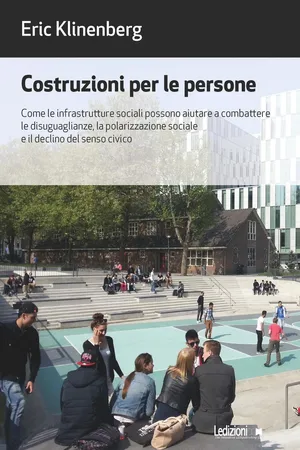
Viviamo in un periodo di profonde divisioni. La polarizzazione e le frammentazioni su base culturale, razziale e religiosa stanno raggiungendo livelli mai visti.In questo volume, Eric Klinenberg ci suggerisce una via da seguire. Argomenta come il futuro delle società democratiche si basi non solo su valori condivisi, ma su spazi condivisi: biblioteche, centri per l'infanzia, librerie, chiese, sinagoghe e parchi dove si formano connessioni cruciali, che possono anche salvare delle vite. Questi sono luoghi in cui le persone si ritrovano, stringono amicizie e rafforzano l'intera comunità. Klinenberg li definisce "infrastrutture sociali" e ci dimostra come siano elementi chiave per una società che prosperi e sia armoniosa.Klinenberg ci porta in giro per il mondo ? da una scuola galleggiante in Bangladesh a un incubatore creativo a Chicago, da un campo da calcio nel Queens a una chiesa evangelica a Houston ? per mostrare come le infrastrutture sociali stiano aiutando a risolvere alcune delle nostre sfide più urgenti: l'isolamento, la criminalità, le dipendenze e la polarizzazione politica. Scritto da un professore di sociologia, già autore di diversi bestseller nella classifica del New York Times, il volume espone in modo divulgativo una ricetta per il futuro delle nostre società e per la salvaguardia della democrazia.
eBook - ePub
Costruzioni per le persone
Come le infrastrutture sociali possono aiutare a combattere le disuguaglianze, la polarizzazione sociale e il declino del senso civico
- 236 pagine
- Italian
- ePUB (disponibile su mobile)
- Disponibile su iOS e Android
eBook - ePub
Costruzioni per le persone
Come le infrastrutture sociali possono aiutare a combattere le disuguaglianze, la polarizzazione sociale e il declino del senso civico
Informazioni su questo libro
Scelto da 375,005 studenti
Accesso a oltre 1,5 milioni di titoli a un prezzo mensile trasparente.
Studia in modo più efficiente con i nostri strumenti dedicati.
Informazioni
Argomento
Scienze socialiCategoria
Geografia umanaNOTE
INTRODUZIONE. L’INFRASTRUTTURA SOCIALE
p. 9 Citazioni di Eric Klinenberg, Heat Wave: A Social Autopsy of Disaster in Chicago (Chicago: University of Chicago Press, 2002).
p. 10 Citazione di Dirk Johnson, “Heat Wave: The Nation; In Chicago, Week of Swelter Leaves an Overflowing Morgue,” New York Times, 17 luglio, 1995.
p. 12 James House, Karl Landis e Debra Umberson, “Social Relationships and Health,” Science 241, no. 4865 (1988):540-45.
p. 14 Citazioni di Emanuela Campanella, “We All Live in a Bubble. Here’s Why You Step Out of It, According to Experts,” Global News, 4 febbraio, 2017, https://globalnews.ca/news/3225274/we-all-live-ina-bubble-heres-why-youstepout-of-it-accordingto-experts/; Sreeram Chaulia, “Why India Is So Unhappy, and How It Can Change,” TODAYonline, 3 aprile, 2017, https://www.todayonline.com/commentary/why-india-so-unhappy-and-how-it-can-change; “Class Segregation ‘on the Rise’”, BBC News, 8 settembre 2007, http://news.bbc.co.uk/2/hi/uk_news/6984707.stm; Rachel Lu, “China’s New Class Hierarchy: A Guide,” Foreign Policy, 25 aprile, 2014, https://foreignpolicy.com/2014/04/25/chinas-new-classhierarchya-guide/; “Private Firms Filling Latin America’s Security Gap”, Associated Press Mail Online, 24 novembre 2014, http://www.dailymail.co.uk/wires/ap/article-2847721/Privatefirms-fillingLatin-Americas-security-gap.htm.
p. 16 Martin Filler, “New York: Conspicuous Construction”, New York Review of Books, 2 aprile, 2015.
p. 16 Evan Osnos, “Doomsday Prep for the Super-Rich”, New Yorker, 30 gennaio 2017.
p. 18 John Dewey, The Public and Its Problems (1927; repr., University Park: Pennsylvania State University Press, 2012), 157.
p. 18 Charles Murray, Coming Apart: The State of White America, 1960–2010 (New York: Crown Forum, 2012), 12, 22, 283.
p. 19 Peter Marsden, ed., Social Trends in American Life (Princeton, NJ: Princeton University Press, 2012).
p. 19 Sul declino del volontariato, si veda the Bureau of Labor Statistics, “Volunteering in the United States, 2015”, https://www.bls.gov/news.release/volun.nr0.htm.
p. 19 Claude Fischer, Still Connected: Family and Friends in America Since 1970, New York: Russell Sage Foundation, 2011, 93.
p. 20 Susan Leigh Star, “The Ethnography of Infrastructure”, American Behavioral Scientist 43, no. 3 (1999): 380-82.
p. 21 Ashley Carse, “Keyword: Infrastructure - How a Humble French Engineering Term Shaped the Modern World”, in Infrastructures and Social Complexity: A Companion, ed. Penny Harvey, Casper Bruun Jensen, and Atsuro Morita (London: Routledge, 2016).
p. 22 Il classico testo su come i piccoli business e gli operatori commerciali modellino la vita sociale quotidiana è di Jane Jacobs, The Death and Life of Great American Cities (New York: Vintage, 1961). Negli ultimi anni, il famoso sociologo Elijah Anderson ha scritto su quella che egli chiama “la canopia cosmopolita”, ossia i posti in cui le persone provenienti da diversi background “non solo condividono lo spazio, ma cercano anche di trovare la presenza dell’altro” e occasionalmente intrecciano anche relazioni. Anderson ha condotto ricerche etnografiche sul campo in diversi siti esemplari d’interazioni incrociate di gruppo, inclusi il Philadelphia’s Reading Terminal Market e Rittenhouse Square, oltre a posti segnati dalla sorveglianza, dal sospetto e dalla segregazione sociale. Si veda Elijah Anderson, The Cosmopolitan Canopy: Race and Civility in Everyday Life (New York: W. W. Norton, 2011).
p. 22 Marshall Brain e Robert Lamb, “What Is a Levee?”, https://science.howstuffworks.com/engineering/structural/levee.htm.
p. 23 Mario Small, Unanticipated Gains: Origins of Network Inequality in Everyday Life (New York: Oxford University Press, 2009).
p.24 Stéphane Tonnelat e William Kornblum, International Express: New Yorkers on the 7 Train (New York: Columbia University Press, 2017).
p. 25 MassObservation, The Pub and the People (1943; repr., London: Cresset Library, 1987), 17.
p. 25 Ray Oldenburg, The Great Good Place: Cafés, Coffee Shops, Bookstores, Bars, Hair Salons and Other Hangouts at the Heart of a Community (Cambridge, MA: Da Capo Press, 1989).
p. 27 Si veda Vanessa Quirk, “The 4 Coolest ‘High Line’ Inspired Projects”, ArchDaily, 16 luglio, 2012, https://www.archdaily.com/254447/the-4-coolest-high-line-inspired-projects.
p. 27 Diversi libri recenti sostengono l’investimento nelle infrastrutture, incluso quello di Rosabeth Moss Kanter, Move: How to Rebuild and Reinvent America’s Infrastructure (New York: W. W. Norton, 2016), Henry Petroski, The Road Taken (New York: Bloomsbury, 2016), e Gretchen Bakke, The Grid (New York: Bloomsbury, 2016); ancora nessuno richiama l’attenzione sul valore dell’infrastruttura sociale.
p. 28 Non molto tempo dopo che Andrew Carnegie iniziò a investire sulle biblioteche, Joseph Stalin iniziò la sua campagna per costruire “palazzi per le persone” in Russia. L’eredità più simbolica di questo progetto è una serie di magnifiche stazioni metropolitane a Mosca, ognuna decorata con grandi lampadari in marmo, mosaici e sculture, così come vari complessi abitativi e club sociali per i lavoratori sovietici.
CAPITOLO UNO: UN POSTO DOVE RIUNIRSI
p. 29 Uno studio del New York University’s Rudin Center for Transportation colloca East New York ultima a Brooklyn per l’accesso al trasporto pubblico per raggiungere il posto di lavoro entro un’ora, e tra le peggiori in tutta New York City. Si veda Sarah Kaufman, Mitchell Moss, Jorge Hernandez, e Justin Tyndall, “Mobility, Economic Opportunity and New York City Neighborhoods”, novembre 2015, https://wagner.nyu.edu/files/faculty/publications/JobAccessNov2015.pdf.
p. 29 Si veda Neal Krause, “Neighborhood Deterioration and Social Isolation in Later Life”, International Journal of Aging and Human Development 36, no. 1 (1993): 9-38.
p. 31 Per dati demografici sull’invecchiamento si veda Administration on Aging, A Profile of Older Americans, 2015,https://www.acl.gov/sites/default/files/Aging%20and%20Disability%20in%20America/2015-Profile.pdf/; e Renee Stepler, “Smaller ...
Indice dei contenuti
- Cover
- Costruzioni per le persone
- Colophon
- Indice
- Nota dell'editore
- Introduzione
- Un posto dove riunirsi
- Spazi sicuri
- Imparare insieme
- Confini della salute
- Un terreno comune
- Davanti alla tempesta
- Conclusioni
- Ringraziamenti
- Note
- L'autore
Domande frequenti
Sì, puoi annullare l'abbonamento in qualsiasi momento dalla sezione Abbonamento nelle impostazioni del tuo account sul sito web di Perlego. L'abbonamento rimarrà attivo fino alla fine del periodo di fatturazione in corso. Scopri come annullare l'abbonamento
No, i libri non possono essere scaricati come file esterni, ad esempio in formato PDF, per essere utilizzati al di fuori di Perlego. Tuttavia, puoi scaricarli nell'app Perlego per leggerli offline su smartphone o tablet. Scopri come scaricare libri offline
Perlego offre due piani: Essential e Complete
- Essential è l'ideale per chi studia o per i professionisti che amano esplorare una vasta gamma di argomenti. Accedi all'Essential Library con oltre 800.000 titoli affidabili e bestseller nei settori business, crescita personale e discipline umanistiche. Include tempo di lettura illimitato e voce standard per la funzione Leggi ad alta voce.
- Complete: perfetto per studenti avanzati e ricercatori che necessitano di accesso completo e senza restrizioni. Sblocca oltre 1,5 milioni di libri su centinaia di argomenti, inclusi titoli accademici e specialistici. Il piano Complete offre anche funzionalità avanzate come Leggi ad alta voce Premium e Assistente alla ricerca.
Perlego è un servizio di abbonamento a libri di testo online che ti permette di accedere a un'intera biblioteca digitale a meno del prezzo di un singolo libro al mese. Con oltre 1,5 milioni di libri su più di 990 argomenti, qui trovi tutto ciò che ti serve! Scopri la nostra missione
Cerca l'icona Sintesi vocale nel prossimo libro che leggerai per verificare se è possibile riprodurre l'audio. Questo strumento permette di leggere il testo a voce alta, evidenziandolo man mano che la lettura procede. Puoi aumentare o diminuire la velocità della sintesi vocale, oppure sospendere la riproduzione. Scopri di più sulla funzione di sintesi vocale
Sì! Puoi utilizzare l'app di Perlego su dispositivi iOS e Android per leggere quando e dove vuoi, anche offline. È perfetta per gli spostamenti quotidiani o quando sei in viaggio.
I dispositivi con iOS 13 e Android 7 o versioni precedenti non sono supportati. Scopri di più su come utilizzare l'app
I dispositivi con iOS 13 e Android 7 o versioni precedenti non sono supportati. Scopri di più su come utilizzare l'app
Sì, puoi accedere a Costruzioni per le persone di Eric Klinenberg in formato PDF e/o ePub, così come ad altri libri molto apprezzati su Scienze sociali e Geografia umana. Abbiamo oltre 1,5 milioni di libri disponibili nel nostro catalogo da esplorare.