- 249 pagine
- Italian
- ePUB (disponibile su mobile)
- Disponibile su iOS e Android
eBook - ePub
Informazioni su questo libro
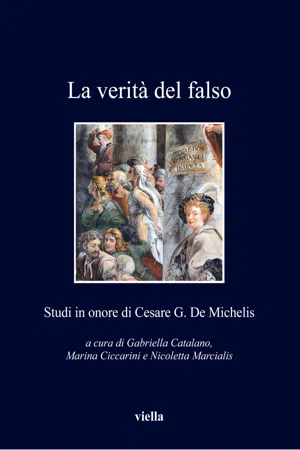
Il vero e il falso sono inestricabilmente intrecciati in molti campi della comunicazione umana. Ma non si tratta di opposti che si escludono a vicenda. Confrontandosi con prodotti canonici, giocando con le aspettative, riempiendo vuoti lasciati nei testi o nelle curve della storia, sfruttando l'onda di un successo di pubblico, il falso appare sempre contiguo al vero, paradossalmente mimetico in forme cangianti (dalle manipolazioni alle copie, dai travestimenti ai plagi e ai pastiches) che impediscono qualsiasi approccio normativo o rigidamente unitario.
Poiché nelle diverse circostanze il metodo e l'intenzione della falsificazione saranno differenti, lo studio dei falsi e della loro fenomenologia richiede allo stesso tempo attenzione filologica e fantasia, passione per il dettaglio e capacità di ascolto della sottile dialettica, oppositiva e integrativa insieme, che unisce il falso alla verità.
Informazioni
Argomento
LetteraturaCategoria
Critica letteraria europeaDiane Ponterotto
Maneuvering between Truth and Falsehood:
Hedging Strategies in Political Interviews
Hedging Strategies in Political Interviews
1. Introduction
The purpose of this study is the analysis of hedging strategies employed by the current President of the United States in the interviews conducted for two TV programmes: CBS Sixty Minutes Overtime, held on Friday December 9, 2011,103 and NBC Meet the Press, held on September 7, 2014,104 focusing on the political problems surrounding the contemporary role of the American presidency. It shall be seen that the interviews are heavily characterized by multiple forms of hedging strategies. By means of a critical analysis of the range of strategies present in the texts, it will be argued that intense hedging is used by the President as a self-protection strategy in the face of the interviewer’s request for specific commitment on controversial issues. The term “self-protection” is here intended both in a personal and political way, as protection of the personal position of a political figure in power and as the protection of the American government’s official position vis-a-vis highly-charged social and political issues, including past and potential military scenarios.
1.1. Hedging
Hedging can be defined as a rhetorical device which serves to “blurr” the speaker’s commitment to the truth of the proposition conveyed (Prince, Frader, Bosk 1982). Hedges, thus characterized by a note of indetermination (Hübler 1983), permit speakers to maneuver between certainty and uncertainty, to leave open the possibility for future modifications and to evade the necessity of full commitment to the assertions put forward. In fact when the category hedge first emerged in a 1972 study by George Lakoff, it was defined in terms of “fuzziness”. Lakoff noted that in natural language processing, concepts do not necessarily have sharp boundaries but are often vaguely defined. He suggested that in English there are expressions that modify the category membership of a predicate or noun phrase to «make things fuzzier or less fuzzy» (Lakoff 1972: 195). Thus hedges serve to avoid an either/or condition in ascertaining the veracity of the truth conditions of facts or events. Utterances need not be either true, false or nonsense but by means of hedging can encode attenuated interpretations, as if to suggest “perhaps true”, “not exactly false”, “both true and false”, “true to a certain degree”, “true or false within the limits determined by subjective or personal knowledge”, etc. Subsequently, a hedge came to be considered not merely a form or set of forms but a discourse strategy, activated by recourse to numerous lexico-grammatical devices. In order to give an idea of the vast range of the devices which can be used for hedging purposes, we present the following chart adapted from Fraser (Fraser 2010) which succinctly summarizes categories of hedges with relevant examples.
Table 1. Categories and examples of typical hedging devices (extracted and adapted from Fraser 2010)
| CATEGORY | EXAMPLE |
| Impersonal pronouns | One just doesn’t do that. |
| Concessive conjunctions (although, though, while, whereas, even though, even if…) | Even though you dislike the beach, it’s worth going for the view. |
| Hedged performative | I must ask you to sit down. |
| Indirect Speech Acts | Could you speak a little louder. |
| Introductory phrases (I believe, to our knowledge, it is our view that, we feel that…) | I believe that he is here. |
| Modal adverbs (perhaps, possibly, probably, practically, presumably, apparently) | I can possibly do that. |
| Modal adjectives (possible, probable, un/likely…) | It is possible that there is no water in the well. |
| Modal noun (assumption, claim, possibility, estimate, suggestion…) | His assumption is that you are going to go… |
| Modal verbs (might, can, would, could…) | John might leave now. |
| Epistemic verbs (seem, appear, believe, assume, suggest, think…) | It seems that no one wants to go… |
| Negation | Didn’t Harry leave? [I think Harry left]; I don’t think I’m going. vs. I’m not going. [Former hedges the meaning of latter] |
| Reversal tag | He’s coming, isn’t he? |
| Parenthetic construction | The picnic is here, I guess. |
| If clause | If true, we’re in deep trouble. |
| Agentless Passive | Many of the troops were injured. (by Ø) |
| Conditional subordinators (as long as, so long as, assuming that, given that…) | Unless the strike has been called off, there will be no trains tomorrow. |
| Progressive form | I am hoping you will come. |
| Tentative Inference | The mountains should be visible from here. |
| Conditional clause implying permission (if you don’t mind my saying so, if I may say so) | If you don’t mind me saying so, your slip is showing. |
| Conditional clause as a metalinguistic comment (if that’s the right word…) | His style is lurid, if that’s the right word. |
| Conditional clause expressing uncertainty about the extralinguistic knowledge required for a correct interpretation of the utterance (if I’m correct, in case you don’t remember) | Chomsky views cannot be reconciled with Piaget, if I understand him correctly. |
| Metalinguistic comment such as (strictly speaking, so to say, exactly, almost, just about, if you will) | He has an idea, a hypothesis, if you will, that you may find interesting. |
It was also argued that it is context which determines the hedged qua...
Indice dei contenuti
- Occhiello
- Frontespizio
- Colophon
- Premessa di Gabriella Catalano, Marina Ciccarini, Nicoletta Marcialis
- Luca Bevilacqua, Mistificazione e menzogna in Baudelaire: una lettura de Le Mauvais Vitrier
- Mario Caramitti, Il Placido Don: espellere Šolochov dalla storia letteraria?
- Antonio Carile, «Famosa scripta». L’uso politico della diffamazione nelle biografie imperiali a Costantinopoli Nuova Roma
- Valerio Casadio, «Sappiamo dire molte menzogne simili al vero». Il dettato delle Muse e le origini dello “statuto” del falso nella letteratura greca antica
- Gabriella Catalano, Meteore del plagio: Goethe e La Guzla di Mérimée
- Carmine Chiodo, Un falsario seicentesco delle lettere politiche e storiche di Traiano Boccalini: Gregorio Leti
- Francesca Chiusaroli, Il grafema, il segno grafico e le “scritture brevi” per la realizzazione del falso
- «Paolo D’Angelo, Dell’inventato, che è quanto dire, del falso». Manzoni e l’immaginazione come specie della falsità
- Marina Formica, Un falso Oriente. Da Gemelli Careri all’Abate Vella
- Andrea Gareffi, La più perfetta delle lontananze
- Daniele Garrone, Chi ha scritto la Bibbia ebraica? A saperlo…
- Donatella Gavrilovich, Lo strano caso della nevrastenia del regista Vsevolod Mejerchol’d. Un’autobiografia “a regola d’arte”
- Tonino Griffero, Falsi sentimenti (atmosferici)? Autentico e inautentico nella sfera emozionale
- Daniela Guardamagna, Apocrifi e falsi shakespeariani
- Michael Hagemeister, The Protocols of the Elders of Zion – a Forgery?
- Raffaele Manica, Una congiuntura editoriale degli anni Settanta
- Elisabetta Marino, Quando la finzione diventa racconto: Roger Dodsworth, the Reanimated Englishman di Mary Shelley
- Reinhard Markner, Gerd Heidemann and the Correspondence between Mussolini and Churchill: a Prelude to the Hitler Diaries Scandal
- Diane Ponterotto, Maneuvering between Truth and Falsehood: Hedging Strategies in Political Interviews
- Franco Salvatori e Alessandro Ricci, Cartografia e mistificazione della realtà geografica.La “rappresentazione addomesticata” come fattore d’identità
- Patrizia Serafin, «…ne qua subaerato mendosum tinniat auro?».La verità e il suono del falso
- Quarta di copertina
Scelto da 375,005 studenti
Accesso a oltre 1,5 milioni di titoli a un prezzo mensile trasparente.
Studia in modo più efficiente con i nostri strumenti dedicati.
Domande frequenti
Sì, puoi annullare l'abbonamento in qualsiasi momento dalla sezione Abbonamento nelle impostazioni del tuo account sul sito web di Perlego. L'abbonamento rimarrà attivo fino alla fine del periodo di fatturazione in corso. Scopri come annullare l'abbonamento
No, i libri non possono essere scaricati come file esterni, ad esempio in formato PDF, per essere utilizzati al di fuori di Perlego. Tuttavia, puoi scaricarli nell'app Perlego per leggerli offline su smartphone o tablet. Scopri come scaricare libri offline
Perlego offre due piani: Essential e Complete
- Essential è l'ideale per chi studia o per i professionisti che amano esplorare una vasta gamma di argomenti. Accedi all'Essential Library con oltre 800.000 titoli affidabili e bestseller nei settori business, crescita personale e discipline umanistiche. Include tempo di lettura illimitato e voce standard per la funzione Leggi ad alta voce.
- Complete: perfetto per studenti avanzati e ricercatori che necessitano di accesso completo e senza restrizioni. Sblocca oltre 1,5 milioni di libri su centinaia di argomenti, inclusi titoli accademici e specialistici. Il piano Complete offre anche funzionalità avanzate come Leggi ad alta voce Premium e Assistente alla ricerca.
Perlego è un servizio di abbonamento a libri di testo online che ti permette di accedere a un'intera biblioteca digitale a meno del prezzo di un singolo libro al mese. Con oltre 1,5 milioni di libri su più di 990 argomenti, qui trovi tutto ciò che ti serve! Scopri la nostra missione
Cerca l'icona Sintesi vocale nel prossimo libro che leggerai per verificare se è possibile riprodurre l'audio. Questo strumento permette di leggere il testo a voce alta, evidenziandolo man mano che la lettura procede. Puoi aumentare o diminuire la velocità della sintesi vocale, oppure sospendere la riproduzione. Scopri di più sulla funzione di sintesi vocale
Sì! Puoi utilizzare l'app di Perlego su dispositivi iOS e Android per leggere quando e dove vuoi, anche offline. È perfetta per gli spostamenti quotidiani o quando sei in viaggio.
I dispositivi con iOS 13 e Android 7 o versioni precedenti non sono supportati. Scopri di più su come utilizzare l'app
I dispositivi con iOS 13 e Android 7 o versioni precedenti non sono supportati. Scopri di più su come utilizzare l'app
Sì, puoi accedere a La verità del falso di Autori Vari in formato PDF e/o ePub, così come ad altri libri molto apprezzati su Letteratura e Critica letteraria europea. Abbiamo oltre 1,5 milioni di libri disponibili nel nostro catalogo da esplorare.