- 133 pagine
- Italian
- ePUB (disponibile su mobile)
- Disponibile su iOS e Android
eBook - ePub
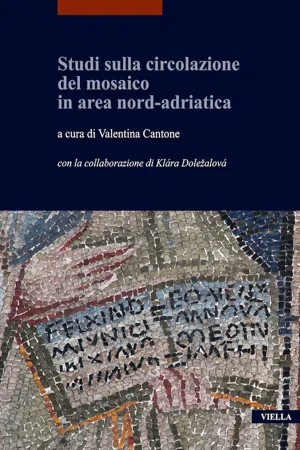
Studi sulla circolazione del mosaico in area nord-adriatica
Informazioni su questo libro
I mosaici paleocristiani che si possono ammirare nel nord Italia nascondono trame complesse, celate sotto il loro diaframma luminoso e seducente. Lo studio delle botteghe, dei motivi iconografici e ornamentali, l'approvvigionamento, la circolazione e la lavorazione dei materiali, le vie percorse per portare a compimento i cantieri possono apparire come una matassa aggrovigliata, fatta di questioni che richiedono di essere analizzate in ottica specialistica, ma che necessitano anche di una integrazione dialogica fra i saperi.
Questo volume raccoglie i risultati di un laboratorio in cui docenti e studenti hanno interrogato una serie di casi di studio, indagati attraverso le metodologie della storia dell'arte, dell'archeologia e dell'archeometria, cercando di offrire diverse soluzioni e nuove prospettive di ricerca.
Informazioni
Argomento
ArteCategoria
Storia dell'arte anticaZuzana Frantová
Autonomous Glass Tesserae Production in Classe? Ravenna between the Sea and the Continent105
From the 5th to the 7th centuries, Classe became one of the most important trading ports in the Mediterranean (Fig. 1).106 The port secured supplies for Ravenna, the new imperial residence since 402, as well as the distribution of goods throughout Northern Italy.107 Although the port had been one of the most important in the Western Roman Empire since its establishment by Emperor Augustus (27 BC - 14 AD), evidence for construction of the port at Classe, which served for maritime and river commerce and encouraged local craft production, is concurrent right with the arrival of the court of the Emperor Honorius in the early 5th century.108 In addition to large quantities of goods necessary for everyday life and those necessary to ensure the functioning of the port,109 luxury goods were imported together with material for their local production. These luxury goods were intended for demanding clients from the ranks of the aristocracy and the imperial court.110 Thus the city surely was home to skilled jewelers, stonemason, ivory carvers and glassblowers.
The archaeological discovery of a glass furnace at Classe in the Seventies of the 20th century111 allowed the scholars to hypothesize that Classe produced glass for Ravenna and other markets (Fig. 2). Based on our current knowledge of workshop practice in Late Antiquity, it is very likely that glass production in Classe included several different branches of the industry.112 The present text focuses on the possibility that also glass tesserae were produced locally for decorating the buildings constructed in the new sedes imperii.113 This hypothesis has been recently discussed in connection with interdisciplinary and archaeometrical research into several Ravennate churches.114 I will not focus on glass objects intended for everyday use, such as glasses, cups, bowls and lamps, the production of which had increased considerably around the middle of the 1st century BC with the invention of glass blowing.115 But research in this area has made considerable progress in recent years, and if we consider some of these results, we can gain a better understanding of the production of glass mosaic tesserae, for which direct evidence is scarcer.116
For a complex understanding of possible local production of glass tesserae in Ravenna, it will therefore be necessary to work with the results of major archaeological discoveries and archaeometrical analyses not only from the field of mosaic production, but also from the field of glass as an applied art. Based on the results of the studies of Late Antique mosaic manufacturing in general and on art historical considerations, we will try to present the additional arguments for the existence of a local workshop producing glass tesserae for the Ravennate churches. The background enriched by such an approach will help us to better understand the artistic milieu of Ravenna and to imagine one of the processes of how the important Late Antique cities were practically created.
Glass Production in Late Antiquity
Up to the Middle Ages, glass was obtained by melting together a siliceous constituent (sand), a fluxing agent (natural soda or sodium-rich plant ashes), and lime, together with colorants, decolorants, or an opacifying substance. Roman glass vessels from the period between the 1st to the 6th centuries are similar in their basic composition, apparently regardless of the geographical location of the workshop or the exact moment of their production.117 This fact can be explained by how Late Antique glassmaking was organized.
The production of glass in Late Antiquity was divided into two separate phases. The primary phase was the production of raw glass; the secondary was the production of the objects themselves, i.e. vessels, cakes for tesserae, or jewelry. The production of raw glass took place only in a few areas that were close to the sources of suitable raw materials.118 Large slabs of glass in natural shades from green and yellow to pale blue were produced there. Subsequently, the slabs were broken into small pieces. In this form, raw glass was shipped to various locations across the whole Roman Empire. There it would be crushed again, melted, dyed and transformed by blowing or casting into final objects in secondary workshops.119 This model has recently come to be preferred by a majority of scholars because it is supported by written sources as well as archaeological and laboratory research. This hypot...
Indice dei contenuti
- Risvolto
- Occhiello
- Frontespizio
- Colophon
- Indice
- Per una pizza arancione. Approcci integrati nello studio del mosaico paleocristiano
- I mosaici vitrei paleocristiani del Veneto: il punto di vista dell’archeometria
- Produrre tessere in vetro a Classe: una prospettiva archeologica
- Autonomous Glass Tesserae Production in Classe? Ravenna between the Sea and the Continent
- Forms and Ideas in the Fifth-Century Mediterranean: Bishop Neon and His Mosaics in Ravenna
- Milano capitale, tra Roma e Ravenna: circolazione di botteghe, di materiali e di idee
Scelto da 375,005 studenti
Accesso a oltre 1,5 milioni di titoli a un prezzo mensile trasparente.
Studia in modo più efficiente con i nostri strumenti dedicati.
Domande frequenti
Sì, puoi annullare l'abbonamento in qualsiasi momento dalla sezione Abbonamento nelle impostazioni del tuo account sul sito web di Perlego. L'abbonamento rimarrà attivo fino alla fine del periodo di fatturazione in corso. Scopri come annullare l'abbonamento
No, i libri non possono essere scaricati come file esterni, ad esempio in formato PDF, per essere utilizzati al di fuori di Perlego. Tuttavia, puoi scaricarli nell'app Perlego per leggerli offline su smartphone o tablet. Scopri come scaricare libri offline
Perlego offre due piani: Essential e Complete
- Essential è l'ideale per chi studia o per i professionisti che amano esplorare una vasta gamma di argomenti. Accedi all'Essential Library con oltre 800.000 titoli affidabili e bestseller nei settori business, crescita personale e discipline umanistiche. Include tempo di lettura illimitato e voce standard per la funzione Leggi ad alta voce.
- Complete: perfetto per studenti avanzati e ricercatori che necessitano di accesso completo e senza restrizioni. Sblocca oltre 1,5 milioni di libri su centinaia di argomenti, inclusi titoli accademici e specialistici. Il piano Complete offre anche funzionalità avanzate come Leggi ad alta voce Premium e Assistente alla ricerca.
Perlego è un servizio di abbonamento a libri di testo online che ti permette di accedere a un'intera biblioteca digitale a meno del prezzo di un singolo libro al mese. Con oltre 1,5 milioni di libri su più di 990 argomenti, qui trovi tutto ciò che ti serve! Scopri la nostra missione
Cerca l'icona Sintesi vocale nel prossimo libro che leggerai per verificare se è possibile riprodurre l'audio. Questo strumento permette di leggere il testo a voce alta, evidenziandolo man mano che la lettura procede. Puoi aumentare o diminuire la velocità della sintesi vocale, oppure sospendere la riproduzione. Scopri di più sulla funzione di sintesi vocale
Sì! Puoi utilizzare l'app di Perlego su dispositivi iOS e Android per leggere quando e dove vuoi, anche offline. È perfetta per gli spostamenti quotidiani o quando sei in viaggio.
I dispositivi con iOS 13 e Android 7 o versioni precedenti non sono supportati. Scopri di più su come utilizzare l'app
I dispositivi con iOS 13 e Android 7 o versioni precedenti non sono supportati. Scopri di più su come utilizzare l'app
Sì, puoi accedere a Studi sulla circolazione del mosaico in area nord-adriatica di Valentina Cantone in formato PDF e/o ePub, così come ad altri libri molto apprezzati su Arte e Storia dell'arte antica. Abbiamo oltre 1,5 milioni di libri disponibili nel nostro catalogo da esplorare.