eBook - ePub
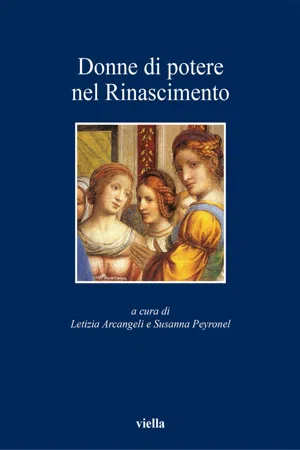
Donne di potere nel Rinascimento
- 834 pagine
- Italian
- ePUB (disponibile su mobile)
- Disponibile su iOS e Android
eBook - ePub
Donne di potere nel Rinascimento
Informazioni su questo libro
Le protagoniste di questo volume – principesse, sovrane di piccoli Stati autonomi, parenti di papi e cardinali, feudatarie e patrizie – sono tutte molto attive nella società politica del Rinascimento italiano: organizzano corti e accademie, governano come reggenti, partecipano alla lotta politica, in alcuni casi sono addirittura alla testa di piccoli eserciti.
Donne di potere nel Rinascimento non costituisce tuttavia una raccolta di biografie di donne illustri, bensì la dimostrazione della "normalità" di un nesso tra le donne dell'aristocrazia italiana e il potere.
I contributi qui raccolti mostrano infatti come, nella complessa articolazione dei poteri dell'antico regime, queste gentildonne assunsero – accanto ai loro padri, fratelli, mariti, figli e nipoti – ruoli di rilievo politico all'interno della sfera pubblica. Ma raccontano anche del loro potere informale, legato alla socialità femminile, di un potere "discorsivo", delle "emozioni", come obblighi affettivi, di onore e fedeltà, che legavano gli individui di un gruppo, o anche del potere dell'amore.
Informazioni
Argomento
HistoryCategoria
Early Modern HistoryIII. Donne e potere politico
Christine Shaw
Bartolomea Campofregoso: A Woman’s Claim to Power in Fifteenth-Century Genoa
Bartolomea Campofregoso was the wife of one doge of Genoa, the mother of another, and the sister-in-law of a third. Her husband was Pietro Campofregoso, doge from 1450 to 1458; her son Battista (Battistino) was doge from 1478 to 1483. Her brother-in-law, Paolo Campofregoso, Archbishop of Genoa, promoted to be a cardinal in 1480, was doge for three periods: briefly, for a few days in May 1462, again from January 1463 to March 1464, and the third time – after he had deposed his nephew Battista – from 1483 to 1487. Bartolomea did not live to see the deposition of her son by her brother-in-law; she died in 1481. In her lifetime, she had not been an enemy to Paolo. On the contrary, the period of her greatest prominence in the affairs of Genoa was not the years in which she was the dogaressa, the consort of Pietro Campofregoso, but the years after his death in 1459, years in which she and Paolo were close collaborators, sometimes conspirators, in the complex struggle for power in Genoa. For several years, she was a participant on her own behalf rather than in defence of the interests of her son, in the competition among the Campofregoso for control of the office of doge and control of the principal fortress of the city, the Castelletto. It was at this time that Bartolomea played an unusually prominent part for a woman in the political life of the city – although her prominence in the affairs of the family was not so unusual for a woman from the noble families, the signori di castello in the Riviere and the mountains of Liguria.
In fact, Bartolomea came from one of these families, the Grimaldi, one of the four powerful clans that had dominated Genoa in the thirteenth century. She was the daughter of Giovanni Grimaldi of Monaco. Her mother was a Campofregoso, Pomellina, a strong-minded woman from whom Bartolomea could have taken example. While Giovanni was absent from Monaco in 1437, Pomellina, acting on his behalf, had made an agreement with Genoa, placing Giovanni and herself under the protection of the doge Tommaso Campofregoso. The year after, Giovanni was arrested in Lombardy, and was handed over, with their son Catalano, to the duke of Savoy. When the duke tried to convince Pomellina to cede Monaco to him in exchange for the liberation of her husband and her son, she refused, in accordance with Giovanni’s wishes. They were eventually freed in the autumn of 1440.1271
In Bartolomea’s marriage contract, drawn up in 1445, apart from being given a dowry of 2,500 ducats, she was named heiress of all the lands and fortresses of her father, should her brother Catalano die without legitimate heirs.1272 This nomination was repeated in her father’s final will, made before his death in 1454; until such time as she should become Catalano’s heiress, she must content herself with her dowry. Pomellina was left furnishings, jewels, clothes, a house in Menton and a vineyard in Turbia.1273 But Pomellina was not ready to withdraw into a secluded widowhood; she behaved as though she was still the signora of Monaco; it was Pomellina, and not her submissive son Catalano who commanded there. When Catalano died in July 1457, by his will he appointed his mother as guardian of his young daughter Claudine, who was to inherit Monaco – but only after the death of Pomellina. The men of his lands were to swear «homagium ligium et fidelitatis sacramentum» to Pomellina, who would be under no obligation to render any account of her guardianship of the inheritance of little Claudine. If Claudine died without heirs, Bartolomea was to succeed her.1274
The unusual terms of this will were contested by Lamberto Grimaldi, who was betrothed to Claudine, and Pomellina, on the advice of other relatives, yielded. It was agreed that Lamberto, acting on behalf of Claudine, should share the government and administration of Monaco and the other lands with Pomellina. Bartolomea’s rights to inherit if her niece died childless were confirmed, and it was stipulated that she and her husband Pietro Campofregoso could visit Monaco and the other estates at their pleasure.1275 This agreement, made in October 1457, did not, however, please Pomellina who conspired with Pietro against Lamberto. After their plots failed in March 1458, Pomellina had to leave Monaco, and go to live in the house her husband had bequeathed her in Menton. There she began conspiring against Lamberto again, inciting the men of Menton to rebel against him and to submit to the duke of Savoy in 1466, but within the year, with the diplomatic support of Galeazzo Maria Sforza, duke of Milan, Lamberto recovered Menton.1276 In November 1468 Pomellina left Menton, and returned to Monaco, where, apparently reconciled to the signoria of her granddaughter’s husband, she died some years later.1277
Bartolomea, therefore, had in her own mother the example of a woman ready to assume and keep a position of command in the administration of the political interests as well as the patrimony of the family into which she had married, and to act not only as the guardian of the interests and the inheritance of her children. The years in which Pomellina was at the height of her power in Monaco were the years in which her daughter Bartolomea was dogaressa of Genoa. As dogaressa, however, Bartolomea had no power, at least no official power. If she exercised any influence over her husband, if she had any voice in his private counsels, it has left no trace in the abundant documentation of Pietro’s time in office.1278
In 1458, the year Pomellina had been forced to leave Menton, Pietro, in effect, sold the city and stato of Genoa to the king of France. The money he was supposed to receive was not forthcoming; nevertheless, his family, including Bartolomea, continued to feel they had a right to it. Pietro soon repented of his bargain and, justifying his actions on the grounds that the terms of his agreement with the French had not been observed, tried to return to Genoa and recover power there. In September 1459, as he tried to enter the city by force, he was killed.
The widowed Bartolomea was at Novi, with her children. Novi was an important stronghold, a significant centre of population in the mountains near the border with the duchy of Milan. Pietro had wanted to make Novi, in a sense, a foundation of the power and prestige of his own branch of the Campofregoso. He had taken to calling himself Pietro Campofregoso da Novi, and Bartolomea adopted this nomenclature.1279 She turned to the duke of Milan, Francesco Sforza, and the duchess Bianca Maria, for help and support, repeatedly protesting her loyalty. Much of the information that survives about Bartolomea in the next years has been preserved in the correspondence in the Archivio Sforzesco. During these years, she collaborated closely with Pietro’s brothers, Archbishop Paolo and Pandolfo, and even when their interests seemed to be somewhat divergent, there were no indications of conflicts or even tensions among these three. It was evident that Bartolomea enjoyed the confidence and esteem of Paolo, who was not a placid and amenable man, not the sort of man readily to follow where others might lead. Both of them, the widow and the archbishop, had forceful personalities, and were ambitious and decisive – that they should have acted together so harmoniously is striking.
At the time of Pietro’s death, Bartolomea and Paolo were both in Novi, from where they wrote a joint letter to Bianca Maria Sforza, asking for help. They had heard only that he had been captured, not that he had been killed, and expressed their...
Indice dei contenuti
- Copertina
- Occhiello
- Frontespizio
- Colophon
- Indice
- Letizia Arcangeli e Susanna Peyronel, Premessa
- Abbreviazioni
- I. Tra famiglie e patrimoni: ricchezze materiali e immateriali
- II. Reti di poteri e spazi di corte femminili
- III. Donne e potere politico
Scelto da 375,005 studenti
Accesso a oltre 1,5 milioni di titoli a un prezzo mensile trasparente.
Studia in modo più efficiente con i nostri strumenti dedicati.
Domande frequenti
Sì, puoi annullare l'abbonamento in qualsiasi momento dalla sezione Abbonamento nelle impostazioni del tuo account sul sito web di Perlego. L'abbonamento rimarrà attivo fino alla fine del periodo di fatturazione in corso. Scopri come annullare l'abbonamento
No, i libri non possono essere scaricati come file esterni, ad esempio in formato PDF, per essere utilizzati al di fuori di Perlego. Tuttavia, puoi scaricarli nell'app Perlego per leggerli offline su smartphone o tablet. Scopri come scaricare libri offline
Perlego offre due piani: Essential e Complete
- Essential è l'ideale per chi studia o per i professionisti che amano esplorare una vasta gamma di argomenti. Accedi all'Essential Library con oltre 800.000 titoli affidabili e bestseller nei settori business, crescita personale e discipline umanistiche. Include tempo di lettura illimitato e voce standard per la funzione Leggi ad alta voce.
- Complete: perfetto per studenti avanzati e ricercatori che necessitano di accesso completo e senza restrizioni. Sblocca oltre 1,5 milioni di libri su centinaia di argomenti, inclusi titoli accademici e specialistici. Il piano Complete offre anche funzionalità avanzate come Leggi ad alta voce Premium e Assistente alla ricerca.
Perlego è un servizio di abbonamento a libri di testo online che ti permette di accedere a un'intera biblioteca digitale a meno del prezzo di un singolo libro al mese. Con oltre 1,5 milioni di libri su più di 990 argomenti, qui trovi tutto ciò che ti serve! Scopri la nostra missione
Cerca l'icona Sintesi vocale nel prossimo libro che leggerai per verificare se è possibile riprodurre l'audio. Questo strumento permette di leggere il testo a voce alta, evidenziandolo man mano che la lettura procede. Puoi aumentare o diminuire la velocità della sintesi vocale, oppure sospendere la riproduzione. Scopri di più sulla funzione di sintesi vocale
Sì! Puoi utilizzare l'app di Perlego su dispositivi iOS e Android per leggere quando e dove vuoi, anche offline. È perfetta per gli spostamenti quotidiani o quando sei in viaggio.
I dispositivi con iOS 13 e Android 7 o versioni precedenti non sono supportati. Scopri di più su come utilizzare l'app
I dispositivi con iOS 13 e Android 7 o versioni precedenti non sono supportati. Scopri di più su come utilizzare l'app
Sì, puoi accedere a Donne di potere nel Rinascimento di Autori Vari, Letizia Arcangeli,Susanna Peyronel Rambaldi, Letizia Arcangeli, Susanna Peyronel in formato PDF e/o ePub, così come ad altri libri molto apprezzati su History e Early Modern History. Abbiamo oltre 1,5 milioni di libri disponibili nel nostro catalogo da esplorare.