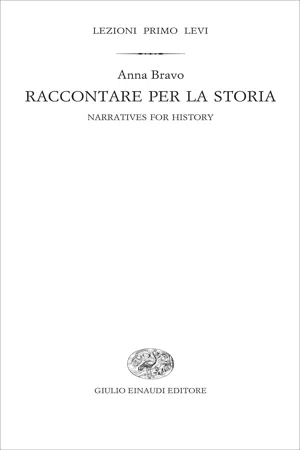
«Raccontare per la storia» significò per Primo Levi due cose essenziali: dare forma all'esperienza di Auschwitz con gli strumenti del narratore - un narratore di fatti reali - capace di stendere un referto significativo per lo storico di professione oltre che per il lettore comune; possedere la sensibilità e il coraggio di proporre categorie nuove per rileggere la Shoah: dalla «zona grigia» alla «vergogna del sopravvissuto». Più coraggiosa ancora la riflessione, radicata nella sua breve esperienza di partigiano, sulla violenza compiuta da chi combatte per una causa giusta. Durante quarant'anni - l'arco che va da Se questo è un uomo a Il sistema periodico a I sommersi e i salvati - Levi ha affidato alla storia le sue narrazioni e le sue diagnosi eticopolitiche. Le raccoglie una storica, Anna Bravo, che lo intervistò nel 1983 e che ci racconta perché esse restino valide oggi e per ogni prevedibile futuro. *** «Narratives for History» meant two main things for Primo Levi: giving form to the experience of Auschwitz with the tools of a narrator - a narrator of real events - in an account that was useful to the professional historian as well as the general reader; and having the sensitivity and courage to suggest new categories for reinterpreting the Shoah: from the «gray zone» to «survivor shame». More courageous still were his thoughts, rooted in his brief experience as a partisan, on violence perpetrated by people fighting for a just cause. For forty years - the period that runs from If This is a Man through The Periodic Table to The Drowned and the Saved - Levi plied history with his narratives and his moral and political diagnoses. They are collected here by a historian, Anna Bravo, who interviewed him in 1983, and who explains why they are still valid today and will remain so for the forseeable future.
- 224 pagine
- Italian
- ePUB (disponibile su mobile)
- Disponibile su iOS e Android
eBook - ePub
Informazioni su questo libro
Informazioni
Argomento
LiteratureCategoria
Literary CriticismNarratives for History
A temptation one could easily fall into apropos of Primo Levi is to think of him as an icon of the Great Witness. That would be doing him an injustice. An icon is by definition never-changing, crystallized around a single meaning, whereas Levi, though indeed a great witness, was also a poet, non-fiction writer and novelist who dealt with themes other than the Shoah. And even on the Shoah he was an evolving thinker, mindful of his duty to bear witness, and as such adept at shifting the focus of his stories and thought on to any register suggested by his personal development, the cultural setting in which his words would be uttered, and the different audiences he addressed them to – schools, conferences, groups of friends, or a wider and more variegated external world.
Primo Levi did not regard history as the universal heir to the past, of which memory was an ingredient or a rough draft. But he knew the importance of historical research in forming the public memory, and he hoped for the emergence of a kind of history that could handle extreme events, and offered it analytical tools and concepts that might help to bring about such a change. It was a complex endeavour, in which he did not always find support, but into which he put a lot of his energy: not one of the lessons we owe to him would have been formulated without his radical independence of judgement, his refusal to treat truth to experience as something subservient to ideological imperatives or group solidarity, and his courage in exposing himself to criticism, disavowals and misunderstandings.
But history often struggled to keep pace with Primo Levi, and not just through inertia or narrow-mindedness. It was as if professional historians considered the Shoah extraneous to their field of expertise, a phenomenon too remote and anomalous, too unsuited to use as a lesson for the future. It’s strange: the profoundest observations on the human condition came from those who reflected freely on the concentration camps, as if only an extreme experience could fully illuminate issues that tend to be blurred in normal life. Yet at the same time Levi warned that it was essential to avoid seeing every oppressive situation as a concentration camp, or taking extermination as a metaphor for modernity, and totalitarianism as the innermost truth of democracy.
Of the themes that Levi’s writings help us to reflect on, I have chosen three. First, his crucial role in focusing attention on the experience and image of racially motivated deportation. Second, the gray zone, especially the links between privilege on the one hand and survival and memory on the other; and the importance of this concept for the historiography of the Resistance and the war. Lastly, the pain that violence inflicted by the ‘just’ causes, not only to the people against whom it is directed, but also to those who inflict it.
1. Deportation on racist grounds.
The confusion of the postwar years.
Today the term deportation instantly calls to mind Auschwitz, a place and word which are symbols of the persecution and extermination of Jews. It was not always thus. In the immediate postwar period, and for many years afterwards, the deportee was essentially a political activist – a partisan and an anti-Fascist militant. To understand what Primo Levi gave to history, we have to start from that period.
It is well known that the awareness that genocide had been the linchpin of Nazi ideology, and of the concentration camp system, was slow to develop and not widespread. This has been shown by several studies of Italy and France, such as Annette Wieviorka’s excellent (and shamefully untranslated into Italian) Déportation et génocide1.
There are precise reasons for the delay. Given the chaotic flow of people from Germany and Poland, it was a more complicated matter than we might imagine today to distinguish former Auschwitz inmates and concentration camp deportees from military prisoners and the so-called ‘free workers’. And the pre-eminence of political activists was influenced by a simple fact: more men had come back from Buchenwald or Mauthausen and more women from Ravensbrück than had returned from Auschwitz, and the role of symbolic camps had fallen to the former rather than the latter2. Consequently, all deportees came to be thought of as political activists.
There were also tactical and ideological reasons. Some of them noble: in those years the Fascism / anti-Fascism dichotomy was so all-embracing, so ‘untouchable’, that distinguishing an experience from that background would have been tantamount to devaluing it; and calling it unpolitical would have meant restricting it to the private sphere, which at that time was considered historically insignificant. The risk was that a hierarchy of reasons for being arrested might degenerate into a hierarchy of sufferings.
The crucial factor was probably a political calculation. For some countries, the priority during this phase was building, or rebuilding, a national identity damaged or shattered by wartime choices, and the deportation might have been an important element in this, both in a positive and in a negative sense. Focusing on the persecution of the Jews would have meant facing up to the shame of the past – which in France involved Vichy, in Italy Fascism as a prototypical authoritarian regime, the war, and the Republic of Salò; and in both countries it would have highlighted the anti-Jewish zeal of the authorities and some sectors of the population. By contrast, widening the Resistance frame to include all those who had returned from Germany could not fail to boost the national image (and the political parties, which wanted to swell the ranks of the appropriate Resistance groups). This was the path that was taken in the immediate postwar period.
However, the concern to lump the deportees together into a single category had a high price: the persecution of the Jews risked being reduced to a religious or ‘ethnic’ detail in the Nazi war on anti-Fascism and the Resistance, and there was a blurring of the distinction between deportation and genocide, as if the latter were an extreme instance of the former. The French political debate reached the point where a specific statute was passed requiring that the bodies of victims should be returned to their families3 – but what about the ashes of the Jews who had been burnt in Auschwitz?
In France these unresolved tensions led to outright conflict between the different representations of the deportation: the political, the nationalist and patriotic, and that of the Jewish communities. In Italy the early creation of a single association of deportees reflected and fostered a political dialogue quite unlike the discord in France between conservative organizations with Gaullist sympathies and others of communist origin4.
Nevertheless, when Levi wrote If This Is a Man, the Jews’ voice was still mixed up with those of other prisoners. Although some of the authors of the earliest memoirs were Jews, they stressed their political activist side, beginning their accounts with a history of Resistance struggle leading to the concentration camp – like many of their non-Jewish comrades, with whom they shared a strong commitment to secular and progressive universalism. It is a powerful, evocative kind of history, which emphasizes the dual identity of partisan and deportee – as if the latter on its own might seem incomplete, or too feeble in comparison with the former.
To some extent that is exactly what happened. In the official accounts and in the public imagination a partisan was someone who, after fighting in the mountains, came down to the lowlands during the Liberation, clashed with the last Fascists and Germans and paraded through the streets, visually embodying the irruption of the new into politics and everyday life. The deportees were a different proposition, less ‘spectacular’, less numerous, arriving when the party was already over, as it were, laden with unparalleled meanings – and, as a consequence, perhaps, seen merely as victims of a vague, distant horror. Primo Levi himself returned to Turin on 19th October 1945, some six months after the Liberation.
Even in the anti-Fascist movement and among the partisans it was hard to get away from this view. If many deportees refrained from telling their stories in the postwar years, it was mainly because the country, preoccupied with its own experiences and with reconstruction, wasn’t listening; because they feared people wouldn’t believe them; because they themselves were trying to forget, and wanted to protect their families from the trauma of knowing – and for various other reasons.
But certainly a significant factor was the irrepressible self-promotion of the people with whom the deportees felt the closest affinity, the partisans – though this does not justify the commonplace that the survivors didn’t talk and write, and so didn’t provide history with any material. Some did so from the outset; many, after waiting for a long time, told their stories once they thought the atmosphere was receptive. If there was one group that tried to provide information to foster complete understanding, it was the former deportees. It was the scholars who opted for silence, shifting responsibility from themselves to the protagonists, from historiography to memory.
Levi the Jewish deportee.
Primo Levi departs markedly from the ‘Resistance’ narrative model. He plays down his experiences in the mountains and stresses his Jewish identity. This set him apart even from some of his closest associates, and jeopardized his chances of attracting a major publisher. One wonders if Einaudi would have been more inclined to publish a more partisan, militant, epic, ‘heroic’ If This Is a Man5 – those were the years when the great Giacomo Debenedetti wrote: “And if one day someone decides to reward the valour of these fallen soldiers, we, the surviving Jews, will certainly not refuse the honour; but let no special medals be minted, no special certificates be printed; let them be the same medals and certificates that other soldiers receive”. And he claims that title of ‘soldier’ for little five-year-old “Chaim Blumenthal, who had fallen at Lviv, among his family, his hands tied behind his back, still defending and bearing witness to the cause of freedom”6.
But Levi knew he himself was not a soldier; he did not aspire to that title – perhaps he didn’t consider it a mark of honour, either. This, too, was a difference, and a very interesting one. Although in the Resistance, and in the state that grew out of it, the impulse towards renewal affected some crucial political and institutional areas, one of the traditional foundations of citizenship still remained strong, at a symbolic level: the link that subordinates full citizenship to the prerogative of bearing arms, with the corollary that those who are unarmed by necessity or choice – notably women – are relegated to the status of minor figures, second-class citizens. It is the model bequeathed to the modern world by the French Revolution an...
Indice dei contenuti
- Copertina
- Raccontare per la storia
- Raccontare per la storia
- Narratives for History
- Appendice
- Appendix
- Il libro
- L’autore
- Dello stesso autore
- Copyright
Scelto da 375,005 studenti
Accesso a oltre 1,5 milioni di titoli a un prezzo mensile trasparente.
Studia in modo più efficiente con i nostri strumenti dedicati.
Domande frequenti
Sì, puoi annullare l'abbonamento in qualsiasi momento dalla sezione Abbonamento nelle impostazioni del tuo account sul sito web di Perlego. L'abbonamento rimarrà attivo fino alla fine del periodo di fatturazione in corso. Scopri come annullare l'abbonamento
No, i libri non possono essere scaricati come file esterni, ad esempio in formato PDF, per essere utilizzati al di fuori di Perlego. Tuttavia, puoi scaricarli nell'app Perlego per leggerli offline su smartphone o tablet. Scopri come scaricare libri offline
Perlego offre due piani: Essential e Complete
- Essential è l'ideale per chi studia o per i professionisti che amano esplorare una vasta gamma di argomenti. Accedi all'Essential Library con oltre 800.000 titoli affidabili e bestseller nei settori business, crescita personale e discipline umanistiche. Include tempo di lettura illimitato e voce standard per la funzione Leggi ad alta voce.
- Complete: perfetto per studenti avanzati e ricercatori che necessitano di accesso completo e senza restrizioni. Sblocca oltre 1,5 milioni di libri su centinaia di argomenti, inclusi titoli accademici e specialistici. Il piano Complete offre anche funzionalità avanzate come Leggi ad alta voce Premium e Assistente alla ricerca.
Perlego è un servizio di abbonamento a libri di testo online che ti permette di accedere a un'intera biblioteca digitale a meno del prezzo di un singolo libro al mese. Con oltre 1,5 milioni di libri su più di 990 argomenti, qui trovi tutto ciò che ti serve! Scopri la nostra missione
Cerca l'icona Sintesi vocale nel prossimo libro che leggerai per verificare se è possibile riprodurre l'audio. Questo strumento permette di leggere il testo a voce alta, evidenziandolo man mano che la lettura procede. Puoi aumentare o diminuire la velocità della sintesi vocale, oppure sospendere la riproduzione. Scopri di più sulla funzione di sintesi vocale
Sì! Puoi utilizzare l'app di Perlego su dispositivi iOS e Android per leggere quando e dove vuoi, anche offline. È perfetta per gli spostamenti quotidiani o quando sei in viaggio.
I dispositivi con iOS 13 e Android 7 o versioni precedenti non sono supportati. Scopri di più su come utilizzare l'app
I dispositivi con iOS 13 e Android 7 o versioni precedenti non sono supportati. Scopri di più su come utilizzare l'app
Sì, puoi accedere a Raccontare per la storia di Anna Bravo, Jonathan Hunt in formato PDF e/o ePub, così come ad altri libri molto apprezzati su Literature e Literary Criticism. Abbiamo oltre 1,5 milioni di libri disponibili nel nostro catalogo da esplorare.