Clinical Endocrinology of Companion Animals
  1. English
  2. ePUB (mobile friendly)
  3. Available on iOS & Android
eBook - ePub

About this book

Clinical Endocrinology of Companion Animals offers fast access to clinically relevant information on managing the patient with endocrine disease. Written by leading experts in veterinary endocrinology, each chapter takes the same structure to aid in the rapid retrieval of information, offering information on pathogenesis, signalment, clinical signs, diagnosis, differential diagnosis, treatment, prognosis, and prevention for a broad list of endocrine disorders.  Chapters begin with brief summaries for quick reference, then delve into greater detail.

With complete coverage of the most common endocrine diseases, the book includes chapters on conditions in dogs, cats, horses, ferrets, reptiles, and other species.  Clinical Endocrinology of Companion Animals is a highly practical resource for any veterinarian treating these common diseases.
Frequently asked questions

Yes, you can cancel anytime from the Subscription tab in your account settings on the Perlego website. Your subscription will stay active until the end of your current billing period. Learn how to cancel your subscription.
No, books cannot be downloaded as external files, such as PDFs, for use outside of Perlego. However, you can download books within the Perlego app for offline reading on mobile or tablet. Learn more here.
Perlego offers two plans: Essential and Complete
  • Essential is ideal for learners and professionals who enjoy exploring a wide range of subjects. Access the Essential Library with 800,000+ trusted titles and best-sellers across business, personal growth, and the humanities. Includes unlimited reading time and Standard Read Aloud voice.
  • Complete: Perfect for advanced learners and researchers needing full, unrestricted access. Unlock 1.4M+ books across hundreds of subjects, including academic and specialized titles. The Complete Plan also includes advanced features like Premium Read Aloud and Research Assistant.
Both plans are available with monthly, semester, or annual billing cycles.
We are an online textbook subscription service, where you can get access to an entire online library for less than the price of a single book per month. With over 1 million books across 1000+ topics, we’ve got you covered! Learn more here.
Look out for the read-aloud symbol on your next book to see if you can listen to it. The read-aloud tool reads text aloud for you, highlighting the text as it is being read. You can pause it, speed it up and slow it down. Learn more here.
Yes! You can use the Perlego app on both iOS or Android devices to read anytime, anywhere — even offline. Perfect for commutes or when you’re on the go.
Please note we cannot support devices running on iOS 13 and Android 7 or earlier. Learn more about using the app.
Yes, you can access Clinical Endocrinology of Companion Animals by Jacquie Rand, Ellen Behrend, Danielle Gunn-Moore, Michelle Campbell-Ward, Jacquie Rand,Ellen Behrend,Danielle Gunn-Moore,Michelle Campbell-Ward in PDF and/or ePUB format, as well as other popular books in Medicina & Medicina veterinaria. We have over one million books available in our catalogue for you to explore.

Information

Year
2012
Print ISBN
9780813805832
eBook ISBN
9781118444979
Edition
1

CHAPTER 1

Hypoadrenocorticism in Dogs

Patty Lathan
Pathogenesis
  • Primary hypoadrenocorticism results from the destruction of >90% of the adrenal cortex.
  • Most cases are presumed to be due to an immune-mediated process.
  • Combined glucocorticoid and mineralocorticoid deficiency occur most frequently, but isolated glucocorticoid deficiency (“atypical hypoadrenocorticism”) is probably underdiagnosed.
Classical Signs
  • Young to middle-age dogs are predisposed, as are poodles, West Highland White Terriers, and Great Danes.
  • Addison’s disease is known as the “Great Pretender” because nonspecific signs such as lethargy, decreased appetite, and weight loss predominate.
  • Gastrointestinal signs such as vomiting and diarrhea are also common.
  • Patients may present in hypovolemic shock or following collapse.
Diagnosis
  • ACTH stimulation test demonstrates minimal cortisol response.
Treatment
  • Glucocorticoid and mineralocorticoid supplementation, Âą intravenous fluids and supportive therapy.

I. Pathogenesis

A. Pathophysiology:
1. Most patients with naturally occurring hypoadrenocorticism (“Addison’s disease”) suffer from ­combined glucocorticoid and mineralocorticoid deficiency:
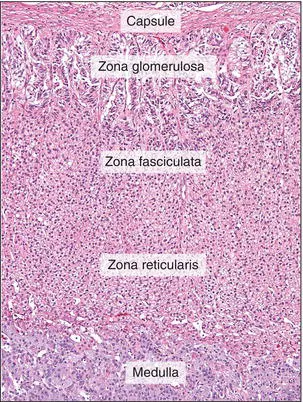
Figure 1.1 The adrenal cortex is made up of three layers—the zona glomerulosa, zona fasciculata, and zona reticularis. The zone glomerulosa is responsible for mineralocorticoid synthesis, whereas the inner two layers are responsible for glucocorticoid and sex hormone synthesis. (Image provided by Dr. Jim Cooley.)
image
a. Aldosterone is a mineralocorticoid secreted in the outermost layer of the adrenal cortex, the zona glomerulosa (Figure 1.1). The major action of aldosterone is the conservation of sodium and water, and excretion of potassium and hydrogen ions (acid), from the distal renal tubule. In ­normal dogs, secretion of aldosterone is stimulated by hypovolemia and hyperkalemia and is primarily regulated by the renin-angiotensin-aldosterone system (RAAS). In patients with ­hypoadrenocorticism and subsequent aldosterone deficiency, hyponatremia, hyperkalemia, and hypovolemia are common.
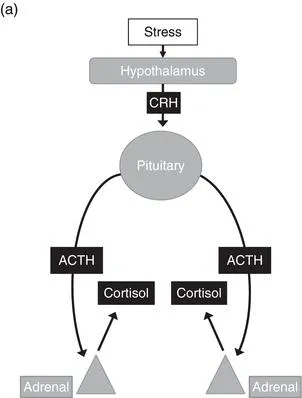
b. Cortisol is a glucocorticoid produced in the inner-most layers of the adrenal cortex, the zonae fasciculata and reticularis. Cortisol has activity in almost every cell in the body. Functions include stimulation of gluconeogenesis and erythropoiesis, maintenance of gastrointestinal mucosal integrity, and suppression of the inflammatory response. Additionally, cortisol has important roles in the maintenance of blood pressure and contractility of the heart. Cortisol requirements increase during times of stress. Cortisol release from the adrenal cortex is controlled by adrenocorticotropic hormone (ACTH) (Figure 1.2). Cortisol deficiency in dogs with hypoadrenocorticism may result in gastrointestinal signs, lethargy, hypoglycemia, hypotension, and anemia.
2. Some patients with hypoadrenocorticism suffer from isolated glucocorticoid deficiency. In these cases, aldosterone secretion is preserved, and electrolyte abnormalities are not present. Patients with isolated glucocorticoid deficiency are often said to have “atypical hypoadrenocorticism” or “atypical Addison’s disease.”
B. Etiology:
1. Primary hypoadrenocorticism results from the destruction of greater than 90% of the adrenal cortex. Most cases of naturally occurring hypoadrenocorticism in dogs are idiopathic, most likely due to immune-mediated destruction of the adrenal cortex. Rarely, infiltration of the adrenal cortex by fungal disease, amyloidosis, or neoplasia has been reported. Trauma, hemorrhage, and infarction may also lead to hypoadrenocorticism.
2. Drug-induced adrenocorticolysis can also result in hypoadrenocorticism in dogs being treated for hyperadrenocorticism:
a. Adrenocortical necrosis caused by mitotane is usually selective to the zonae fasciculata and reticularis, resulting in decreased cortisol production. However, inadequate monitoring or use in a ­particularly sensitive patient may lead to destruction of the cells of the zona glomerulosa, resulting in aldosterone deficiency as well.
b. The other commonly used medication to treat hyperadrenocorticism is trilostane. As an inhibitor of at least one enzyme involved in steroid synthesis (3β-hydroxysteroid dehydrogenase), trilostane overdose may lead to cortisol deficiency and, less frequently, aldosterone deficiency. Additionally, idiosyncratic adrenocortical necrosis has been reported to occur in some dogs taking trilostane, resulting in hypoadrenocorticism.
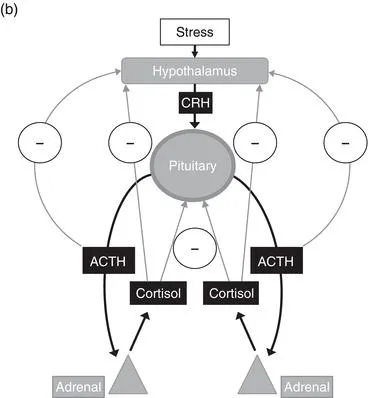
Figure 1.2 (a) The hypothalamic pituitary axis without negative feedback. Corticotropin-releasing hormone (CRH) is released by neurons in the hypothalamus and transported to the anterior pituitary by portal circulation. CRH then stimulates the release of ACTH from the pituitary gland into systemic circulation. ACTH then stimulates the synthesis and secretion of cortisol. (b) Negative feedback is the mechanism by which the endocrine system regulates secretion of its hormones. In the HPA-axis, ACTH feeds back to the hypothalamus to inhibit continued release of CRH, which then leads to decreased release of ACTH. Cortisol feeds back to both the hypothalamus to decrease CRH secretion, and to the pituitary gland to decrease ACTH release. By this mechanism, the HPA-axis is able to maintain the physiologically necessary concentration of cortisol in the bloodstream—not too much, nor too little.
image
image
3. Hypoadrenocorticism secondary to decreased ACTH production is characterized by isolated glucocorticoid deficiency since ACTH has little regulatory control of aldosterone production:
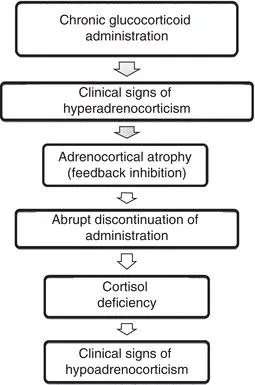
a. The most common form of secondary hypoadrenocorticism is iatrogenic, resulting from exogenous glucocorticoid administration (Figure 1.3). Exogenous glucocorticoids inhibit the release of adrenocorticotropic hormone (ACTH) from the pituitary gland. Adrenal gland atrophy then occurs, resulting in decreased secretion of cortisol. Following acute withdrawal of the exogenous glucocorticoid, a stressful event will cause increased release of ACTH, but the atrophied adrenal glands will be unable to respond by secreting an appropriate amount of cortisol, which may result in signs of cortisol deficiency. Chronic administration of glucocorticoids is more likely to result in hypoadrenocorticism than short-term use, and longer-acting repositol steroids (such as methylprednisolone acetate) are more potent suppressors of ACTH than shorter-acting glucocorticoids (such as oral prednisolone). Topical, otic, and ophthalmic preparations containing glucocorticoids may also lead to iatrogenic hypoadrenocorticism, particularly in smaller patients.
b. Naturally occurring causes of secondary hypoadrenocorticism include pituitary masses, trauma, or other lesions that inhibit ACTH release.
Figure 1.3 Diagrammatic representation of the relationship between iatrogenic hyperadrenocorticism and iatrogenic hypoadrenocorticism. Chronic glucocorticoid administration leads to clinical signs of glucocorticoid excess (“iatrogenic hyperadrenocorticism”). At the same time, the exogenous glucocorticoid provides feedback inhibition to the pituitary gland, decreasing the production of ACTH. Without ACTH, the dog’s own adrenal glands atrophy. While the dog is still taking the exogenous glucocorticoids, the dog will appear to have hyperadrenocorticism. Upon abrupt withdrawal of the steroid, the dog’s own atrophied adrenal gland will be unable secrete cortisol, potentially resulting in clinical signs of hypoadrenocorticism. Clinical signs may be seen more often following a stressful event in these patients.
image
4. At this time, the etiology of atypical hypoadrenocorticism (isolated glucocorticoid deficiency) is un­known. ACTH deficiency has been ruled out in many cases. It may be the result of partial immune-mediated destruction of the adrenal cortex, sparing the zona glomerulosa. Although some have hypothesized that atypical hypoadrenocorticism is simply an early manifestation of “typical” hypoadrenocorticism, many patients never lose their ability to secrete aldosterone.
C. Risk factors for hypoadrenocorticism:
1. Dogs with other immune-mediated endocrinopathies, such as diabetes mellitus and hypothyroidism, may be at increased risk for hypoadrenocorticism.
2. Dogs with the disease are more likely to have clinical signs during or following a stressful event.

II. Signalment

A. Any breed of dog may be afflicted with hypoadrenocorticism, including mixed-breeds. However, an increased prevalence of hypoadrenocorticism has been documented in all sizes of poodles, West Highland white ­terriers, Great Danes, bearded collies, Portuguese water dogs, Leonbergers, Nova Scotia duck-tolling ­retrievers, and possibly Saint Bernards.
B. A genetic basis has been proved in standard poodles, Bearded collies, and Nova Scotia duck-tolling retrievers.
C. Young to middle-aged dogs (2–5 years old) are predisposed. However, dogs of any age can be diagnosed with hypoadrenocort...

Table of contents

  1. Cover
  2. Title page
  3. Copyright page
  4. Dedication
  5. Contributors
  6. Preface
  7. CHAPTER 1: Hypoadrenocorticism in Dogs
  8. CHAPTER 2: Hypoadrenocorticism in Cats
  9. CHAPTER 3: Hypoadrenocorticism in Other Species
  10. CHAPTER 4: Critical Illness-Related Corticosteroid Insufficiency (Previously Known as Relative Adrenal Insufficiency)
  11. CHAPTER 5: Hyperadrenocorticism in Dogs
  12. CHAPTER 6: Primary Functioning Adrenal Tumors Producing Signs Similar to Hyperadrenocorticism Including Atypical Syndromes in Dogs
  13. CHAPTER 7: Hyperadrenocorticism in Cats
  14. CHAPTER 8: Primary Functioning Adrenal Tumors Producing Signs Similar to Hyperadrenocorticism Including AtypicalSyndromes in Cats
  15. CHAPTER 9: Hyperadrenocorticism in Ferrets
  16. CHAPTER 10: Hyperadrenocorticism and Primary Functioning Adrenal Tumors inOther Species (Excluding Horses and Ferrets)
  17. CHAPTER 11: Hyperadrenocorticism (Pituitary Pars Intermedia Dysfunction) in Horses
  18. CHAPTER 12: Primary Hyperaldosteronism
  19. CHAPTER 13: Pheochromocytoma in Dogs
  20. CHAPTER 14: Pheochromocytoma in Cats
  21. CHAPTER 15: Canine Diabetes Mellitus
  22. CHAPTER 16: Feline Diabetes Mellitus
  23. CHAPTER 17: Diabetes Mellitus in Other Species
  24. CHAPTER 18: Canine Diabetic Emergencies
  25. CHAPTER 19: Feline Diabetic Ketoacidosis
  26. CHAPTER 20: Equine Metabolic Syndrome/Insulin Resistance Syndrome in Horses
  27. CHAPTER 21: Insulinoma in Dogs
  28. CHAPTER 22: Insulinoma in Cats
  29. CHAPTER 23: Insulinomas in Other Species
  30. CHAPTER 24: Gastrinoma, Glucagonoma, andOther APUDomas
  31. CHAPTER 25: Hypothyroidism in Dogs
  32. CHAPTER 26: Hypothyroidism in Cats
  33. CHAPTER 27: Hypothyroidism in Other Species
  34. CHAPTER 28: Hyperthyroidism in Dogs
  35. CHAPTER 29: Hyperthyroidism in Cats
  36. CHAPTER 30: Hyperthyroidism/Thyroid Neoplasia in Other Species
  37. CHAPTER 31: Hypocalcemia in Dogs
  38. CHAPTER 32: Hypocalcemia in Cats
  39. CHAPTER 33: Hypocalcemia in Other Species
  40. CHAPTER 34: Hypercalcemia in Dogs
  41. CHAPTER 35: Hypercalcemia in Cats
  42. CHAPTER 36: Hypercalcemia in Other Species
  43. CHAPTER 37: Nutritional Secondary Hyperparathyroidism in Reptiles
  44. CHAPTER 38: Hyposomatotropism in Dogs
  45. CHAPTER 39: Hyposomatotropism in Cats
  46. CHAPTER 40: Acromegaly in Dogs
  47. CHAPTER 41: Acromegaly in Cats
  48. CHAPTER 42: Diabetes Insipidus and Polyuria/Polydipsia in Dogs
  49. CHAPTER 43: Diabetes Insipidus in Cats
  50. CHAPTER 44: Hyponatremia, SIADH, andRenal Salt Wasting
  51. CHAPTER 45: Estrogen- and Androgen-Related Disorders
  52. CHAPTER 46: Progesterone and Prolactin-Related Disorders; Adrenal Dysfunction and Sex Hormones
  53. CHAPTER 47: Pathologic Reproductive Endocrinology in Other Species
  54. Index
  55. Advertisements