Biochemical Pathways
eBook - ePub

Biochemical Pathways

An Atlas of Biochemistry and Molecular Biology

  1. English
  2. ePUB (mobile friendly)
  3. Available on iOS & Android
eBook - ePub

Biochemical Pathways

An Atlas of Biochemistry and Molecular Biology

About this book

The pathways and networks underlying biological function

Now in its second edition, Biochemical Pathways continues to garner praise from students, instructors, and researchers for its clear, full-color illustrations of the pathways and networks that determine biological function.

Biochemical Pathways examines the biochemistry of bacteria, plants, and animals. It offers a quick overview of the metabolic sequences in biochemical pathways, the chemistry and enzymology of conversions, the regulation of turnover, the expression of genes, the immunological interactions, and the metabolic background of health disorders. A standard set of conventions is used in all illustrations, enabling readers to easily gather information and compare the key elements of different biochemical pathways. For both quick and in-depth understanding, the book uses a combination of:

  • Illustrations integrating many different features of the reactions and their interrelationships
  • Tables listing the important system components and their function
  • Text supplementing and expanding on the illustrated facts

In the second edition, the volume has been expanded by 50 percent. Text and figures have undergone a thorough revision and update, reflecting the tremendous progress in biochemical knowledge in recent years. A guide to the relevant biochemical databases facilitates access to the extensive documentation of scientific knowledge.

Biochemical Pathways, Second Edition is recommended for all students and researchers in such fields as biochemistry, molecular biology, medicine, organic chemistry, and pharmacology. The book's illustrated pathways aids the reader in understanding the complex set of biochemical reactions that occur in biological systems.
From the reviews: "… highly recommended for every scientist and student working in biochemistry." –Umwelt & Gesundheit 4/2012 (review in German language)

Frequently asked questions

Yes, you can cancel anytime from the Subscription tab in your account settings on the Perlego website. Your subscription will stay active until the end of your current billing period. Learn how to cancel your subscription.
No, books cannot be downloaded as external files, such as PDFs, for use outside of Perlego. However, you can download books within the Perlego app for offline reading on mobile or tablet. Learn more here.
Perlego offers two plans: Essential and Complete
  • Essential is ideal for learners and professionals who enjoy exploring a wide range of subjects. Access the Essential Library with 800,000+ trusted titles and best-sellers across business, personal growth, and the humanities. Includes unlimited reading time and Standard Read Aloud voice.
  • Complete: Perfect for advanced learners and researchers needing full, unrestricted access. Unlock 1.4M+ books across hundreds of subjects, including academic and specialized titles. The Complete Plan also includes advanced features like Premium Read Aloud and Research Assistant.
Both plans are available with monthly, semester, or annual billing cycles.
We are an online textbook subscription service, where you can get access to an entire online library for less than the price of a single book per month. With over 1 million books across 1000+ topics, we’ve got you covered! Learn more here.
Look out for the read-aloud symbol on your next book to see if you can listen to it. The read-aloud tool reads text aloud for you, highlighting the text as it is being read. You can pause it, speed it up and slow it down. Learn more here.
Yes! You can use the Perlego app on both iOS or Android devices to read anytime, anywhere — even offline. Perfect for commutes or when you’re on the go.
Please note we cannot support devices running on iOS 13 and Android 7 or earlier. Learn more about using the app.
Yes, you can access Biochemical Pathways by Gerhard Michal, Dietmar Schomburg, Gerhard Michal,Dietmar Schomburg in PDF and/or ePUB format, as well as other popular books in Biological Sciences & Biochemistry. We have over one million books available in our catalogue for you to explore.

Information

Publisher
Wiley
Year
2013
Print ISBN
9780470146842
eBook ISBN
9781118656884
Chapter 1
Introduction and General Aspects
Gerhard Michal and Dietmar Schomburg

1.1 Organization of This Book

This book deals with the chemistry of living organisms. However, this topic cannot be considered in an isolated way, but has to be placed into a more general context. In two introductory chapters, a short outline of interconnections with neighboring sciences is given.
Chapter 1 deals with the organic chemistry of important components present in living organisms and with the physical chemistry of reactions.
Chapter 2 describes the overall organization of cells and their organelles as well as the structure of proteins and nucleic acids. This is followed by a discussion of enzyme function, which depends on the protein structure and regulates almost all biological processes.
The topics of Chapter 3 are various aspects of metabolism, showing the complex network with multiple interconnections.
Sections 3.1...3.6 are devoted to general metabolism, focusing on small molecules (carbohydrates, amino acids, tetrapyrroles, lipids including glycolipids, steroids, nucleosides and nucleotides). Figures 1.1-11.1-3 give a simplified survey of the main metabolic pathways in order to allow quick location of the detailed descriptions in this book. The decimal classification numbers in the various boxes refer to chapters and sections. Figure 1.1-1, which abstracts Chapter 3, shows only biosynthetic pathways and sequences passed through in both directions (amphibolic pathways). This avoids a complicated presentation. (In the text, however, the degradation pathways of these compounds are usually discussed immediately following the biosynthesis reactions.) Most of the compounds mentioned here are ‘key compounds’, which appear in the detailed figures later in this book either at the beginning or at the end of the reaction sequences. The classification of these compounds into chemical groups is indicated by the color background of the names. Section 3.7 deals with cofactors and vitamins, which are involved in many reactions of general metabolism. Sections 3.8 and 3.9 describe the metabolism of DNA in bacteria and eukarya and the repair systems of these essential information carriers. The special metabolism of bacteria (including energy aspects), the biosynthesis and the effects of antibiotics are topics of Section 3.10. Aerobic respiration and its central role in energy turnover, as well as the photosynthetic reactions that are the source of almost all compounds in living beings, are discussed in Sections 3.11 and 3.12. Many special metabolic reactions take place in plants. These are summarized in Section 3.13.
Figure 1.1-1. Biosynthetic Reactions in General Metabolism
Key to the background colors:
green = carbohydrates;
blue = amino acids;
red = lipids including steroids;
orange = nucleotides;
brown = tetrapyrroles;
none = compounds involved in general interconversions.
The colors of the frames are for easy differentiation only.
1.1-1
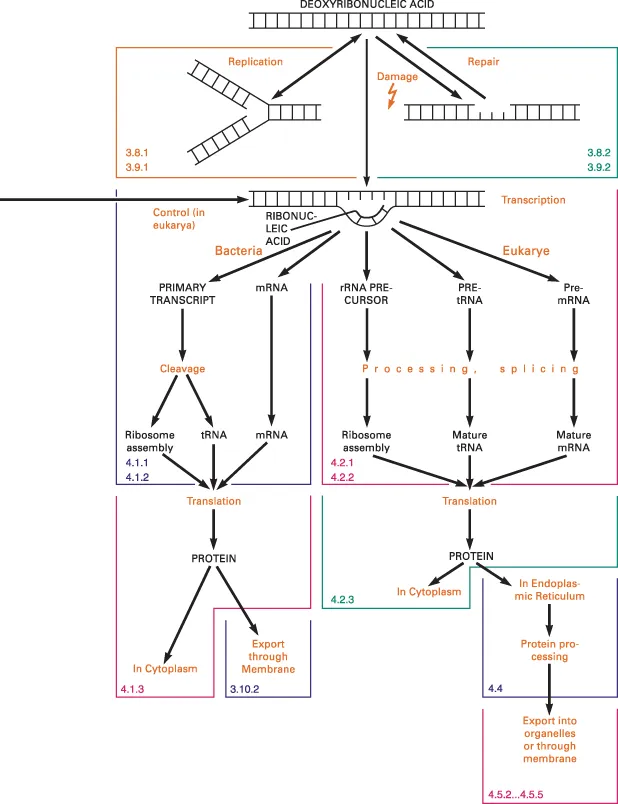
The biosynthesis of proteins in bacteria and eukarya, and their consecutive modification, as well as the cell cycle, are discussed in Chapter 4. Figure 1.1-2 gives a short outline of these reactions, subdivided into bacterial reactions (left) and eukaryotic reactions (right).
Figure 1.1-2 Protein Biosynthesis
1.1-2
Viruses, which utilize these mechanisms in hosts, are discussed in Chapter 5.
Chapter 6 gives a survey of transport mechanisms through membranes and within vessels.
The topic of Chapter 7 is cellular communication and the regulation mechanisms employ...

Table of contents

  1. Cover
  2. Biochemical Pathways Posters
  3. Title Page
  4. Copyright
  5. Preface to the Second Edition
  6. From the Preface to the First Edition
  7. Contributors
  8. Chapter 1: Introduction and General Aspects
  9. Chapter 2: The Cell and Its Contents
  10. Chapter 3: Metabolism
  11. Chapter 4: Protein Biosynthesis, Modifications and Degradation
  12. Chapter 5: Viruses
  13. Chapter 6: Transport
  14. Chapter 7: Signal Transduction and Cellular Communication
  15. Chapter 8: Immune System
  16. Chapter 9: Blood Coagulation and Fibrinolysis
  17. Chapter 10: Biochemical Networks, Bioinformatics and Systems Biology
  18. Index