Written with both postgraduate students and researchers in academia and industry in mind, this reference covers the chemistry behind metal nanopowders, including production, characterization, oxidation and combustion. The contributions from renowned international scientists working in the field detail applications in technologies, scale-up processes and safety aspects surrounding their handling and storage.
Estimation of Thermodynamic Data of Metallic Nanoparticles Based on Bulk Values
Dieter Vollath and Franz Dieter Fischer
1.1 Introduction
It is a well-accepted fact: the temperature of phase transformation is particle-size dependent. In general, this dependency is described as
1.1
In Equation 1.1, the quantities
and
stand for the transformation temperature of nanoparticles and the bulk material, respectively, d for the particle diameter, and α is a constant value depending on the entropy of transformation and the difference of the surface energy in both phases [1]. The same description, as proved for phase transformations, was found to be valid for the enthalpy of phase transformations. As typical examples, experimental results obtained for aluminum particles were given by Eckert [2], for tin particles by Lai et al. [3], or by Suresh and Mayo [4, 5] on yttrium-doped zirconia particles.
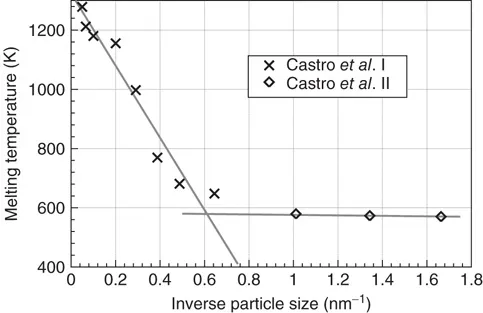
The range of particle sizes where Equation 1.1 is valid is limited. In the case of larger particles, Coombes [6] has shown that these have a surface layer of about 3 nm, where melting starts. As long as this surface layer dominates the behavior of the particles, Equation 1.1 cannot be applied. The existence of such a surface layer was also shown by Chang and Johnson [7] by theoretical considerations, concluding that this surface layer is less ordered than the center of the particles. As it was shown by Kaptay [8], the thickness of this premelting layer can be estimated by the rules of classical thermodynamics. Therefore, the assumption of a surface layer where melting starts is well justified. Now, one may ask if there is also a lower limit of particle sizes, below which Equation 1.1 is not applicable. Experimental results suggest this. Figure 1.1 displays the melting temperature of gold nanoparticles according to Castro et al. [9]. In this graph, the melting temperature is plotted versus the inverse particle size. According to Equation 1.1, one has to expect a linear relation.
Figure 1.1 Experimental data for the melting temperature of gold nanoparticles, according to Castro et al. [9], together with linear fits plotted versus the inverse particle size. This graph shows clearly two separated ranges of the melting temperature: at larger particles, a range following Equation 1.1 (Range I) and a second range with particle-size-independent temperature (Range II).
The experimental data of Castro et al. may be separated into two ranges: Range I, which follows Equation 1.1 and a separated Range II, which is far off from the expected value. A linear fit of the experimental data in both ranges delivers an intersection at an inverse particle size of 0.62 nm−1, which is equivalent to a particle size of 1.6 nm. Obviously, for particle sizes below this intersection, Equation 1.1 is no longer valid. Such a phenomenon or similar ones are quit...
Table of contents
Cover
Related Titles
Title Page
Copyright
Foreword
List of Contributors
Introduction
Chapter 1: Estimation of Thermodynamic Data of Metallic Nanoparticles Based on Bulk Values
Chapter 2: Numerical Simulation of Individual Metallic Nanoparticles
Chapter 3: Electroexplosive Nanometals
Chapter 4: Metal Nanopowders Production
Chapter 5: Characterization of Metallic Nanoparticle Agglomerates
Chapter 6: Passivation of Metal Nanopowders
Chapter 7: Safety Aspects of Metal Nanopowders
Chapter 8: Reaction of Aluminum Powders with Liquid Water and Steam
Chapter 9: Nanosized Cobalt Catalysts for Hydrogen Storage Systems Based on Ammonia Borane and Sodium Borohydride
Chapter 10: Reactive and Metastable Nanomaterials Prepared by Mechanical Milling
Chapter 11: Characterizing Metal Particle Combustion In Situ: Non-equilibrium Diagnostics
Chapter 12: Characterization and Combustion of Aluminum Nanopowders in Energetic Systems
Index
End User License Agreement
Trusted by 375,005 students
Access to over 1.5 million titles for a fair monthly price.
Study more efficiently using our study tools.
Frequently asked questions
Yes, you can cancel anytime from the Subscription tab in your account settings on the Perlego website. Your subscription will stay active until the end of your current billing period. Learn how to cancel your subscription
No, books cannot be downloaded as external files, such as PDFs, for use outside of Perlego. However, you can download books within the Perlego app for offline reading on mobile or tablet. Learn how to download books offline
Perlego offers two plans: Essential and Complete
Essential is ideal for learners and professionals who enjoy exploring a wide range of subjects. Access the Essential Library with 800,000+ trusted titles and best-sellers across business, personal growth, and the humanities. Includes unlimited reading time and Standard Read Aloud voice.
Complete: Perfect for advanced learners and researchers needing full, unrestricted access. Unlock 1.5M+ books across hundreds of subjects, including academic and specialized titles. The Complete Plan also includes advanced features like Premium Read Aloud and Research Assistant.
Both plans are available with monthly, semester, or annual billing cycles.
We are an online textbook subscription service, where you can get access to an entire online library for less than the price of a single book per month. With over 1.5 million books across 990+ topics, we’ve got you covered! Learn about our mission
Look out for the read-aloud symbol on your next book to see if you can listen to it. The read-aloud tool reads text aloud for you, highlighting the text as it is being read. You can pause it, speed it up and slow it down. Learn more about Read Aloud
Yes! You can use the Perlego app on both iOS and Android devices to read anytime, anywhere — even offline. Perfect for commutes or when you’re on the go. Please note we cannot support devices running on iOS 13 and Android 7 or earlier. Learn more about using the app
Yes, you can access Metal Nanopowders by Alexander A. Gromov,Ulrich Teipel in PDF and/or ePUB format, as well as other popular books in Physical Sciences & Industrial & Technical Chemistry. We have over 1.5 million books available in our catalogue for you to explore.