Satellite Networking
eBook - ePub

Satellite Networking

Principles and Protocols

  1. English
  2. ePUB (mobile friendly)
  3. Available on iOS & Android
eBook - ePub

Satellite Networking

Principles and Protocols

About this book

This book provides up to date coverage of the basics of ATM and internet protocols, and characteristics of satellite networks and internetworking between satellite and terrestrial networks

Satellite Networking: Principles and Protocols, Second Edition provides up to date information of the original topics in satellite networking and protocols focusing on Internet Protocols (IP) over satellites, broadband over satellites, next generation IP (IPv6) over satellites, new generation of DVB-S/S2 and DVB-RCS next generations andĀ  new services and applications. It also includes some analytical techniques for evaluation of end to end IP performance and QoS over satellite, reflecting the recent convergence of telecommunication, Internet, broadcasting and mobile networks.

Topics new to this edition: Internetworking with MANET, DVB-S/S2 and DVB-RCS/RCS2 (including TCP/IP over DVB-S/RCS), recent developments in broadband satellite systems, convergence of services and network technologies (including Internet, telecom, mobile, TV, etc.), radio resource management, PEP, I-PEP, SCPS, traffic modelling and engineering with analysis and examples, andĀ  future developments of satellite networking.

  • Ā Provides up to date coverage of the basics of ATM and internet protocols, and characteristics of satellite networks and internetworking between satellite and terrestrial networks (e.g. mobile ad hoc networks), including coverage of new services and applications (e.g. Internet, telecom, mobile and TV)
  • Discusses the real-time protocols including RTP, RTCP and SIP for real-time applications such as VoIP and MMC, and explains TCP/IP over satellite and evolution of IPv6 over satellite and beyond
Frequently asked questions

Yes, you can cancel anytime from the Subscription tab in your account settings on the Perlego website. Your subscription will stay active until the end of your current billing period. Learn how to cancel your subscription.
No, books cannot be downloaded as external files, such as PDFs, for use outside of Perlego. However, you can download books within the Perlego app for offline reading on mobile or tablet. Learn more here.
Perlego offers two plans: Essential and Complete
  • Essential is ideal for learners and professionals who enjoy exploring a wide range of subjects. Access the Essential Library with 800,000+ trusted titles and best-sellers across business, personal growth, and the humanities. Includes unlimited reading time and Standard Read Aloud voice.
  • Complete: Perfect for advanced learners and researchers needing full, unrestricted access. Unlock 1.4M+ books across hundreds of subjects, including academic and specialized titles. The Complete Plan also includes advanced features like Premium Read Aloud and Research Assistant.
Both plans are available with monthly, semester, or annual billing cycles.
We are an online textbook subscription service, where you can get access to an entire online library for less than the price of a single book per month. With over 1 million books across 1000+ topics, we’ve got you covered! Learn more here.
Look out for the read-aloud symbol on your next book to see if you can listen to it. The read-aloud tool reads text aloud for you, highlighting the text as it is being read. You can pause it, speed it up and slow it down. Learn more here.
Yes! You can use the Perlego app on both iOS or Android devices to read anytime, anywhere — even offline. Perfect for commutes or when you’re on the go.
Please note we cannot support devices running on iOS 13 and Android 7 or earlier. Learn more about using the app.
Yes, you can access Satellite Networking by Zhili Sun in PDF and/or ePUB format, as well as other popular books in Technology & Engineering & Electrical Engineering & Telecommunications. We have over one million books available in our catalogue for you to explore.

Chapter 1
Introduction

This chapter aims to introduce the basic concepts of satellite networking including applications and services, circuit and packet switching, broadband networks, network protocols and reference models, characteristics of satellite networks, internetworking between satellite and terrestrial networks and convergence of network technologies and protocols. It also highlights the recent development of broadband satellite systems and standards. When you have completed this chapter, you should be able to:
  • Understand the concepts of satellite networks and internetworking with terrestrial networks.
  • Know the different satellite services, network services and quality of service (QoS).
  • Appreciate the differences between satellite networking and terrestrial networking issues.
  • Describe the functions of network user terminals and satellite terminals and gateway.
  • Know the basic principles of protocols and the ISO reference model.
  • Know the basic ATM reference model.
  • Know the basic Internet TCP/IP protocol suite.
  • Understand the basic concepts of multiplexing and multiple accessing.
  • Understand the basic switching concepts including circuit switching, virtual circuit switching and routing.
  • Understand the evolution process and convergence of network technologies and protocols.
  • Be aware of the recent development of broadband satellite systems and standards.

1.1 Applications and Services of Satellite Networks

Satellites are manmade stars in the sky, and are often mistaken for real stars. To many people, they are full of mystery. Scientists and engineers love to give life to them by calling them birds—like birds, they fly but so high that other creatures can only dream of. They watch the earth from the sky at its vantage point, help us to find our way around the world, carry our telephone calls, emails and web pages, and relay TV programmes across the sky. Actually, the altitudes of satellites are far beyond the reach of any real bird. When satellites are used for networking, their high altitude enables them to play a unique role in the global network infrastructure (GNI).
Satellite networking is an expanding field, which has developed significantly since the birth of the first telecommunication satellite, from traditional telephony and TV broadcast services to modern broadband and Internet networks, video on demand and digital satellite broadcasts. Many of the technological advances in networking areas are centred on satellite networking. With increasing bandwidth and mobility demands in the horizon, satellite is a logical option to provide greater bandwidth with global coverage beyond the reach of terrestrial networks, and shows great promise for the future. With the development of networking technologies, satellite networks are becoming more and more integrated into the GNI. Integration of mobile ad hoc networks provides new systems for emergency and rescues services with great mobility. Therefore, internetworking with terrestrial networks and protocols is an important part of satellite networking.
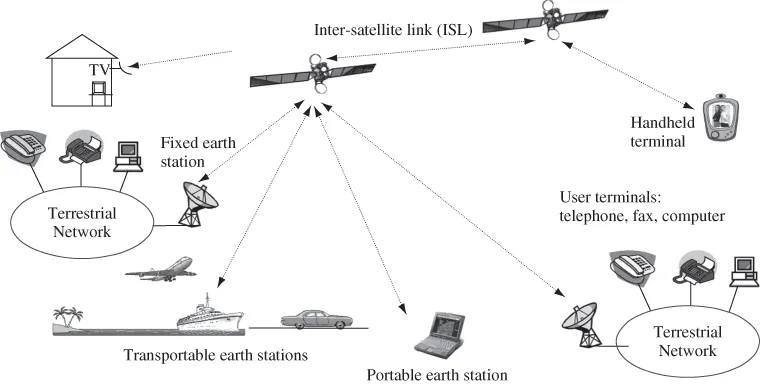
The ultimate goal of satellite networking is to provide services and applications. User terminals provide services and applications directly to users. The network provides transportation services to carry information between users' terminals across the network nodes, switches and routers for a certain distance. Figure 1.1 illustrates a typical satellite network configuration consisting of terrestrial networks, satellites with an inter-satellite link (ISL), fixed earth stations, transportable earth stations, portable and handheld terminals, and user terminals connecting to satellite links directly or through terrestrial networks.
c01f001
Figure 1.1 Typical applications and services of satellite networking

1.1.1 Roles of Satellite Networks

In terrestrial networks, many links and nodes are needed to reach long distances and cover wide areas. They are organised to achieve cost effective deployment, maintenance and operation of the networks. The nat...

Table of contents

  1. Cover
  2. Title Page
  3. Copyright
  4. Dedication
  5. List of Figures
  6. List of Tables
  7. About the Author
  8. Preface
  9. Acknowledgements
  10. Chapter 1: Introduction
  11. Chapter 2: Satellite Orbits and Networking Concepts
  12. Chapter 3: B-ISDN ATM and Internet Protocols
  13. Chapter 4: Satellite Internetworking with Terrestrial Networks
  14. Chapter 5: B-ISDN ATM over Satellite Networks
  15. Chapter 6: Internet Protocol (IP) over Satellite Networks
  16. Chapter 7: Impact of Satellite Networks on Transport Layer Protocols
  17. Chapter 8: Next Generation Internet (NGI) over Satellite
  18. Index
  19. End User License Agreement