![]()
CHAPTER 1
WHAT IS SCENARIO-BASED e-LEARNING?
Imagine Corey, an apprentice automotive technician. He’s had basic training in the fundamentals. He’s completed a year on the job. Still, when an unusual work order shows up, he can’t help feeling a little uneasy. He sees the confidence and efficiency of the journeymen technicians and wishes he could get there faster. . . .
Next consider the situation of a new combat officer. He’s been on several deployments, but this is his first time in charge of the entire company in a combat situation. He looks forward to the challenge but also realizes that he will be making life-and-death decisions. Everyone has to start somewhere, he thinks. But he wishes he had a little more experience to fall back on.
Finally, consider Linda. As a software development team lead, she spends a lot of time with customers, team members, and contractors. Linda groans as she sees all tomorrow morning blocked out for the annual mandatory compliance training. Just like last year—staff from legal and HR lecture on everything from taking gifts from clients to insider information laws and penalties. And this year there is a new policy—NO mobile devices on during the training! “I really could use the time to review the latest project plan revision! How can I get around this time-waster?”
If any of these situations sound familiar, you may find a solution in scenario-based e-learning.
The complexity of 21st century work is rooted in expertise. And as the word implies, expertise grows out of experience. In fact, psychologists who studied experts in sports, music, and strategy games like chess have found that people require about ten years of sustained and focused practice to reach the highest levels of competency in any domain. However, today’s organizations don’t have ten years to grow expertise. And some skills such as reacting to emergencies demand practice before the situation arises. Are there some ways to accelerate expertise outside of normal job experience? Are there some training techniques to turn a compliance meeting into a more relevant and engaging experience? One answer is scenario-based e-learning.
SCENARIO-BASED e-LEARNING: A FIRST LOOK
Let’s begin with a couple of examples. I will draw on seven main lesson examples throughout the book and you can see an orientation to these lessons in Appendix A. In addition, you can find color screen shots from these lessons at www.pfeiffer.com/go/scenario. One set of online screen shots is organized in the sequence in which they appear in the book. You can refer to these as you read the book. A second set shows multiple screen shots from several of the main lessons in their logical instructional sequence to illustrate how an intact lesson might flow.
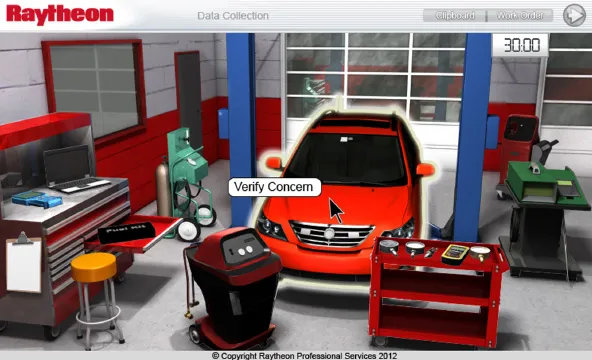
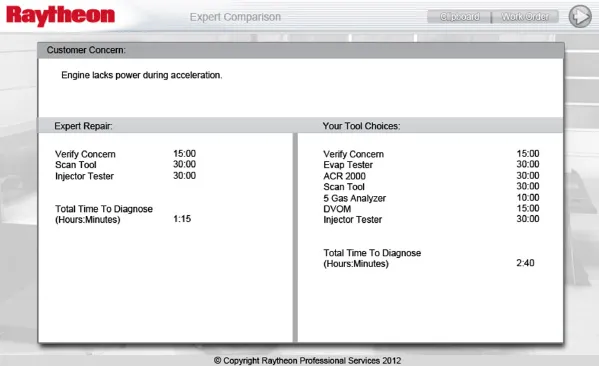
Figure 1.1 illustrates a virtual automotive repair bay. After reviewing a work order, the student technician can access the various on-screen shop tools to run virtual diagnostic tests. The results are saved on his virtual clipboard. As he works through the problem, he can access the company technical reference guides on the online shop computer as well as expert advice through the telephone. When he is ready, he can select the appropriate failure and repair from a list of ten failures. After making a selection, the automobile functions normally or continues to show symptoms associated with the failure. At the end of the lesson, he can review his sequence of testing activities, which have been tracked by the program. He can compare his decisions, shown in Figure 1.2 on the right, with an expert solution shown on the left.
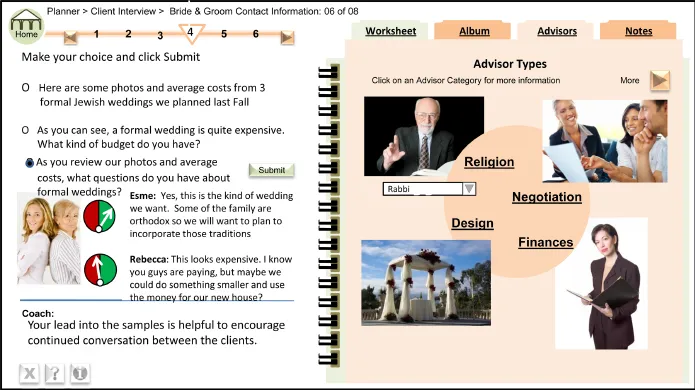
For contrast, let’s take an introductory look at a second example from a demonstration lesson called Bridezilla that Mark Palmer and I designed for newly hired wedding planners. This course uses tabs to navigate to each of four main resources: (1) worksheets where client data is entered and stored, (2) an album that includes examples with financial data for different types of weddings, (3) advisors, and (4) a notes section. In Figure 1.3 I show the menu to access advice on religion, design, negotiation skills, and finances—each a major knowledge and skill domain required for successful wedding planning. Each advisor provides basic information with additional links to various reference sources. Unlike the troubleshooting scenario, the goal of this type of lesson may not be so much to arrive at a single correct answer but to offer a context for learning basic knowledge and skills about wedding planning. Most of the wedding solutions will involve tradeoffs, and the scenarios offer the opportunity to build experience around those tradeoffs.
WHAT DO YOU THINK?
We’ll see more of these lessons as well as some different examples throughout the book. Remember that you can see a set of screens organized either by course or in the same sequence that they appear in this book online at www.pfeiffer.com/go/scenario. However, based on just these two examples, check which features below characterize scenario-based e- learning:
1. Begin with a work-realistic problem or assignment.
2. Require computer simulations.
3. Require high-end media like video or animations.
4. Allow learners to make mistakes and learn from mistakes.
5. Provide immediate feedback when an incorrect option is selected.
6. Use a structured rule-example-practice sequence.
You can see my answers at the end of the chapter. Take a look now if you can’t wait—or find most of the answers by reading the next few pages.
SCENARIO-BASED e-LEARNING DEFINED
I know it’s not too exciting to start a discussion with a definition. However, our training field actually needs more definitions because we routinely use the same words to mean different things and different words to mean the same thing. No point in moving forward until we make a good attempt at a common understanding. Here’s my definition:
Scenario-based e-learning is a preplanned guided inductive learning environment designed to accelerate expertise in which the learner assumes the role of an actor responding to a work-realistic assignment or challenge, which in turn responds to reflect the learner’s choices.
Let’s look at this definition in more detail.
The Learner Is an Actor Responding to a Job-Realistic Situation
By actor, I mean that the learner is placed in a realistic work role and takes on-screen actions to complete a work assignment or respond to a work challenge. Because the environment is highly learner-centric, a key feature of scenario-based e-learning is high engagement learning. In traditional instructional environments such as a slide-based presentation, the learner is an observer and listener—primarily playing the role of a passive receiver. I call these learning environments receptive or “show and tell.”
In directive environments, the learner observes and listens and periodically responds to some questions or a short exercise based on what she has heard and seen. In these moderately engaging environments, the learner is a receiver and an occasional responder to highly structured questions. Procedural software training often reflects this type of design. In contrast, in scenario-based e-learning, the learner assumes the role of an active respondent from the beginning and continues in that mode throughout the lesson.
The Environment Is Preplanned
Like any well-designed training, there are defined learning objectives and desired knowledge and skill outcomes which are the focus of the lesson design. For example, in the automotive technician training, the objective requires the learner to follow an efficient and accurate process to perform and interpret diagnostic tests in order to identify the correct failure and repair action. In Bridezilla, there is no single “correct” answer. Instead, the objective is to help learners make decisions during wedding planning consultation that reflect the religious, financial, aesthetic, and social values of the clients. As the learner works with different virtual clients, she has the opportunity to learn about diverse cultural, religious, aesthetic, and financial aspects of weddings as well as to apply problem-solving skills in negotiating discrepancies in client resources or opinions.
Learning Is Inductive Rather Than Instructive
In inductive environments, the emphasis is on learning from a series of progressively complex experiences by taking actions, reviewing responses to those actions, and reflecting on the consequences. For example, the automotive technician student has the opportunity to try a diverse...