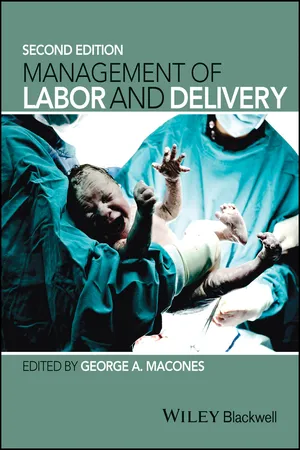
The process of labor and delivery has been one of the most perilous activities in human life. The awkward evolutionary compromises giving rise to humans makes birthing potentially life threatening for both mother and child. Despite the development of modern care, labor and delivery continues to be a dangerous process even though the levels of fatality have decreased over the past several decades.
This clinically focused guide to modern labor and delivery care covers low and high-risk situations, the approach of the team in achieving a successful outcome and what to consider when quick decisions have to be made. Aimed at both trainee and practicing obstetrician-gynecologists, this new edition includes practical guidance such as algorithms, protocols, and quick-reference summaries. It is squarely focused on the process of birth and concentrates on modern clinical concerns, blending science with clinical applications.
Molly Stout1, Jessica C. Garrett1, and David M. Stamilio2
1Department of Obstetrics and Gynecology, Washington University in St Louis, St Louis, MO, USA
2Department of Obstetrics and Gynecology, University of North Carolina at Chapel Hill, Chapel Hill, NC, USA
1.1 Introduction
Childbirth most often is viewed as a joyful event and most commonly culminates in a happy outcome. However, it is also a major life change for the pregnant woman that frequently produces anxiety, stress, and fear, and is associated with considerable pain and a need for substantial physical and emotional exertion. Women have described childbirth pain as severe, with 60% of women reporting labor pain as the most intense that they had ever experienced [1–2]. Some authors have described pregnancy and childbirth as having a crisis character, similar in some ways to the crisis character of surgery. Thus, the pregnant patient must, in some way, cope with the critical nature of childbirth [3–4]. And her ability to cope with the pain and stress of childbirth can determine whether she views it as a positive or a negative experience. Further, her perception of childbirth and how she coped with the process has the potential to shape either favorably or detrimentally her own self-image, and to affect attitudes and relationships with her newborn child, partner, and other family members. Thus, childbirth has great potential to cause long-lasting changes in a woman’s adaptation to and progression through life.
Antenatal childbirth education as a formal construct was initially conceived in the 1930s and then further developed in the 1960s and 1970s to address the critical nature of childbirth and to better prepare pregnant women for the stress associated with this major life-event, in hopes of improving physical and emotional outcomes related to pregnancy [5–9]. The pregnant patient is faced with several stressors associated with childbirth. While historically pain has been the primary focus for obstetric providers, other stressors for the pregnant patient include fear of the unknown, fatigue, loss of dignity, loss of ability to actively participate in the birthing process, aloneness, and health threats to mother and newborn [10]. In response to these stressors, various antenatal childbirth education programs have been developed with goals to: “influence health behavior; build women’s confidence in their ability to give birth; prepare women and their partners for childbirth; prepare for parenthood; develop social support networks; promote confident parents; and contribute to reducing perinatal morbidity and mortality.” Indeed, women commonly report that their primary reason for attending childbirth classes is to reduce anxiety about labor and birth [11]. Women also seek antenatal education to get information on physiologic changes of pregnancy, fetal development, the course of labor and birth, their care options in labor and birth, possible birth-related complications, and newborn care [11–12].
Antenatal childbirth education has remained popular over the last six decades, although some centers are reporting a decreased attendance, perhaps related to the expanding popularity and accessibility of internet-based information [13]. Still, medical professional organizations and providers commonly recommend antenatal childbirth education to patients, and a substantial proportion of patients, especially primiparas, seek and attend education programs [9,11,13]. Several observational and qualitative studies, many on the psychoprophylaxis of Lamaze, indicate that women who take prepared childbirth classes rate birth experiences more positively [10], and the large majority of participants report high satisfaction with their selected educational program [14]. The efficacy of antenatal childbirth classes has been a source of debate, in part, due to the variability in the outcomes assessed by investigators, but also likely a manifestation of the wide variability in the content of and approach to antenatal education. This topic will be discussed in detail later in the chapter, but there are mounting data on the efficacy, benefits, and utility of antenatal childbirth programs.
1.2 Goals of antenatal childbirth education
Various childbirth education programs have been developed to achieve multiple and often varied goals. The variability in program aims not only influences educational content but also produces controversy in the expert community regarding the purpose and effectiveness of antenatal childbirth education. In his expert commentary, Dr Enkin cautions clinicians and investigators that childbirth classes are an educational rather than obstetric intervention, and that effectiveness of childbirth classes should be evaluated by assessing outcomes that reflect their objectives, as determined by the attendees [15]. Women attend childbirth classes not just to improve pregnancy outcomes or to minimize the use of analgesic drugs, but “to be informed, to learn what to expect during labor and afterward, to learn about obstetric interventions and hospital routines, to obtain advice and answers to questions, to reduce anxiety, to meet other expectant parents, and to learn about baby care and feeding” [15]. Thus, he urges that the efficacy and utility of childbirth classes be assessed using the educational objectives that are important to the women attending rather than the obstetrical outcomes important to clinicians. While it is important to assure that clinical outcomes are not compromised and it would be advantageous if the educational objectives could result in improved pregnancy outcomes, the success of programs in achieving educational goals must also be prioritized and assessed directly. The goals of antenatal childbirth education should be to inform about childbirth, influence health behavior, build the woman’s confidence in her ability to birth, prepare women and partners for childbirth and parenthood, develop social support networks, and, potentially, reduce perinatal morbidity and mortality [11]. Humenic reviewed the literature on childbirth preparation and pain management and identified maternal control during and satisfaction with the birthing process as important factors or steps in achieving improved psychosocial outcomes, such as less postpartum depression, improved self-esteem, and better self-perception after delivery [3]. Thus she identified improved maternal satisfaction with the labor and delivery experience and an improved perception of control or “mastery” of the birth process as the major goals of childbirth preparation (Table 1.1) [10].
Table 1.1 Goals of antenatal childbirth classes.
Patient-based
Learn about childbirth
Learn about obstetrical interventions
Obtain medical advice
Reduce anxiety
Learn about baby care
Establish social support
Provider-based
Influence health behavior
Potentially reduce morbidity and mortality
Improve maternal satisfaction with childbirth
1.3 Theoretical approaches to antenatal childbirth education
As antenatal childbirth education evolved in the 1970s, there was a major shift in the theoretic framework of maternal satisfaction with childbirth and the positive effects of childbirth preparation. The prevailing model for childbirth satisfaction assumed pain control to be the primary factor in achieving satisfaction in childbirth. In opposition to this “Pain Management Model” (Figure 1.1), Humenic developed the “Mastery Model” (Figure 1.2) as a more comprehensive theory to explain maternal satisfaction with the birth process and consequential improved psychosocial outcomes and mental health [10]. The Mastery Model was constructed from the qualitative and observational research that explored the effects of pharmaceutical pain control versus childbirth classes on maternal satisfaction with childbirth. The model was also based on qualitative research that related maternal satisfaction and improved mental health to various factors associated with control or “mastery” of the childbirth process. Control was most often identified as a key factor in satisfaction and was defined by women as the ability to influence decisions made, not surrendering all decisions and responsibilities to care providers, and maintaining a working alliance with healthcare providers [10,16]. Unlike the Pain Management Model, which identified pain as the primary important birth stressor, the Mastery Model identifies pain as one of several potential maternal stressors, such as fear, fatigue, sense of helplessness, loss of dignity, and health threats (Figure 1.2). Via childbirth classes and preparation, these stressors are minimized by providing women with mechanisms to control these stressors, such as knowledge, coping skills, and support from others. Armed with these supports, the pregnant woman has a sense of greater control in the birthing process and a perception of mastery of her childbirth experience. In turn, this mastery positively influences self-esteem, self-perception, locus of control, and sense of satisfaction, all of which influence the woman’s ability to assume the task of parenthood and relate to her child and others. These positive psychosocial effects may also directly improve clinical outcome...
Table of contents
Cover
Title Page
Table of Contents
Contributor List
CHAPTER 1: Antenatal preparation for labor
CHAPTER 2: Normal labor and delivery
CHAPTER 3: Management of labor and delivery in low-risk subjects
CHAPTER 4: Induction and augmentation of labor
CHAPTER 5: Fetal monitoring and assessment
CHAPTER 6: Operative vaginal delivery
CHAPTER 7: Cesarean delivery
CHAPTER 8: Trial of labor after cesarean
CHAPTER 9: Malpresentation and malposition
CHAPTER 10: Multiple gestations
CHAPTER 11: Obstetrical emergencies
CHAPTER 12: Surgical management of obstetrical emergencies
CHAPTER 13: Maternal disorders affecting labor and delivery
CHAPTER 14: Fetal disorders affecting labor and delivery
CHAPTER 15: Labor and delivery management of the obese gravida
CHAPTER 16: Intrapartum and postpartum infections
CHAPTER 17: Obstetric anesthesia
CHAPTER 18: Postpartum care
CHAPTER 19: Development of an obstetrical patient safety program
Index
End User License Agreement
Trusted by 375,005 students
Access to over 1.5 million titles for a fair monthly price.
Study more efficiently using our study tools.
Frequently asked questions
Yes, you can cancel anytime from the Subscription tab in your account settings on the Perlego website. Your subscription will stay active until the end of your current billing period. Learn how to cancel your subscription
No, books cannot be downloaded as external files, such as PDFs, for use outside of Perlego. However, you can download books within the Perlego app for offline reading on mobile or tablet. Learn how to download books offline
Perlego offers two plans: Essential and Complete
Essential is ideal for learners and professionals who enjoy exploring a wide range of subjects. Access the Essential Library with 800,000+ trusted titles and best-sellers across business, personal growth, and the humanities. Includes unlimited reading time and Standard Read Aloud voice.
Complete: Perfect for advanced learners and researchers needing full, unrestricted access. Unlock 1.5M+ books across hundreds of subjects, including academic and specialized titles. The Complete Plan also includes advanced features like Premium Read Aloud and Research Assistant.
Both plans are available with monthly, semester, or annual billing cycles.
We are an online textbook subscription service, where you can get access to an entire online library for less than the price of a single book per month. With over 1.5 million books across 990+ topics, we’ve got you covered! Learn about our mission
Look out for the read-aloud symbol on your next book to see if you can listen to it. The read-aloud tool reads text aloud for you, highlighting the text as it is being read. You can pause it, speed it up and slow it down. Learn more about Read Aloud
Yes! You can use the Perlego app on both iOS and Android devices to read anytime, anywhere — even offline. Perfect for commutes or when you’re on the go. Please note we cannot support devices running on iOS 13 and Android 7 or earlier. Learn more about using the app
Yes, you can access Management of Labor and Delivery by George A. Macones in PDF and/or ePUB format, as well as other popular books in Medicine & Gynecology, Obstetrics & Midwifery. We have over 1.5 million books available in our catalogue for you to explore.