- English
- ePUB (mobile friendly)
- Available on iOS & Android
eBook - ePub
Vibrations and Waves
About this book
This introductory text emphasises physical principles, rather than the mathematics. Each topic begins with a discussion of the physical characteristics of the motion or system. The mathematics is kept as clear as possible, and includes elegant mathematical descriptions where possible. Designed to provide a logical development of the subject, the book is divided into two sections, vibrations followed by waves. A particular feature is the inclusion of many examples, frequently drawn from everyday life, along with more cutting-edge ones. Each chapter includes problems ranging in difficulty from simple to challenging and includes hints for solving problems. Numerous worked examples included throughout the book.
1
Simple Harmonic Motion
In the physical world there are many examples of things that vibrate or oscillate, i.e. perform periodic motion. Everyday examples are a swinging pendulum, a plucked guitar string and a car bouncing up and down on its springs. The most basic form of periodic motion is called simple harmonic motion (SHM). In this chapter we develop quantitative descriptions of SHM. We obtain equations for the ways in which the displacement, velocity and acceleration of a simple harmonic oscillator vary with time and the ways in which the kinetic and potential energies of the oscillator vary. To do this we discuss two particularly important examples of SHM: a mass oscillating at the end of a spring and a swinging pendulum. We then extend our discussion to electrical circuits and show that the equations that describe the movement of charge in an oscillating electrical circuit are identical in form to those that describe, for example, the motion of a mass on the end of a spring. Thus if we understand one type of harmonic oscillator then we can readily understand and analyse many other types. The universal importance of SHM is that to a good approximation many real oscillating systems behave like simple harmonic oscillators when they undergo oscillations of small amplitude. Consequently, the elegant mathematical description of the simple harmonic oscillator that we will develop can be applied to a wide range of physical systems.
1.1 PHYSICAL CHARACTERISTICS OF SIMPLE HARMONIC OSCILLATORS
Observing the motion of a pendulum can tell us a great deal about the general characteristics of SHM. We could make such a pendulum by suspending an apple from the end of a length of string. When we draw the apple away from its equilibrium position and release it we see that the apple swings back towards the equilibrium position. It starts off from rest but steadily picks up speed. We notice that it overshoots the equilibrium position and does not stop until it reaches the other extreme of its motion. It then swings back toward the equilibrium position and eventually arrives back at its initial position. This pattern then repeats with the apple swinging backwards and forwards periodically. Gravity is the restoring force that attracts the apple back to its equilibrium position. It is the inertia of the mass that causes it to overshoot. The apple has kinetic energy because of its motion. We notice that its velocity is zero when its displacement from the equilibrium position is a maximum and so its kinetic energy is also zero at that point. The apple also has potential energy. When it moves away from the equilibrium position the apple’s vertical height increases and it gains potential energy. When the apple passes through the equilibrium position its vertical displacement is zero and so all of its energy must be kinetic. Thus at the point of zero displacement the velocity has its maximum value. As the apple swings back and forth there is a continuous exchange between its potential and kinetic energies. These characteristics of the pendulum are common to all simple harmonic oscillators: (i) periodic motion; (ii) an equilibrium position; (iii) a restoring force that is directed towards this equilibrium position; (iv) inertia causing overshoot; and (v) a continuous flow of energy between potential and kinetic. Of course the oscillation of the apple steadily dies away due to the effects of dissipative forces such as air resistance, but we will delay the discussion of these effects until Chapter 2.
1.2 A MASS ON A SPRING
1.2.1 A mass on a horizontal spring
Our first example of a simple harmonic oscillator is a mass on a horizontal spring as shown in Figure 1.1. The mass is attached to one end of the spring while the other end is held fixed. The equilibrium position corresponds to the unstretched length of the spring and x is the displacement of the mass from the equilibrium position along the x-axis. We start with an idealised version of a real physical situation. It is idealised because the mass is assumed to move on a frictionless surface and the spring is assumed to be weightless. Furthermore because the motion is in the horizontal direction, no effects due to gravity are involved. In physics it is quite usual to start with a simplified version or model because real physical situations are normally complicated and hard to handle. The simplification makes the problem tractable so that an initial, idealised solution can be obtained. The complications, e.g. the effects of friction on the motion of the oscillator, are then added in turn and at each stage a modified and improved solution is obtained. This process invariably provides a great deal of physical understanding about the real system and about the relative importance of the added complications.
Figure 1.1 A simple harmonic oscillator consisting of a mass m on a horizontal spring.
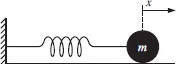
Figure 1.2 Variation of displacement x with time t for a mass undergoing SHM.
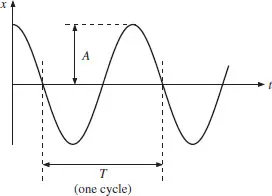
Experience tells us that if we pull the mass so as to extend the spring and then release it, the mass will move back and forth in a periodic way. If we plot the displacement x of the mass with respect to time t we obtain a curve like that shown in Figure 1.2. The amplitude of the oscillation is A, corresponding to the maximum excursion of the mass, and we ...
Table of contents
- Cover
- Contents
- Series page
- Title page
- Copyright page
- Dedication
- Editors’ Preface to the Manchester Physics Series
- Author’s Preface
- 1 Simple Harmonic Motion
- 2 The Damped Harmonic Oscillator
- 3 Forced Oscillations
- 4 Coupled Oscillators
- 5 Travelling Waves
- 6 Standing Waves
- 7 Interference and Diffraction of Waves
- 8 The Dispersion of Waves
- Appendix: Solutions to Problems
- Index
Trusted by 375,005 students
Access to over 1.5 million titles for a fair monthly price.
Study more efficiently using our study tools.
Frequently asked questions
Yes, you can cancel anytime from the Subscription tab in your account settings on the Perlego website. Your subscription will stay active until the end of your current billing period. Learn how to cancel your subscription
No, books cannot be downloaded as external files, such as PDFs, for use outside of Perlego. However, you can download books within the Perlego app for offline reading on mobile or tablet. Learn how to download books offline
Perlego offers two plans: Essential and Complete
- Essential is ideal for learners and professionals who enjoy exploring a wide range of subjects. Access the Essential Library with 800,000+ trusted titles and best-sellers across business, personal growth, and the humanities. Includes unlimited reading time and Standard Read Aloud voice.
- Complete: Perfect for advanced learners and researchers needing full, unrestricted access. Unlock 1.5M+ books across hundreds of subjects, including academic and specialized titles. The Complete Plan also includes advanced features like Premium Read Aloud and Research Assistant.
We are an online textbook subscription service, where you can get access to an entire online library for less than the price of a single book per month. With over 1.5 million books across 990+ topics, we’ve got you covered! Learn about our mission
Look out for the read-aloud symbol on your next book to see if you can listen to it. The read-aloud tool reads text aloud for you, highlighting the text as it is being read. You can pause it, speed it up and slow it down. Learn more about Read Aloud
Yes! You can use the Perlego app on both iOS and Android devices to read anytime, anywhere — even offline. Perfect for commutes or when you’re on the go.
Please note we cannot support devices running on iOS 13 and Android 7 or earlier. Learn more about using the app
Please note we cannot support devices running on iOS 13 and Android 7 or earlier. Learn more about using the app
Yes, you can access Vibrations and Waves by George C. King in PDF and/or ePUB format, as well as other popular books in Physical Sciences & Physics. We have over 1.5 million books available in our catalogue for you to explore.