Ensuring safe and plentiful supplies of potable water (both now and for future generations) and developing sustainable treatment processes for wastewater are among the world's greatest engineering challenges. However, sustainability requires investment of money, time and knowledge. Some parts of the world are already working towards this goal but many nations have neither the political will nor the resources to tackle even basic provision and sanitation. Combining theory and practice from the developing and developed worlds with high- and low-tech, high- and low-cost solutions, this book discusses fundamental and advanced aspects of water engineering and includes:
water resource issues including climate change, water scarcity, economic and financial aspects
requirements for sustainable water systems
fundamentals of treatment and process design
industrial water use and wastewater treatment
sustainable effluent disposal
sustainable construction principles
With integrated theory, design and operation specifications for each treatment process, this book addresses the extent to which various treatment methods work in theory as well as how cost effective they are in practice. It provides a nontechnical guide on how to recover and reuse water from effluent, which is suitable for those in water resource management, environmental planning, civil and chemical engineering.
Water is essential for life; our food cannot grow without water and millions of plants and animals live in it. Despite this, it is taken for granted in many parts of the world. At times it may feel as though there is an infinite stock of freshwater but available freshwater in the world is less than 1% of all the water on earth. The human population has increased enormously and data show that freshwater species are threatened by human activities. The average population of freshwater species fell by around 47% between 1970 and 2000 (UNESCO, 2006). The problems we face today are numerous but we experience only some of them directly. For example, while many people and animals have died due to water scarcity in various parts of the world, excess nitrate runoff is responsible for dead zones (low-oxygen areas in the oceans) in other parts of the world.
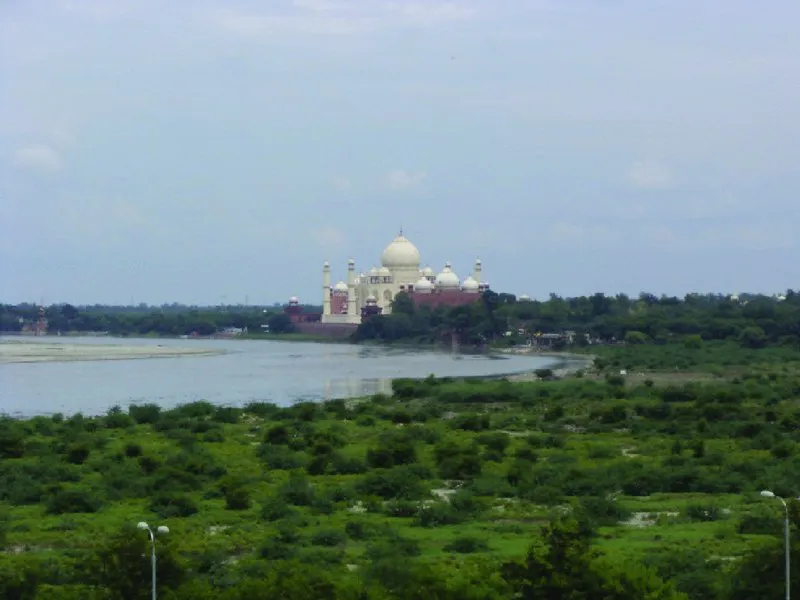
Drinking water that is clean and safe is one of the basic needs for the survival of human beings and other species. It has a large effect on our daily lives and therefore civilizations are concentrated around water bodies (Figure 1.1). We may have to pay a certain amount of money to water suppliers to access drinking water, or we may receive the water supply as an amenity from governments.
Figure 1.1 Civilization has been mainly concentrated adjacent to water bodies.
Although our planet has a large amount of water, estimated at 1.4 billion km3, only 2.8% consists of freshwater. Moreover, most of this freshwater is contained in polar glaciers, which dramatically reduces the amount of water available to human beings. Renewable water resources decreased from 17 000 m3 per inhabitant per year in 1950, to 7500 m3 in 1995 (UNESCO, 1996), and they are continuing to decrease. Water resource distribution is not uniform on the planet and some countries suffer from natural disasters, such as floods or earthquakes. In such cases, the shortage of drinking water becomes a major problem. Water quality can be dramatically reduced, as was the case after the tsunami in Indonesia in 2004 (Barbot et al., 2009).
Statistically there are many problems associated with a lack of a clean freshwater supply. Diseases and contamination are spread through unsafe water and many people become sick as a result. Problems with water are expected to grow worse in the coming decades, with water scarcity occurring globally. In regions currently considered water rich, primary water treatment may not be accessible when natural disasters occur (Shannon et al., 2008). Problems with drinking water in the event of natural disasters often concern microbial pollutants, although organic and inorganic chemical pollutants can also play a role (Ashbolt, 2004). Access, to potable clean and safe drinking water has been reported as a major problem faced by the people affected by natural disasters.
Virtually all business decisions will affect natural resources. Of these natural resources, water is the most affected by business decisions all over the world. As other resources have been extracted, the water fit for direct human consumption diminished; often it is not even directly suitable for other purposes, for example industrial and agricultural uses.
Water stress can be defined as a situation where there is insufficient water for all uses. It results from an increase in population, invention of new uses for water and the use of water bodies as disposal points for wastes. Technology has also made it easy to extract water from the groundwater table, divert surface water flows and transport the water to water-scarce locations. Intense urbanization and industrialization have resulted in climate change, thereby enhancing water scarcity and reducing the sustainable supply. Changing climate has increased water shortages due to variation in precipitation patterns and intensity. The subtropics and mid-latitudes, where most of the world's poorest people live, are likely to become substantially drier (Chandrappa et al., 2011). An increase in the temperature has been linked to glacier/snow-cap melting. This water will ultimately reach the sea, so that it will no longer be useful unless it is treated in costly desalination plants. Extreme weather patterns may result in disasters, affecting the quality of water.
Groundwater-dependent areas (where open wells were once sunk) have now adopted drilling technology to extract ground water through bore wells. This technology was attractive as it reduced the time for sinking a well from 3 months to a day. Failure at one spot does not discourage people from sinking another bore well a few metres away at a greater depth than the earlier one. Competition amongst neighbours resulted in emptying ground water, within a decade, which had accumulated over thousands of years.
As the perception of water as an infinite resource is diminishing, many attempts have been made around the world to adapt to the situation using wisdom within the community. Some ideas were successful over time; others failed. While the people in Greenland used melted snow to meet their water needs, the people in the Sahara settled around oases. While people in dry areas of India took a bath once a week or once a month, others in the same country tried to build huge dams across rivers and diverted the water course through a system of canals. While the urban agglomeration grew, these approaches could not be sustained. The wisdom of engineers four decades back is no longer meeting the needs of present population. Systems designed half a century ago have placed environmental and economic burdens on countries and communities alike.
Many of the solutions have now become problems. Examples include huge wastewater treatment plants that are not adequate to cater for today's sewage generation. The entrepreneurs who built industries in the past did not bother to construct sound waste-treatment plants. As a result, mankind depends on technology that requires large amounts of energy and chemicals, resulting in high carbon emissions and large ecological footprints.
Negligence and lack of consideration by government (legislative, executive and judiciary) as well as inadequate investment in public drinking water supplies led to adaptive measures like selling water in sachets in some parts of the world. While pollution has encouraged the bottled water industry, water scarcity has adversely affected food security. Irrigation has helped to improve agricultural yields in semi-arid and arid environments (Hanjra et al., 2009a, 2009b) but 40% of the world's food is produced by 19% of the irrigated agricultural land (Molden et al., 2010). Continued demand for water for urban and industrial use has put irrigation water under greater stress.
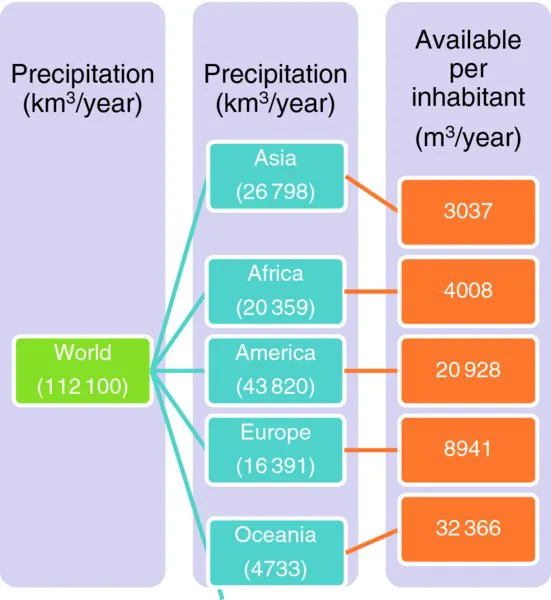
Figure 1.2 shows the availability of water per person in different regional of the world based on the information available in Ramirez et al. (2011). These figures lead to the conclusion that fresh rain water is more available for a person in America than for one in Asia. This is true because Asia has historically more populous countries. Asia also experiences a lower amount of rain due to its geographical location. Some of the largest deserts are in this continent.
Figure 1.2 Availability of water per person in different regional of the world (based on the information available in Ramirez et al., 2011).
Not all of the 112 100 km3 of water on the surface of the earth is available to humans. It flows and reaches the sea, making less than 3% of the world's water fresh, of which 2.5% is frozen, locked up in the Arctic, on Antarctica as well as in glaciers. Thus, humanity and terrestrial ecosystems have to rely on the 0.5% of global water. But global freshwater distribution is not equal. The following countries possess nearly 60% of the world's freshwater resources: Brazil, Russia, China, Canada, Indonesia, the United States, India, Columbia and the Democratic Republic of Congo. But, it does not mean that all the people in these countries have sufficient water to fulfil their needs. Local variations within these countries are highly significant.
Given that 120 l/person/day is just sufficient to fulfil the water needs of one person, precipitatio...
Table of contents
Cover
Dedication
Titlepage
Copyright
Preface
Abbreviations
Glossary
Chapter 1: Water Crisis
Chapter 2: Requirements for the Sustainability of Water Systems
Chapter 3: Water Quality Issues
Chapter 4: Fundamentals of Treatment and Process Design, and Sustainability
Chapter 5: Sustainable Industrial Water Use and Wastewater Treatment
Chapter 6: Sustainable Effluent Disposal
Chapter 7: Sustainable Construction of Water Structures
Chapter 8: Safety Issues in Sustainable Water Management
Index
End User License Agreement
Trusted by 375,005 students
Access to over 1.5 million titles for a fair monthly price.
Study more efficiently using our study tools.
Frequently asked questions
Yes, you can cancel anytime from the Subscription tab in your account settings on the Perlego website. Your subscription will stay active until the end of your current billing period. Learn how to cancel your subscription
No, books cannot be downloaded as external files, such as PDFs, for use outside of Perlego. However, you can download books within the Perlego app for offline reading on mobile or tablet. Learn how to download books offline
Perlego offers two plans: Essential and Complete
Essential is ideal for learners and professionals who enjoy exploring a wide range of subjects. Access the Essential Library with 800,000+ trusted titles and best-sellers across business, personal growth, and the humanities. Includes unlimited reading time and Standard Read Aloud voice.
Complete: Perfect for advanced learners and researchers needing full, unrestricted access. Unlock 1.5M+ books across hundreds of subjects, including academic and specialized titles. The Complete Plan also includes advanced features like Premium Read Aloud and Research Assistant.
Both plans are available with monthly, semester, or annual billing cycles.
We are an online textbook subscription service, where you can get access to an entire online library for less than the price of a single book per month. With over 1.5 million books across 990+ topics, we’ve got you covered! Learn about our mission
Look out for the read-aloud symbol on your next book to see if you can listen to it. The read-aloud tool reads text aloud for you, highlighting the text as it is being read. You can pause it, speed it up and slow it down. Learn more about Read Aloud
Yes! You can use the Perlego app on both iOS and Android devices to read anytime, anywhere — even offline. Perfect for commutes or when you’re on the go. Please note we cannot support devices running on iOS 13 and Android 7 or earlier. Learn more about using the app
Yes, you can access Sustainable Water Engineering by Ramesha Chandrappa,Diganta B. Das in PDF and/or ePUB format, as well as other popular books in Physical Sciences & Organic Chemistry. We have over 1.5 million books available in our catalogue for you to explore.