![]()
Chapter 1
Food Cities: Ecology + Urban Agriculture
Lafayette Greens Detroit, Michigan
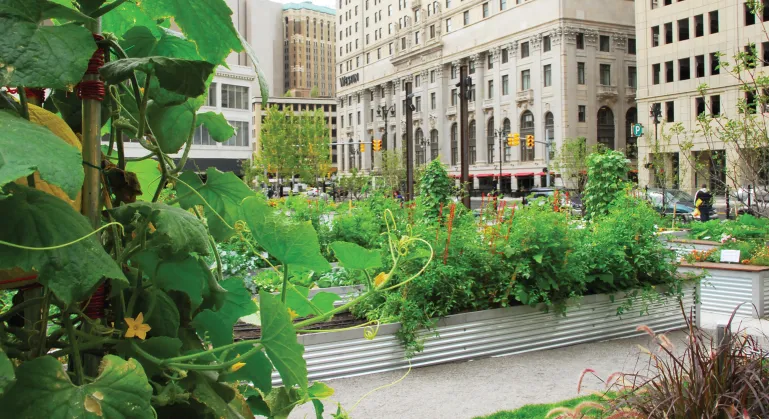
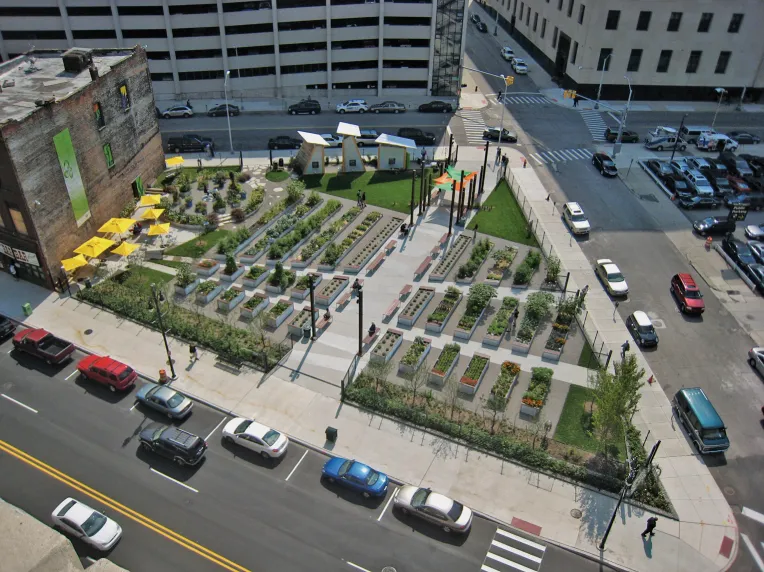
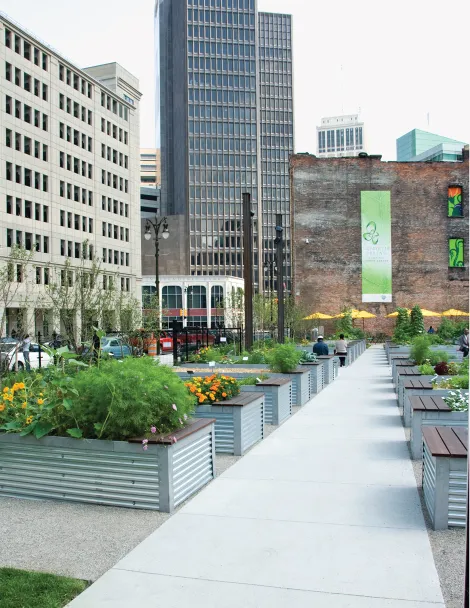
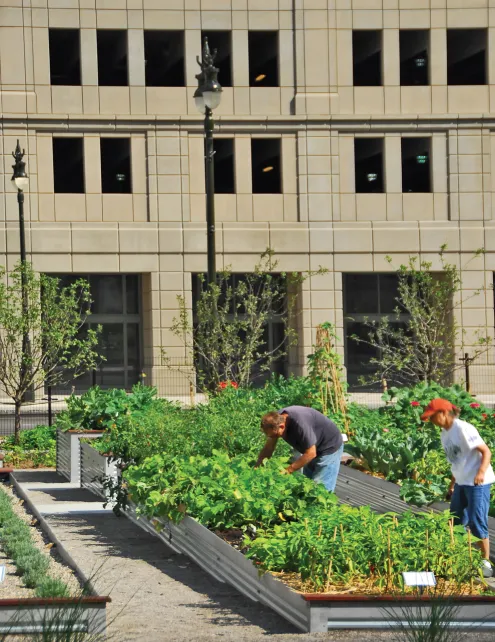
Though owned by Compuware, a large software corporation headquartered in Detroit, the Lafayette Greens (Figure 1.1) edible urban garden and park looks, feels, and operates more like a public institution landscape (Figure 1.2). Compuware envisioned the project as a means to give back to the community by helping to beautify downtown and creating a space where downtown workers, visitors, and residents can relax and recreate. By making the space an edible landscape, instead of just a plaza, the company is helping to educate the public about health, environmental responsibility, and how to grow food.
Designed by Kenneth Weikal Landscape Architecture, the three-quarter-acre Lafayette Greens is both an aesthetic and functional success, winning an honor award from the American Society of Landscape Architects in 2012.
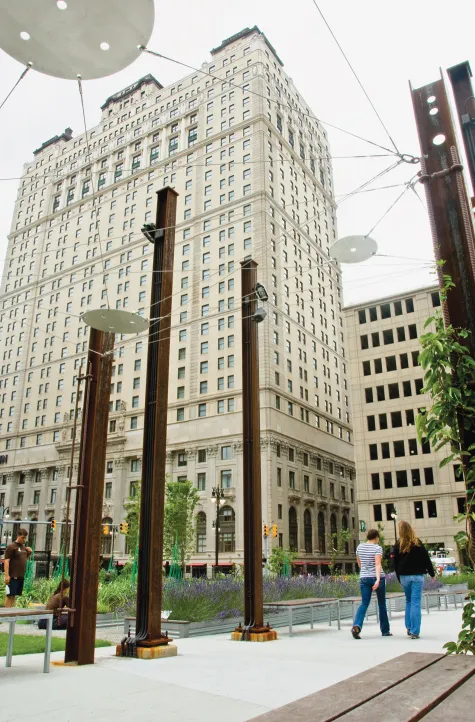
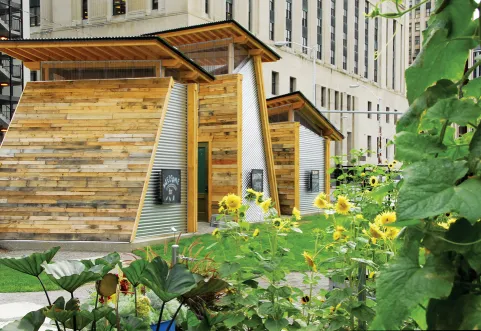
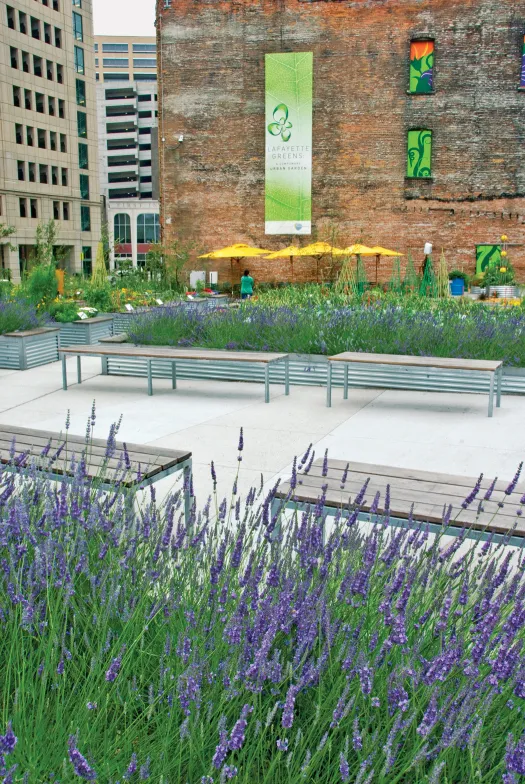
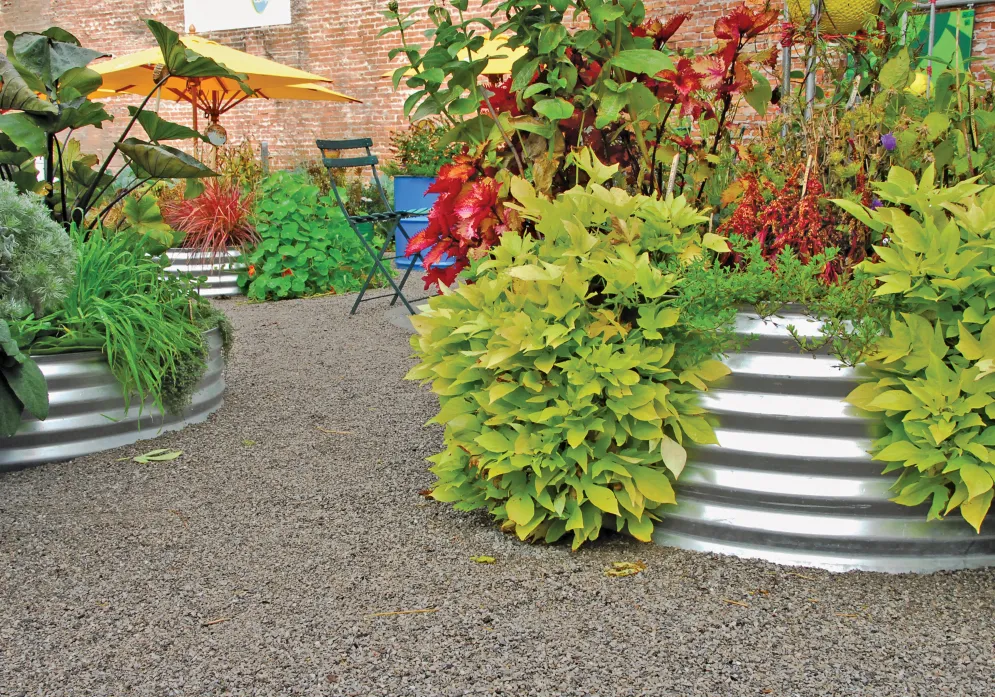
The site design incorporates a wide variety of elements and materials to maximize programming on the site and foster strong connections (Figure 1.3) outwardly to the landscape's urban downtown context (Figure 1.4). In addition to the custom metal raised beds (Figure 1.5), elements include garden sheds (Figure 1.6), a children's garden and learning area, and a dedicated space for public art. Informative signage serves to educate the public about the connections between horticulture and sustainability.
Built on the lot of a recently demolished building, the site's geometry is based partly on the desire lines of those who traversed the site while it was vacant. This facilitates and encourages circulation through the site rather than around it. A wide main walkway lined with lavender (Figure 1.7) and custom-built benches traverses the site. Lavender was chosen because it has been shown to have a calming effect on people. The site layout and edible-plant-bed orientation were designed to maximize sun exposure for the site-specific shade patterns caused by surrounding buildings. The children's area is in one of the sunnier spots of the plaza to promote lingering (Figure 1.8). And unlike many projects, the garden's aesthetic geometry can be appreciated by those who look down on it from nearby buildings.
The garden is intricately detailed, and incorporates many reused and repurposed materials. Concrete rubble is used to form gabion curbs, while broken sidewalk pieces serve as pavers.
On-site garden sheds are built from reused wood and salvaged doors. Repurposed food-grade steel drums are used to make smaller planters in the garden's children's area (Figure 1.8). Environmental efforts extend beyond materials, with the site's stormwater being captured, filtered, and detained in a bioswale of native plants. Adjustable drip irrigation is used to tailor water consumption to each plant's needs, minimizing waste. Roughly 70 percent of the site's surfaces are permeable, including small, drought-tolerant fescue lawns.
The all-organic urban garden is highly productive as well. Over 200 species of plants are grown on site, including vegetables, berries, herbs, and even kiwi vines on an overhead trellis. An “orchard meadow” of native fruit trees and an heirloom apple orchard line the site's northern edge. Currently, the garden is run by a garden manager from Compuserve, and worked by volunteers, many of whom are Compuserve employees. All food is donated to downtown Detroit's local food banks, with the volunteers allowed to take home a little food themselves in gratitude for pitching in.
| Design Team: |
| Client/Developer: | Compucare |
| Landscape Architect: | Kenneth Weikal Landscape Architecture |
| General Contractor: | Tooles Contracting Group, LLC |
| Landscape Contractor: | WH Canon Company |
| Irrigation Consultant: | Liquid Assets, LLC |
| Architectural Consultant: | Fusco Shaffer and Pappas Inc. |
| Garden Shed Construction: | Mackinac Woodworking Concepts |
| Civil Engineering: | Zeimet Wozniak & Associates |
| Structural Engineering: | Desai/Nasr Consulting Engineers |
| Electrical Engineering: | TAC Associates, LLC |
Designer as Change Agent
The twenty-first-century sustainable city requires the merging of urbanism with sustainable food systems. The design strategies for agricultural urbanism are about reinviting food back into the city and reconnecting people with their local and regional food systems to promote a healthier and more sustainable lifestyle. This challenges today's industrial food system that currently separates people from their food sources. Urban agriculture is, now more than ever before, a movement in transition, and these new urban landscapes are demonstrating that they are far more than growing vegetables on abandoned lots.
In addition to needing water, food is a basic human need for human existence. Food is also essential to economic growth. Food provides a new perspective for answering the question about how we make our cities more livable places. Everyone needs food, in all probability likes food, and has shared food with others. Food represents both celebration and sustenance in all cultures. Almost everyone has a personal history that centers on rituals and relationships that revolve around food. Whether birthdays, family holidays, or even meeting for dinner with friends, food plays a large part in our daily lives. Food, because of its universal appeal and appreciation, can become an important key to further advance the sustainable city dialogue.
Along with integrating a more comprehensive ecosystem-based approach to the redesign of our cities and towns to handle the ever-increasing complexity of the urban realm, integration of an economically viable urban food system needs to become an integral part of the urban ecosystems that frame the foundation of the sustainable city. The time has come for designers to act as change agents and design for integration of natural systems with urban systems into city infrastructure. That infrastructure needs to include urban agriculture as an integral part of an economically viable food system within a city.
An economically viable urban food system would result from an ecological and biological based city-planning model that would focus on health (human and city), community (support and connectivity), and ecosystems (natural and manmade). Current urban design and planning is focused on the fragments rather than a cohesive whole. A new way toward designing integration is emerging through ecological-based urban agriculture. This integrative process, also known as integrated systems thinking, focuses on solutions based on the interconnectedness of the systems as a whole unit, rather than separate units.
This book will outline a framework of information to aid in the creation of urban agriculture landscapes that promote ecological biodiversity and social sustainability. Consideration for creating these landscapes needs to accommodate design strategies that integrate social, ecological, and economic values to achieve the best results. Plus, diving deeper into planning and policy, information will unfold on how to incentivize and design a regenerative landscape that benefits the community and local ecology. An emphasis now must be on how designers are the change agents for this new green infrastructure in today's cities.
In an interview in the Yale Daily News in October 2011, former Slow Food USA president Josh Viertel said, “Slow Food is like a gateway drug for civic engagement, environmentalism, for changing the world, because when you share food with people you see what you have in common. Food becomes a vehicle for understanding each other and for dealing with issues of race, class, oppression, and gender.” Thus, food and the conversation around food becomes the topic starter for the community and civic dialogues that must ensue.
In recent years, there has been a tremendous upsurge of interest in growing food in urban centers. In the past quarter century, food production has been pushed to the periphery of the city. Now the trend is to connect it back to the heart of the city and build bridges between the urban communities and peri-urban and rural communities. This resurgence is in response to concerns about rising food prices, food miles, and the environment. It is also because people want better access to good, healthy, and affordable food, and to enjoy cultivating beautiful green spaces and meeting local people. Eating food you have grown yourself is a visceral experience. There are now millions of people planting urban farms today in the United States. The trend is up 35 percent over the past year and 15 percent of the United States now has a backyard garden. In a country of 300 million people, this is a huge trend. You would think that this means that the new urban farmers are hip twenty-something-year-olds, but in actuality, 80 percent of US farmers today are over 60 years old. Wh...