This book brings together in a single volume a unique contribution by the top experts around the world in the field of compact semiconductor lasers to provide a comprehensive description and analysis of the current status as well as future directions in the field of micro- and nano-scale semiconductor lasers.
It is organized according to the various forms of micro- or nano-laser cavity configurations with each chapter discussing key technical issues, including semiconductor carrier recombination processes and optical gain dynamics, photonic confinement behavior and output coupling mechanisms, carrier transport considerations relevant to the injection process, and emission mode control.
Required reading for those working in and researching the area of semiconductors lasers and micro-electronics.
- English
- ePUB (mobile friendly)
- Available on iOS & Android
eBook - ePub
Compact Semiconductor Lasers
About this book
Information
1
Nanoscale Metallo-Dielectric Coherent Light Sources
1.1 Introduction
Compact photonic components are important for the design and fabrication of integrated optical devices and circuits. In the case of light sources, reducing the size can result in improved metrics such as higher packing density and reduced power consumption and also may enhance cavity–emitter interactions such as the Purcell effect. Until recently it was commonly known that the minimum size for a laser is ultimately determined by the free-space wavelength, λ0. For example, as the size of a conventional Fabry–Perot semiconductor laser is scaled down in all three dimensions toward λ0, three effects adversely influence the lasing process. Firstly, the roundtrip path of the optical wave in the gain medium is shortened. Secondly, radiative losses from the end mirrors have an increased effect. Thirdly, the lateral field confinement in the resonator waveguide is reduced, resulting in a smaller overlap of the optical mode with the gain medium. All these effects lead to a significant increase in the lasing threshold. As a result lasing cannot be achieved below a certain size limit. By allowing the laser size to increase in one or two dimensions, it is possible to reduce the physical size of the laser in the remaining dimension(s) to values below this limit. For example, the disk thickness in whispering-gallery-mode (WGM) lasers [1] can be reduced to a fraction of the free-space wavelength [2] but, to compensate for the small thickness, the disk diameter must be increased. It should be noted that, in addition to the optical mechanisms noted above, nonradiative surface recombination can have a non-negligible negative effect on the emitter efficiency and thus needs to be accounted for in the design and analysis of such sources. The ultimate challenge in this respect is concurrent reduction of the resonator size in all three dimensions, and, at the same time, satisfying the requirements for lasing action.
The size of an optical cavity can be defined using different metrics, for example, the physical dimensions of the cavity or the size of the optical mode. However, if the goal of size reduction is to increase the integration density (for example, in a laser array), the effective cavity size should account for both the overall physical dimensions of the resonator and the spread of the optical mode beyond the physical boundary of the resonator. By this token, most conventional dielectric laser cavities are not amenable to dense integration because they have either a large physical footprint or a large effective mode. For example, distributed Bragg resonators [3] and photonic-crystal cavities [4] (both of which can be designed to have very small mode volumes) have physical footprints that are many wavelengths in size, due to the several Bragg layers or lattice periods that are required for maintaining high finesse. On the other hand, it has been demonstrated that the diameter of thick (λ0/n) micro-disk lasers can be reduced below their free-space emission wavelength [5]; however, the spatial spread of the resultant modes (which have low azimuthal numbers owing to the small disk diameters) into the surrounding space beyond the physical boundaries of the disks may lead to mode coupling and formation of “photonic molecules” in closely spaced disks [6]. For illustration purposes, an M = 4 WGM for a semiconductor disk with radius rc = 460 nm and height hc = 480 nm (Figure 1.1a) is shown in Figure 1.1b, clearly indicating the radiative nature of the mode and its spatial spread, which, as mentioned, can lead to mode coupling with nearby structures. (M is the azimuthal order of the resonance, corresponding to half the number of lobes in the modal plot of |E|.)
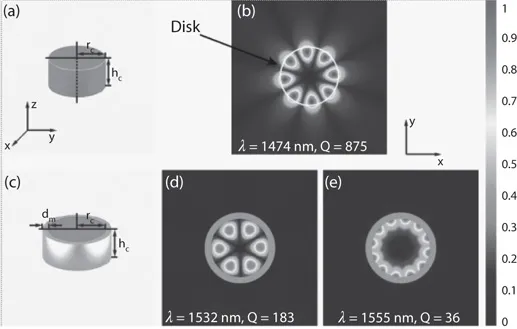
Figure 1.1 The M = 4 whispering gallery resonance for a thick semiconductor disk (a) is shown in (b) (rc = 460 nm, hc = 480 nm, and nsemi = 3.4). Note the spatial spread of the mode compared to the actual disk size. (c) The same disk encased in an optically thick (dm = 100 nm) gold shield will have well-confined reflective (d) and plasmonic (e) modes but with much higher mode losses. |E| is shown in all cases and the section plane is horizontal and through the middle of the cylinder. (From [7].). (Please find a color version of this figure on the color plates.)
One approach to alleviate these issues is to incorporate metals into the structure of dielectric cavities, because metals can suppress leaky optical modes and effectively isolate them from their neighboring devices. The modes in these metallo-dielectric cavities can be grouped into two main categories: (i) surface bound (that is, surface plasmon polariton (SPP)) resonant modes and (ii) conventional resonant modes (called photonic modes), resulting purely from reflections within the metal cavity. Although they are highly confined, the disadvantage of plasmonic modes is their high loss, which is caused by the relatively large mode overlap of the optical field with the metal (compared to the reflective case). Owing to the high Joule loss at telecommunication and visible wavelengths, the lasing gain threshold for such cavities can be very large. On the other hand, the negative permittivity of metals not only allows them to support SPP modes, but also enables them to act as efficient mirrors. This leads to the second class of metallo-dielectric cavity modes, which can be viewed as lossy versions of the modes in a perfectly conducting metal cavity. Because the mode volume overlap with the metal is usually smaller than in the plasmonic case, in a cavity supporting this type of mode it is possible to achieve higher resonance quality-factors (Q-factors) and lower lasing gain thresholds, albeit at the expense of reduced mode confinement (compared to plasmonic modes). In general, both types of modes can exist in a metal cavity. Embedding the gain disk mentioned earlier in a gold shield (Figure 1.1c) effec...
Table of contents
- Cover
- Related Titles
- Title Page
- Copyright
- Preface and Introduction
- List of Contributors
- 1 Nanoscale Metallo-Dielectric Coherent Light Sources
- 2 Optically Pumped Semiconductor Photonic Crystal Lasers
- 3 Electrically Pumped Photonic Crystal Lasers: Laser Diodes and Quantum Cascade Lasers
- 4 Photonic-Crystal VCSELs
- 5 III–V Compact Lasers Integrated onto Silicon (SOI)
- 6 Semiconductor Micro-Ring Lasers
- 7 Nonlinearity in Semiconductor Micro-Ring Lasers
- Index
- End User License Agreement
Trusted by 375,005 students
Access to over 1.5 million titles for a fair monthly price.
Study more efficiently using our study tools.
Frequently asked questions
Yes, you can cancel anytime from the Subscription tab in your account settings on the Perlego website. Your subscription will stay active until the end of your current billing period. Learn how to cancel your subscription
No, books cannot be downloaded as external files, such as PDFs, for use outside of Perlego. However, you can download books within the Perlego app for offline reading on mobile or tablet. Learn how to download books offline
Perlego offers two plans: Essential and Complete
- Essential is ideal for learners and professionals who enjoy exploring a wide range of subjects. Access the Essential Library with 800,000+ trusted titles and best-sellers across business, personal growth, and the humanities. Includes unlimited reading time and Standard Read Aloud voice.
- Complete: Perfect for advanced learners and researchers needing full, unrestricted access. Unlock 1.5M+ books across hundreds of subjects, including academic and specialized titles. The Complete Plan also includes advanced features like Premium Read Aloud and Research Assistant.
We are an online textbook subscription service, where you can get access to an entire online library for less than the price of a single book per month. With over 1.5 million books across 990+ topics, we’ve got you covered! Learn about our mission
Look out for the read-aloud symbol on your next book to see if you can listen to it. The read-aloud tool reads text aloud for you, highlighting the text as it is being read. You can pause it, speed it up and slow it down. Learn more about Read Aloud
Yes! You can use the Perlego app on both iOS and Android devices to read anytime, anywhere — even offline. Perfect for commutes or when you’re on the go.
Please note we cannot support devices running on iOS 13 and Android 7 or earlier. Learn more about using the app
Please note we cannot support devices running on iOS 13 and Android 7 or earlier. Learn more about using the app
Yes, you can access Compact Semiconductor Lasers by Richard De La Rue,Jean-Michel Lourtioz,Siyuan Yu in PDF and/or ePUB format, as well as other popular books in Technology & Engineering & Electrical Engineering & Telecommunications. We have over 1.5 million books available in our catalogue for you to explore.