Cost-effective manufacturing of biopharmaceutical products is rapidly gaining in importance, while healthcare systems across the globe are looking to contain costs and improve efficiency. To adapt to these changes, industries need to review and streamline their manufacturing processes.
This two volume handbook systematically addresses the key steps and challenges in the production process and provides valuable information for medium to large scale producers of biopharmaceuticals.
It is divided into seven major parts:
- Upstream Technologies
- Protein Recovery
- Advances in Process Development
- Analytical Technologies
- Quality Control
- Process Design and Management
- Changing Face of Processing
With contributions by around 40 experts from academia as well as small and large biopharmaceutical companies, this unique handbook is full of first-hand knowledge on how to produce biopharmaceuticals in a cost-effective and quality-controlled manner.
- English
- ePUB (mobile friendly)
- Available on iOS & Android
eBook - ePub
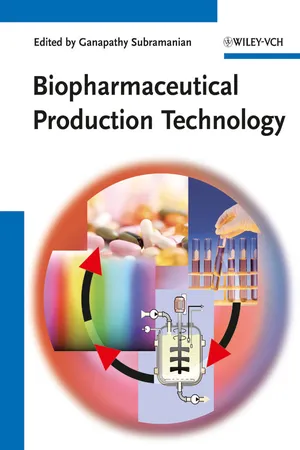
Biopharmaceutical Production Technology
About this book
Information
The Editor
Dr. Ganapathy Subramanian
44 Oaken Grove
Maidenhead
Berkshire SL6 6HH
United Kingdom
All books published by Wiley-VCH are carefully produced. Nevertheless, authors, editors, and publisher do not warrant the information contained in these books, including this book, to be free of errors. Readers are advised to keep in mind that statements, data, illustrations, procedural details or other items may inadvertently be inaccurate.
Library of Congress Card No.: applied for
British Library Cataloguing-in-Publication Data
A catalogue record for this book is available from the British Library.
Bibliographic information published by the Deutsche Nationalbibliothek
The Deutsche Nationalbibliothek lists this publication in the Deutsche Nationalbibliografie; detailed bibliographic data are available on the Internet at <http://dnb.d-nb.de>.
© 2012 Wiley-VCH Verlag & Co. KGaA, Boschstr. 12, 69469 Weinheim, Germany
All rights reserved (including those of translation into other languages). No part of this book may be reproduced in any form – by photoprinting, microfilm, or any other means – nor transmitted or translated into a machine language without written permission from the publishers. Registered names, trademarks, etc. used in this book, even when not specifically marked as such, are not to be considered unprotected by law.
Composition Toppan Best-set Premedia Limited, Hong Kong
Cover Design Adam-Design, Weinheim
Print ISBN: 978-3-527-33029-4
ePDF ISBN: 978-3-527-65312-6
ePub ISBN: 978-3-527-65311-9
mobi ISBN: 978-3-527-65310-2
oBook ISBN: 978-3-527-65309-6
Preface
Over a few decades the advancement of technologies and our understanding and demands has rejuvenated the biotechnology industries in finding biologicals with therapeutic value. Thus, currently over 12 000 large-molecule biotherapeutic products are in preclinical discovery or clinical trials around the world today; however, less than one-third of these are in clinical development and very few have found a successful market. As the demand for healthcare products increases around the globe, the need to produce cost-effective therapeutic solutions for the world community has to be met by the biotechnology industries. It is a challenge that the industries have to embrace to face the future and it is clear that the industries have to adapt in order to survive.
The issues at stake are as complex as they are well known. With the current global situation, serious questions of facility financing, and a shift in healthcare policy and reimbursement all create a massive burden on strategic planning. The industries realize the need to adapt to face the future in effective manufacturing.
Volume 1 of this book is organized into three parts containing 12 chapters contributed by experienced international scientists. The first two chapters give an overview of strategies for plasmid DNA production from Escherichia coli and advances in protein production technology. Chapters 3–7 give a perspective of the methodologies for protein recovery. An overview of process development is given in Chapters 8–12.
My thanks to all of the authors who have devoted their spare time, and also for their diligence, patience, and goodwill during the production of the volume. They deserve the full credit for the source of the volume.
It is hoped that this volume will be of great value to all those who are involved in the processing and production of bioproducts, and that it will stimulate further progress and advances in this field to meet the ever-increasing demands and challenges.
I should be most grateful for any suggestion that could serve to improve future editions of this volume.
Finally, my deep appreciation to Dr. Frank Weinreich of Wiley-VCH for inviting me to edit the volume, and also to Lesley Belfit and her colleagues for their sustained support and help.
G. Subramanian
June 2012
Maidenhead, UK
June 2012
Maidenhead, UK
List of Contributors
Lars Aumann
ChromaCon AG
Technoparkstrasse 1
8005 Zürich
Switzerland
ChromaCon AG
Technoparkstrasse 1
8005 Zürich
Switzerland
Andy Bailey
Virusure GmbH
Wissenschafts- und Technologiepark
Donau-City-Strasse 1
1220 Wien
Austria
Virusure GmbH
Wissenschafts- und Technologiepark
Donau-City-Strasse 1
1220 Wien
Austria
Miloš Barut
BIA Separations d.o.o.
Teslova 30
1000 Ljubljana
Slovenia
and
The Center of Excellence for Biosensors
Instrumentation and Process Control – COBIK
Velika pot 22
5250 Solkan
Slovenia
BIA Separations d.o.o.
Teslova 30
1000 Ljubljana
Slovenia
and
The Center of Excellence for Biosensors
Instrumentation and Process Control – COBIK
Velika pot 22
5250 Solkan
Slovenia
Marc Bisschops
Tarpon Biosystems Inc.
Batavia Bioservices B.V.
Zernikedreef 9
2333 CK Leiden
The Netherlands
Tarpon Biosystems Inc.
Batavia Bioservices B.V.
Zernikedreef 9
2333 CK Leiden
The Netherlands
Eva Brand
Technische Universität Berlin
Department of Biotechnology
Ackerstrasse 71–76
13355 Berlin
Germany
Technische Universität Berlin
Department of Biotechnology
Ackerstrasse 71–76
13355 Berlin
Germany
Yap Pang Chuan
University of Queensland
Australian Institute for Bioengineering and Nanotechnology
Corner College and Cooper Roads
Brisbane, Queensland 4072
Australia
University of Queensland
Australian Institute for Bioengineering and Nanotechnology
Corner College and Cooper Roads
Brisbane, Queensland 4072
Australia
Vinod B. Damodaran
Colorado State University
Department of Chemistry
Fort Collins, CO 80523
USA
Colorado State University
Department of Chemistry
Fort Collins, CO 80523
USA
Reinhard Ditz
Merck KGaA
Performance & Life Science Chemicals R&D
Frankfuter Strasse 250
64293 Darmstadt
Germany
Merck KGaA
Performance & Life Science Chemicals R&D
Frankfuter Strasse 250
64293 Darmstadt
Germany
Graziella El Khoury
University of Cambridge
Institute of Biotechnology
Department of Chemical Engineering and Biotechnology
Tennis Court Road
Cambridge CB2 1QT
UK
University of Cambridge
Institute of Biotechnology
Department of Chemical Engineering and Biotechnology
Tennis Court Road
Cambridge CB2 1QT
UK
Robert Falconar
University of Sheffield
ChELSI Institute
Department of Chemical and Biological Engineering
Mappin Street
Sheffield S1 3JD
UK
University of Sheffield
ChELSI Institute
Department of Chemical and Biological Engineering
Mappin Street
Sheffield S1 3JD
UK
Suzanne S. Farid
University College London
Advanced Centre for Biochemical Engineering
Department of Biochemical Engineering
Torrington Place
London WC1E 7JE
UK
University College London
Advanced Centre for Biochemical Engineering
Department of Biochemical Engineering
Torrington Place
London WC1E 7JE
UK
Conan J. Fee
University of Canterbury
Biomolecular Interaction Centre
Department of Chemical and Process Engineering
Private Bag 4800
Christchurch 8020
New Zealand
University of Canterbury
Biomolecular Interaction Centre
Department of Chemical and Process Engineering
Private Bag 4800
Christchurch 8020
New Zealand
Daryl L. Fernandes
Ludger Ltd
Culham Science Centre
Abingdon OX14 3EB
UK
Ludger Ltd
Culham Science Centre
Abingdon OX14 3EB
UK
Richard Francis
Francis Pharma
38 Longmeadow
Riverhead, Kent TN13 2QY
UK
Francis Pharma
38 Longmeadow
Riverhead, Kent TN13 2QY
UK
Ruth Freitag
University of Bayreuth
Process Biotechnology
Universitätsstrasse 30
95440 Bayreuth
Germany
University of Bayreuth
Process Biotechnology
Universitätsstrasse 30
95440 Bayreuth
Germany
Florian Grote
Clausthal University of Technology
Institute for Separation and Process Technology
Leibnizstrasse 15
38678 Clausthal-Zellerfeld
Germany
Clausthal University of Technology
Institute for Separation and Process Technology
Leibnizstrasse 15
38678 Clausthal-Zellerfeld
Germany
Christoph Helling
Clausthal University of Technology
Institute for Separation and Process Technology
Leibnizstrasse 15
38678 Clausthal-Zellerfeld
Germany
Clausthal University of Technology
Institute for Separation and Process Technology
Leibnizstrasse 15
38678 Clausthal-Zellerfeld
Germany
Frank Hilbrig
University of Bayreuth
Process Biotechnology
Universitätsstrasse 30
95440 Bayreuth
Germany
University of Bayreuth
Process Biotechnology
Universitätsstrasse 30
95440 Bayreuth
Germany
Dirk Itzeck
Technische Universität Berlin
Department of Biotechnology
Ackerstrasse 71–76
13355 Berlin
Germany
Technische Universität Berlin
Department of Biotechnology
Ackerstrasse 71–76
13355 Berlin
Germany
Maik W. Jornitz
Sartorius Stedim North America Inc.
5 Orville Drive
Bohemia, NY 11716
USA
Sartorius Stedim North America Inc.
5 Orville Drive
Bohemia, NY 11716
USA
Stefan Junne
Technische Universität Berlin
Department of Biotechnology
Ackerstrasse 71–76
13355 Berlin
Germany
Technische Universität Berlin
Department of Biotechnology
Ackerstrasse 71–76
13355 Berlin
Germany
Glenwyn Kemp
Dream Laboratory Ltd
Mulgrave Terrace
Gateshead NE8 1AW
UK
Dream Laboratory Ltd
Mulgrave Terrace
Gateshead NE8 1AW
UK
Arne Klingner
Technische Universität Braunschweig
Institute of Biochemical Engineering
Gaussstrasse 17
38106 Braunschweig
Germany
Technische Universität Braunschweig
Institute of Biochemical Engineering
Gaussstrasse 17
38106 Braunschweig
Germany
Sriram Kumaraswamy
ForteBio Inc.
Suite 201
1360 Willow Road
Menlo Park, CA 94025
USA
ForteBio Inc.
Suite 201
1360 Willow Road
Menlo Park, CA 94025
USA
John Lewis
Crucell Holland BV
PO Box 2048
2301 CA Leiden
The Netherlands
Crucell Holland BV
PO Box 2048
2301 CA Leiden
The Netherlands
Christopher R. Lowe
University of Cambridge
Institute of Biotechnology
Department of Chemical Engineering and Biotechnology
Tennis Court Road
Cambridge CB2 1QT
UK
University of Cambridge
Institute of Biotechnology
Department of Chemical Engineering and Biotechnology
Tennis Court Road
Cambridge CB2 1QT
UK
Linda H.L. Lua
University of Queensland
UQ Protein Expression Facility
AIBN Building
Corner College and Cooper Roads
Brisbane, Queensland 4072
Australia
University of Queensland
UQ Protein Expression Facility
AIBN Building
Corner College and Cooper Roads
Brisbane, Queensland 4072
Australia
Alfred Luitjens
Crucell Holland BV
PO Box 2048
2301 CA Leiden
The Netherlands
Crucell Holland BV
PO Box 2048
2301 CA Leiden
The Netherlands
Anton P.J. Middelberg
University of Queensland
Australian Institute for Bioengineering and Nanotechnology
Corner College and Cooper Roads
Brisbane, Queensland 4072
Australia
University of Queensland
Australian Institute for Bioengineering and Nanotechnology
Corner College and Cooper Roads
Brisbane, Queensland 4072
Australia
Nawin Mishra
University of South Carolina
Department of Biological Sciences
715 Sumter Street
Columbia, SC 29208
USA
University of South Carolina
Department of Biological Sciences
715 Sumter Street
Columbia, SC 29208
USA
Dethardt Müller
Rentschler Biotechnologie GmbH
Erwin-Rentschler-Strasse 21
88471 Laupheim
Germany
Rentschler Biotechnologie GmbH
Erwin-Rentschler-Strasse 21
88471 Laupheim
Germany
Thomas Müller-Späth
ChromaCon AG
Technoparkstrasse 1
8005 Zürich
Switzerland
ChromaCon AG
Technoparkstrasse 1
8005 Zürich
Switzerland
Peter Neubauer
Technische Universität Berlin
Department of Biotechnology
Ackerstrasse 71–76
13355 Berlin
Germany
Technische Universität Berlin
Department of Biotechnology
Ackerstrasse 71–76
13355 Berlin
Germany
Matjaž Peterka
BIA Separations d.o.o.
Teslova 30
1000 Ljubljana
Slovenia
and
The Center of Excellence for Biosensors
Instrumentation and Process Control – COBIK
Velika pot 22
5250 Solkan
Slovenia
BIA Separations d.o.o.
Teslova 30
1000 Ljubljana
Slovenia
and
The Center of Excellence for Biosensors
Instrumentation and Process Control – COBIK
Velika pot 22
5250 Solkan
Slovenia
Thorsten Peuker
Sartorius Stedim Biotech GmbH
Schwarzenberger Weg 73–79
34212 Melsungen
Germany
Sartorius Stedim Biotech GmbH
Schwarzenberger Weg 73–79
34212 Melsungen
Germany
Aleš Podgornik
BIA Separations d.o.o.
Teslova 30
1000 Ljubljana
Slovenia
and
The Center of Excellence for Biosensors
Instrumentation and Process Control – COBIK
Velika pot 22
5250 Solkan
Slovenia
BIA Separations d.o.o.
Teslova 30
1000 Ljubljana
Slovenia
and
The Center of Excellence for Biosensors
Instrumentation and Process Control – COBIK
Velika pot 22
5250 Solkan
Slovenia
Alain Pralong
Crucell Holland BV
PO Box 2048
2301 CA Leiden
The Netherlands
Crucell Holland BV
PO Box 2048
2301 CA Leiden
The Netherlands
Kathrin Ralla
Technische Universität Berlin
Department of Biotechnology
Ackerstrasse 71–76
13355 Berlin
Germany
Technische Universität Berlin
Department of Biotechnology
Ackerstrasse 71–76
13355 Berlin
Germany
Laura Rowe
University of Cambridge
Institute of Biotechnology
Department of Chemical Engineering and Biotechnology
Tennis Court Road
Cambridge CB2 1QT
UK
University of Cambridge
Institute of Biotechnology
Department of Chemical Engineering and Biotechnology
Tennis Court Road
Cambridge CB2 1QT
UK
Aleš Štrancar
BIA Separations d.o.o.
Teslova 30
1000 Ljubljana
Slovenia
and
The Center of Excellence for Biosensors
Instrumentation and Process Control – COBIK
Velika pot 22
5250 Solkan
Slovenia
BIA Separations d.o.o.
Teslova 30
1000 Ljubljana
Slovenia
and
The Center of Excellence for Biosensors
Instrumentation and Process Control – COBIK
Velika pot 22
5250 Solkan
Slovenia
Guido Ströhlein
ChromaCon AG
Technoparkstrasse 1
8005 Zürich
Switzerland
ChromaCon AG
Technoparkstrasse 1
8005 Zürich
Switzerland
Jochen Strube
Clausthal University of Technology
Institute for Separation and Process Technology
Leibnizstrasse 15
38678 Clausthal-Zellerfeld
Germany
Clausthal University of Technology
Institute for Separation and Process Technology
Leibnizstrasse 15
38678 Clausthal-Zellerfeld
Germany
Detlev Szarafinski
Sartorius Stedim Biotech GmbH
August-Spindler Strasse 11
37079 Goettingen
Germany
Sartorius Stedim Biotech GmbH
August-Spindler Strasse 11
37079 Goettingen
Germany
Helmut Trautmann
abiotec AG
Buchenweg 21
4310 Rheinfelden
Switzerland
abiotec AG
Buchenweg 21
4310 Rheinfelden
Switzerland
Achim Treumann
NEPAF
Devonshire Building
Devonshire Terrace
Newcastle upon Tyne NE1 7RU
UK
NEPAF
Devonshire Building
Devonshire Terrace
Newcastle upon Tyne NE1 7RU
UK
Roland Wagner
Rentschler Biotechnologie GmbH
Erwin-Rentschler-Strasse 21
88471 Laupheim
Germany
Rentschler Biotechnologie GmbH
Erwin-Rentschler-Strasse 21
88471 Laupheim
Germany
Omar M. Wahab
Sartorius Stedim Biotech GmbH
Purification Technologies
Spindler Strasse
Gottingen 37079
Germany
Sartorius Stedim Biotech GmbH
Purification Technologies
Spindler Strasse
Gottingen 37079
Germany
Upstream Technologies
1
Strategies for Plasmid DNA Production in Escherichia coli
1.1 Introduction
DNA-based therapeutics has become an interesting and highly efficient solution for vaccination since its introduction in the 1990s by Wolff et al. (e.g., [1, 2]). Since then DNA vaccines have become a viable option to boost the host’s immune response for the treatment of bacterial and viral diseases (such as AIDS/HIV, Ebola, and malaria), as well as for the treatment of cancer [3, 4] and even for gene therapy [5]. Principally, DNA can be delivered by viral (generally adenovirus related) or nonviral vector systems. ...
Table of contents
- Cover
- Related Titles
- Volume 1
- Volume 2
- Index
Trusted by 375,005 students
Access to over 1.5 million titles for a fair monthly price.
Study more efficiently using our study tools.
Frequently asked questions
Yes, you can cancel anytime from the Subscription tab in your account settings on the Perlego website. Your subscription will stay active until the end of your current billing period. Learn how to cancel your subscription
No, books cannot be downloaded as external files, such as PDFs, for use outside of Perlego. However, you can download books within the Perlego app for offline reading on mobile or tablet. Learn how to download books offline
Perlego offers two plans: Essential and Complete
- Essential is ideal for learners and professionals who enjoy exploring a wide range of subjects. Access the Essential Library with 800,000+ trusted titles and best-sellers across business, personal growth, and the humanities. Includes unlimited reading time and Standard Read Aloud voice.
- Complete: Perfect for advanced learners and researchers needing full, unrestricted access. Unlock 1.5M+ books across hundreds of subjects, including academic and specialized titles. The Complete Plan also includes advanced features like Premium Read Aloud and Research Assistant.
We are an online textbook subscription service, where you can get access to an entire online library for less than the price of a single book per month. With over 1.5 million books across 990+ topics, we’ve got you covered! Learn about our mission
Look out for the read-aloud symbol on your next book to see if you can listen to it. The read-aloud tool reads text aloud for you, highlighting the text as it is being read. You can pause it, speed it up and slow it down. Learn more about Read Aloud
Yes! You can use the Perlego app on both iOS and Android devices to read anytime, anywhere — even offline. Perfect for commutes or when you’re on the go.
Please note we cannot support devices running on iOS 13 and Android 7 or earlier. Learn more about using the app
Please note we cannot support devices running on iOS 13 and Android 7 or earlier. Learn more about using the app
Yes, you can access Biopharmaceutical Production Technology by Ganapathy Subramanian in PDF and/or ePUB format, as well as other popular books in Medicine & Pharmacology. We have over 1.5 million books available in our catalogue for you to explore.