- The first health psychology text aimed specifically at regional postgraduate trainees
- Covers an array of topics and issues and focuses on applied aspects of clinical health and health promotion
- Includes both specialized topics and new frontiers of research
- Contextualizes health psychology teaching and learning for Australasian students

- English
- ePUB (mobile friendly)
- Available on iOS & Android
eBook - ePub
Applied Topics in Health Psychology
About this book
This selection of in-depth, critical and comprehensive chapters on topical issues in applied health psychology features the work of key researchers and practitioners in the Australasian health system and deals with both theoretical and methodological aspects of the subject.
Information
Part 1
Health Behavior Change and Enhancing Health Behaviors
1
Health Behavior Change Techniques
Health behavior change interventions are an essential component to the treatment of chronic medical conditions, illnesses, and injuries. The demand for health behavior change experts – that is, health psychologists – is rapidly growing, particularly with the world-wide phenomena of aging populations. Specifically, the World Health Organization (WHO; 2010) has referred to chronic illness as a “global epidemic” that will have the highest impact on deaths and disability across the world in coming years.
Health Behavior Change
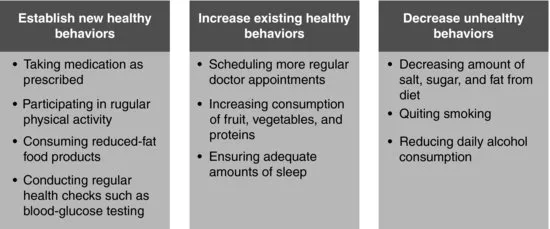
While many individuals develop chronic illnesses due to genetic and biological factors (e.g., cystic fibrosis, systemic lupus, Type 1 diabetes), a significant proportion of the population develop diseases due to unhealthy behaviors, such as smoking, excess consumption of alcohol, or unhealthy eating (WHO, 2011). In order to manage and prevent the onset of chronic medical conditions which result from an individual's unhealthy behavior, health behavior change must occur on a number of different levels including, establishing new healthy behaviors, increasing existing healthy behaviors, and decreasing unhealthy behaviors. Examples of the types of health behavior changes that occur at each of these levels are presented in Figure 1.1.
Figure 1.1 Examples of health behavior change.
Maintaining health behavior changes
The long-term maintenance of positive health behaviors has been found to be problematic for individuals. For example, a recent study has indicated that behavior change, in terms of increased levels of physical activity, was only evident in 27% of patients with coronary heart disease at 18 month follow-up (Hansen et al., 2010). Therefore, in addition to the development of medical and pharmacological interventions, developing interventions that focus on changing poor health behaviors is important in reducing the burden of illness. In fact, nutritional, pharmacological, and surgical interventions for a range of conditions, such as weight management, have been shown to have greater positive health outcomes when a behavioral component is included as part of the intervention. For example, a study by Papalazarou and colleagues (2010) investigated the effectiveness of a behavioral and lifestyle intervention following vertical banded gastroplasty in severely obese patients. It was found that patients who received the behavior-modification intervention (e.g., nutrition education, self-monitoring, goal setting, reinforcement, stimulus control) lost significantly more weight and recorded more positive health behavior changes (e.g., improved eating behavior) compared to controls at 12, 24, and 36 months post-surgery.
Models of Health Behavior Change
Health behavior change models of care have been implemented on a range of intervention levels, from primary care administered by medical, nursing, and allied health professionals, health coaches, and carers to higher levels of care which involve interventions administered by health psychologists. Health psychologists are trained in high-level skills to help patients and other health professionals better manage the behavioral, cognitive, and emotional factors of the development and management of medical conditions.
This chapter focuses on the higher-level knowledge of models and skills required for complex health behavior change. More specifically, it outlines a range of evidence-based health behavior change models and discusses a range of techniques used by health psychologists to achieve successful health behavior change outcomes using time- and cost-effective implementation approaches.
Underlying principles of health behavior change
The foundation knowledge and skills for health behavior change assessment and intervention approaches come from cognitive behavior theories and cognitive behavior therapies (CBTs).
Although health behavior change can appear to be straightforward and easily implemented, in reality individual or small-group interventions are rarely straightforward and best outcomes for a range of individual, medical, and social situations require a thorough grounding in the assumptions of CBT techniques. That is, positive patient outcomes in terms of medical, psychological, and social indicators is best achieved when: patient–psychologist communications are structured; health behavior change treatment is focused on overt symptoms and outcomes; the treatment identifies clearly defined goals; health behavior change interventions are adapted to the patient's health problem; the patient is seen as an essentially competent source of pertinent information; the intervention focuses on changes that can be made in the immediate future; and any treatment approach places value on empirical support for intervention techniques that work (Dobson & Dozois, 2001).
While health behavior change involves the application of these basic behavior change principles, health behavior change interventions also incorporate a biopsychosocial view where psychological and social factors, in addition to biological factors, are said to influence the severity and nature of an individual's illness and an individual's capacity to maintain or undertake health behavior change (Browning & Thomas, 2005). For example, negative emotions or low self-efficacy will predict unsuccessful attempts to implement health behavior changes (Luszczynska et al., 2007). Additionally, social factors, such as relationship difficulties, cultural expectations, or financial problems can also have a negative impact on health behavior change (Abbott et al., 2010; Abraham et al., 2011; Blackburn et al., 2005).
Health Psychology Models of Health Behavior Change
There are a large number of models of health and illness which outline factors related to health beliefs, health decisions, and behavioral intentions from both public health and clinical health perspectives. However, in terms of individual health behavior change, the decision-making and illness-perception-based models, known as the readiness to change model and the self-regulatory model, respectively, dominate the research literature (e.g., Kim et al., 2004; Whitmarsh et al., 2003).
Readiness to change model
The theoretical framework of the readiness to change model (Prochaska & Velicer, 1997) helps the health practitioner to understand that patients who have not internalized a need for change do not respond well to an immediate focus on goals for change. The constructs of the readiness to change model include five temporal stages of change. Each of the five stages of change are related to an individual's readiness to change, where a person in the precontemplation stage of change has no active intention to change. The contemplation stage of change describes a person with some awareness of a need to change but has no intention to change within the next 6 months, whereas a person in the preparation stage of change has an intention to change within the next 6 months, and is likely to be engaging in activities that could be identified as preparing for action. The action stage of change is when a person is undertaking the target behavior, such as quitting smoking, or daily blood glucose monitoring, and the maintenance stage of change is when an individual has successfully carried out the target behavior for at least the past 6 months.
The model proposes that interventions aimed at achieving health behavior change need to be appropriate to the patient's readiness to make the required change. This view has been supported by Mau and colleagues (2001) who suggested that “tailoring a lifestyle intervention to a person's stage of change may enhance its effectiveness in changing diet and exercise behaviors” (p. 1774). Furthermore, the development of stage-matched interventions has been shown to increase adherence behavior for patients with a chronic illness, including diabetes (Kim et al., 2004; Mau et al., 2001).
In a study involving 1029 participants, Jones et al. (2003) found a significant effect of a telephone-counselling intervention, developed from the readiness to change model, on multiple self-management behaviors for diabetes. Participants, randomly selected for the intervention group, were provided with a list of health behaviors requiring change. They were more likely to move from one of the pre-action stages of change to the action stage of change when one or two health behaviors were listed as requiring change compared to a “treatment as usual” group of diabetes sufferers.
Furthermore, Miller and colleagues identified numerous processes that facilitate cognitive and behavior change which are more evident in one stage compared to other stages (Miller et al., 1997). As a result, it is of particular importance that health professionals engage in processes of discussion and exploration for health behavior change in a manner that is relevant to the patient's stage of change. Table 1.1 presents suggested discussion points between the health professional and patient across the stages of change using healthy eating as an example of the behavior change goal.
Table 1.1 Suggested behavior change discussion points for healthy eating across the five stages of change
| Stage of change | Suggested stage-relevant discussion points for the health professional |
| Pre-contemplation | Explore the cost of medicines and medical appointments over time versus the adoption of health behaviors Discuss with the patient the consequences of continued poor eating habits, even in terms of worst-case scenarios Ask the patient to consider the future impact of their illness on others |
| Contemplation | Evaluate and list the barriers to healthy eating: determine things that can be changed easily and those that will take time |
| Preparation | Suggest that the patient browse recipe books to assist in making healthy food choices Suggest that the patient involve a family member to assist them in making healthy food choices |
| Action | Work with the patient to plan on preparing smaller food portions Discuss with the patient the option of walking to the shops to establish a healthy mind-set before they buy food Help the patient plan regular reviews with health professionals Work with the patient to keep a diary of positive comments people make about the changes in their behavior and appearance |
| Maintenance | Help the patient to develop a system of visual reminders around their house/office |
Self-regulatory model
Another model that has been used in the investigation of treatment adherence for chronic illness has been Leventhal's self-regulatory model (SRM; Leventhal et al., 1992). This is an illness behavior model that treats the patient as an active self-manager of their illness. The SRM proposes that three stages are involved in an individual's health behavior change. In the first stage, the patient's cognitive (categorized into five components: identity, cause, consequences, time line, and cure/control) and emotional illness perceptions are interpreted (Hagger & Orbell, 2003; Leventhal et al., 1992). These factors then influence the patient's second stage in which coping strategies, such as adherence to medication and behavior treatmen...
Table of contents
- Cover
- Title Page
- Copyright
- About the Editors
- About the Contributors
- Foreword
- Preface
- Acknowledgments
- Part 1: Health Behavior Change and Enhancing Health Behaviors
- Part 2: Age, Gender, and Cultural Factors in Health
- Part 3: Health and Wellbeing
- Part 4: Health Conditions and Health Issues
- Part 5: Body Image, Eating Problems, and Obesity
- Part 6: Substance Use: Prevention and Treatment
- Part 7: Chronic Illness: Facilitating Adjustment
- Part 8: Multidisciplinary Approaches
- Index
Trusted by 375,005 students
Access to over 1.5 million titles for a fair monthly price.
Study more efficiently using our study tools.
Frequently asked questions
Yes, you can cancel anytime from the Subscription tab in your account settings on the Perlego website. Your subscription will stay active until the end of your current billing period. Learn how to cancel your subscription
No, books cannot be downloaded as external files, such as PDFs, for use outside of Perlego. However, you can download books within the Perlego app for offline reading on mobile or tablet. Learn how to download books offline
Perlego offers two plans: Essential and Complete
- Essential is ideal for learners and professionals who enjoy exploring a wide range of subjects. Access the Essential Library with 800,000+ trusted titles and best-sellers across business, personal growth, and the humanities. Includes unlimited reading time and Standard Read Aloud voice.
- Complete: Perfect for advanced learners and researchers needing full, unrestricted access. Unlock 1.5M+ books across hundreds of subjects, including academic and specialized titles. The Complete Plan also includes advanced features like Premium Read Aloud and Research Assistant.
We are an online textbook subscription service, where you can get access to an entire online library for less than the price of a single book per month. With over 1.5 million books across 990+ topics, we’ve got you covered! Learn about our mission
Look out for the read-aloud symbol on your next book to see if you can listen to it. The read-aloud tool reads text aloud for you, highlighting the text as it is being read. You can pause it, speed it up and slow it down. Learn more about Read Aloud
Yes! You can use the Perlego app on both iOS and Android devices to read anytime, anywhere — even offline. Perfect for commutes or when you’re on the go.
Please note we cannot support devices running on iOS 13 and Android 7 or earlier. Learn more about using the app
Please note we cannot support devices running on iOS 13 and Android 7 or earlier. Learn more about using the app
Yes, you can access Applied Topics in Health Psychology by Marie Louise Caltabiano,Lina Ricciardelli in PDF and/or ePUB format, as well as other popular books in Psychology & Physiological Psychology. We have over 1.5 million books available in our catalogue for you to explore.