Chapter 1
The UKCAT and University
In This Chapter
Understanding medicine and dentistry as careers
Getting into medical or dental school
Understanding the role of UKCAT in the application process
You can easily drift into a career without really thinking about whether it’s right for you. This chapter explains what medicine and dentistry are like as careers, and what role the United Kingdom Clinical Aptitude Test (UKCAT) plays in the application process for these courses.
Looking at the Lifestyle
Getting into university to study medicine or dentistry is tough. Doctors and dentists are some of the most respected members of society. Medical and dental jobs retain an air of glamour and mystique in the eyes of the general public. And although the reality is often more challenging and more pedestrian than the fantasy of medical dramas, these careers do have some unique benefits.
As a doctor or dentist, you earn extraordinary privileges. As well as receiving an excellent grounding in the sciences, you develop your communication skills, sharpen your deductive skills, and discover all sorts of intimate details about complete strangers along the way.
Medicine and dentistry are two of the few professions where you can incorporate both science and art into your daily working life. A career in medicine or dentistry comes with more job security than most jobs provide, along with an historically comfortable salary.
These jobs have downsides too. Doctors and dentists often cope with the less enjoyable bureaucracy and organisational restructuring. They also face perennial threats to training time, remuneration, and education budgets. More fundamentally, the jobs are often exhausting – physically, mentally and emotionally. Dealing with some of the most troubled and unwell people in the country every day can take its toll. Ask yourself whether that’s something you want to do, and why. A bit of honest soul-searching now may save you from agony later on.
If you still want to apply to medical or dental school, you need to overcome one of the toughest university degree application systems. Things weren’t always so complicated. When we started out, all we needed was a bit of relevant work experience, solid A-level predictions, and the ability to sound intelligent and vaguely enthusiastic in an interview. If you applied to Oxford, you needed to navigate the little matter of the Oxford Entrance Exam, but if you performed well, you got a two Es offer: as long as you got two Es on your A-levels, you were in!
Barriers to admission are far higher today. To be accepted as one of tomorrow’s doctors or dentists, you have to show intelligence and initiative, communication skills and commitment, and resilience and reliability. You need to demonstrate both breadth and depth of work experience, take part in significant extracurricular activities, have excellent AS results and A-level predictions, be prepared to take on large tuition fees with their associated loans, be naturally talented and have practised enough to perform well in the extra exams that universities make you sit, such as the BioMedical Admissions Test (BMAT) and the United Kingdom Clinical Aptitude Test (UKCAT).
This increasing complexity isn’t due only to more people applying for courses. The situation is also because universities increasingly struggle to distinguish between good and great candidates on the basis of A-level predictions and results alone. We wait to see whether the recent introduction of the A* grade shifts the balance back to A-level results, but currently many universities consider good UKCAT scores vital. Because university admissions policies tend to change particularly slowly, there may be an organisational inertia against streamlining entrance requirements for fear that doing so would lead to a reduction in the quality of applicants to the best universities. Therefore, UKCAT is likely to remain a key part of the selection procedures for the foreseeable future.
Getting a good UKCAT score is crucial to your chances of success.
We often hear first-hand how worrying the UKCAT is to candidates. The good news is that with preparation, you can improve your eventual performance markedly. In this book we aim to help you do just that.
Applying to Read Medicine or Dentistry
If you’ve weighed the pros and cons of a career in medicine or dentistry and decided it’s what you really want, you need to know exactly how to go about it. The application process is long, and it starts early.
Use this section as a jumping-off point to research the medical fields further. Our focus on the UKCAT in this book means that the information in this section is only introductory to the wider application process. For more detailed information, take a look at our related book, Get into UK Medical School for Dummies (Wiley).
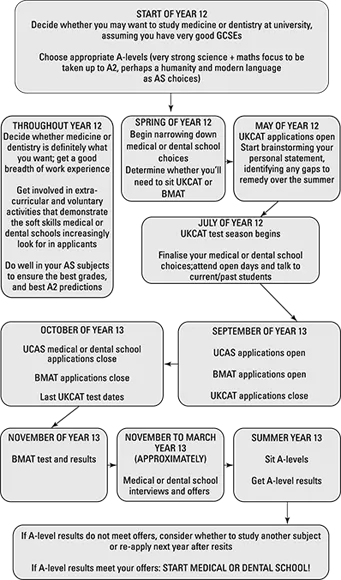
Considering the timeline
In Figure 1-1 we show a rough timeline of when to do what if you want to apply to medical or dental school. Use the timeline to keep the big picture of the application process in mind.
Picking your A-levels
Unless you’re reading this book at a remarkably early stage, you’ve probably already chosen your A-levels. If you still have time to optimise your choices for medicine or dentistry, remember that chemistry is mandatory, and having biology really helps too. Many medical and dental applicants study physics or mathematics at A-level, but these subjects aren’t essential for getting into medical or dental school.
An increasing number of candidates sit more than three A-levels. Languages, psychology and business studies are popular options to help potential medical and dental students demonstrate their breadth of ability.
The choice is yours, but you need to expect to score highly in your...