- English
- ePUB (mobile friendly)
- Available on iOS & Android
eBook - ePub
Optical Engineering of Diamond
About this book
This is the first comprehensive book on the engineering of diamond optical devices. Written by 39 experts in the field, it gives readers an up-to-date review of the properties of optical quality synthetic diamond (single crystal and nanodiamond) and the nascent field of diamond optical device engineering. Application areas covered in detail in this book include quantum information processing, high performance lasers and light sources, and bioimaging. It provides scientists, engineers and physicists with a valuable and practical resource for the design and development of diamond-based optical devices.
Information
1
Intrinsic Optical Properties of Diamond
Diamond comprises the lowest mass element that can form a stable covalently bonded crystal lattice, and this lattice is highly symmetric and tightly bound. Its resulting extreme properties, along with the recent developments in its synthesis, have led to an explosion of interest in the material for a diverse range of optical technologies including sensors, sources, and light manipulators. The optical properties in many respects sit well apart from those of other materials, and therefore offer the tantalizing prospect of greatly enhanced capability. A detailed knowledge base of the interaction of electromagnetic radiation with the bulk and the surface of diamond is of fundamental importance in assisting optical design.
For any material, the dataset characterizing optical performance is large and diamond is no exception despite its inherent lattice simplicity. The properties of interest extend over a large range of optical frequencies, intensities and environmental parameters, and for many variants of the diamond form including defect and impurity levels, crystal size, and isotopic composition. Over and above the fascination held for this ancient material, its highly symmetric structure and pure natural isotopic content (98.9% 12C) provides an outstanding example for underpinning solid-state theory. As a result, diamond has been extensively studied and its optical properties are better known than most other materials.
Many excellent reviews of optical properties have been reported previously (see e.g. Refs [1–3]). These concentrate mainly on linear optical properties, often focus on extrinsic phenomena, and are written from perspectives outside of the field of optics, such as electronics and solid-state physics. Consequently, there is a need to consolidate the data from the perspective of optical design. Furthermore, the nonlinear optical properties of diamond have not to date been comprehensively reviewed. The aim of this chapter is to do this, with emphasis placed on the intrinsic properties of single-crystal diamond (i.e., pure Type IIa diamond1)). The chapter also includes the dependence of optical properties on basic variables such as wavelength, temperature, and isotopic composition. Although the scope is limited to bulk intrinsic properties, the intention is to stimulate a further expansion of the knowledge base as the limits of measurement resolution and performance are extended, and as more detailed investigations emerge into areas such as surface optics, crystal variants, and nano-optical effects.
The chapter focuses on the optical properties spanning from ultraviolet (UV) to infrared (IR). It should be noted that, throughout the chapter, Système Internationale (SI) units have been used, apart from some exceptions to stay with conventions. The data provided refer to diamond with the naturally occurring isotopic ratio, unless specifically stated otherwise.
1.1 Transmission
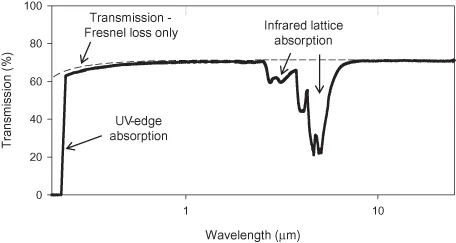
Diamond has a wide bandgap and lacks first-order infrared absorption, which makes it one of the most broadly transmitting of all solids. As shown in Figure 1.1, the transmission spectrum for a diamond window is featureless for wavelengths longer than approximately 225 nm (α < 1 cm−1 for λ > 235 nm), apart from a moderate absorption in the range 2.6 to 6.2 µm and extending weakly outside each side. Indeed, there is no absorption in the long-wavelength limit, which is a characteristic of the Group IV elements (e.g., Si and Ge) that share the diamond lattice symmetry. UV-edge absorption, infrared lattice absorption and Fresnel reflection dominate the wavelength dependence for transmission. The Fresnel reflection at each diamond–air interface is approximately 17% in the visible (R = 17.1% at 632 nm), and when accounting for multiple reflections between each surface this leads to a maximum transmission of (1 − R)2/(1 − R2) = 70.8%. Using dispersion data for the refractive index (see Section 1.4), the transmission upper limit (no absorption) is shown as a function of wavelength (dashed line in Figure 1.1).
Figure 1.1 Transmission spectrum for a Type IIa diamond window (“Type IIIa,” Element 6) of 1 mm thickness. The spectrum was measured using a Cary 5000 spectrometer (UV-near IR) and Bruker Zertex 80 (>2 µm; resolution 4 cm−1). The transmission for Fresnel loss only (dashed curve) was calculated using the relation described in the text and in Equation (1.6). The small difference between the dashed and measured curves in the regions away from the UV-edge and lattice absorption is largely attributed to the combination of spectrometer calibration error and scatter in the sample.
1.2 Lattice Absorption
The absorption in the mid-IR, which is most prominent in the range 2.6 to 6.2 µm, arises due to the coupling of radiation with the movement of nuclei, and is often referred to as “lattice” or “multiphonon” absorption. The magnitude and shape of the absorption spectrum is a consequence of the vibrational properties of the crystal lattice, which are governed by the forces between neighboring atoms and the symmetry of collective vibrations. The theoretical framework that most successfully describes the spectrum has been developed since the 1940s, stimulated by the pioneering work of Sir C.V. Raman on diamond’s optical properties and Max Born on the quantum theory of crystals. It is interesting to note that, although diamond’s lattice is one of the most simple, there have been substantial controversies in explaining the spectrum (see e.g., Ref. [4]) and there are on-going challenges to thoroughly explain some of the features.
A brief and qualitative summary of the theory of lattice absorption is provided here to assist in an understanding of the IR spectrum’s dependence on important material and environmental parameters such as impurity levels, isotopic content, and temperature. A greatly simplifying and important aspect is that there is no one-phonon absorption in pure, defect-free diamond (which would appear most strongly near 7.5 µm for diamond), as also for other monatomic crystals with inversion symmetry such as Si and Ge. The movement of nuclei in vibrational modes of the lattice are countered by equal and opposite movement of neighbors, so that no dipole moment for coupling with radiation is induced. One-phonon absorption may proceed by spoiling the local symmetry through, for example, lattice imperfections (impurities and defects) or by the application of electric field. Dipole moments may also be induced in the crystal via interaction of the incident photon with more than one phonon, although with reduced oscillator strength; this is the origin of la...
Table of contents
- Cover
- Related Titles
- Title page
- Copyright page
- Foreword
- Preface
- List of Contributors
- 1 Intrinsic Optical Properties of Diamond
- 2 Optical Quality Diamond Grown by Chemical Vapor Deposition
- 3 Polishing and Shaping of Monocrystalline Diamond
- 4 Refractive and Diffractive Diamond Optics
- 5 Nitrogen-Vacancy Color Centers in Diamond: Properties, Synthesis, and Applications
- 6 n-Type Diamond Growth and Homoepitaxial Diamond Junction Devices
- 7 Surface Doping of Diamond and Induced Optical Effects
- 8 Diamond Raman Laser Design and Performance
- 9 Quantum Optical Diamond Technologies
- 10 Diamond-Based Optical Waveguides, Cavities, and Other Microstructures
- 11 Thermal Management of Lasers and LEDs Using Diamond
- 12 Laser Micro- and Nanoprocessing of Diamond Materials
- 13 Fluorescent Nanodiamonds and Their Prospects in Bioimaging
- Index
Trusted by 375,005 students
Access to over 1.5 million titles for a fair monthly price.
Study more efficiently using our study tools.
Frequently asked questions
Yes, you can cancel anytime from the Subscription tab in your account settings on the Perlego website. Your subscription will stay active until the end of your current billing period. Learn how to cancel your subscription
No, books cannot be downloaded as external files, such as PDFs, for use outside of Perlego. However, you can download books within the Perlego app for offline reading on mobile or tablet. Learn how to download books offline
Perlego offers two plans: Essential and Complete
- Essential is ideal for learners and professionals who enjoy exploring a wide range of subjects. Access the Essential Library with 800,000+ trusted titles and best-sellers across business, personal growth, and the humanities. Includes unlimited reading time and Standard Read Aloud voice.
- Complete: Perfect for advanced learners and researchers needing full, unrestricted access. Unlock 1.5M+ books across hundreds of subjects, including academic and specialized titles. The Complete Plan also includes advanced features like Premium Read Aloud and Research Assistant.
We are an online textbook subscription service, where you can get access to an entire online library for less than the price of a single book per month. With over 1.5 million books across 990+ topics, we’ve got you covered! Learn about our mission
Look out for the read-aloud symbol on your next book to see if you can listen to it. The read-aloud tool reads text aloud for you, highlighting the text as it is being read. You can pause it, speed it up and slow it down. Learn more about Read Aloud
Yes! You can use the Perlego app on both iOS and Android devices to read anytime, anywhere — even offline. Perfect for commutes or when you’re on the go.
Please note we cannot support devices running on iOS 13 and Android 7 or earlier. Learn more about using the app
Please note we cannot support devices running on iOS 13 and Android 7 or earlier. Learn more about using the app
Yes, you can access Optical Engineering of Diamond by Rich Mildren,James Rabeau in PDF and/or ePUB format, as well as other popular books in Physical Sciences & Optics & Light. We have over 1.5 million books available in our catalogue for you to explore.