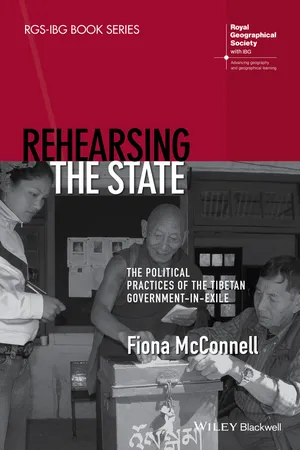
There is both a familiar mundanity to this scene of bureaucratic busyness, and a sense of ‘out of place-ness’ (Cresswell 1996). Tibetans in the monsoon rains of India, Members of Parliament in monastic robes and individuals ‘playing’ at being state bureaucrats and foreign ministers. This might catch our attention as a somewhat intriguing set-up, but it is also one that is easy to dismiss. No government or state legally recognises the Tibetan Government-in-Exile (TGiE).1 This institution has no legal jurisdiction over territory in Tibet or in exile, it operates within the sovereign state of India, and it is vilified as a ‘separatist political group campaigning against the motherland’ by the Chinese Government (Zhu Weiqun cited in Aiming 2011: 8). At first glance, therefore, this government-in-exile appears to be both a powerless pawn in Asian geopolitics and simply another political ‘oddity’ on the margins of the inter-state system.
But this book is a call to pause a little longer, and to consider both the everyday practicalities and the wider repercussions of what is going on here. In what follows I consider how this exiled and unrecognised government is able to function, what the hopes and goals of its leadership are, and what this case might be able to tell us about the nature of state-like governance more generally. For, though their legal authority is extremely limited, the over 3000 staff of the TGiE are nevertheless attempting to play the state game. And it is the metaphor of play, in the theatrical as well as the ludic sense, that I want to suggest can offer a revealing lens, both for viewing the particularities of this state-like non-state, and for examining the nature of everyday state practices and the pedestal upon which statehood continues to be placed.
Two questions are at the core of this book. First, how does the TGiE enact state-like functions from its situation of exile in India and a lack of legal recognition? And, second, why is such work put into emulating, or mimicking (cf. Bhabha 1984), this particular form of political organization? In order to address these, the chapters that follow are an exploration of this state-in-waiting; a set of institutions, performances and actors through which the exiled community is practising stateness with the broader aim of one day employing it ‘for real’ back in the homeland. Or, to frame it in another way, this is a ‘rehearsal state’, complete with playwrights (the Dalai Lama and, increasingly, the elected Tibetan Prime Minister), designated roles amongst the Tibetan civil service, a dedicated rehearsal space in the exile settlements and audiences ranging from the host state India to the Chinese government and the international community more widely. Through chapters that take aspects of rehearsal in turn – settings, roles, scripts and audiences – I argue that this metaphor speaks to the situation of exile stateness in important ways. First, rehearsal has an inherent but ambiguous temporality: rehearsal is done in anticipation of the ‘real’ event, but could be indefinite. Second, rehearsal depends on participation, on practice, and on developing expertise, but it also presents the challenge of how to keep people engaged with the broader project. Finally, contingent on belief in a script, in the playwright and in there actually being a final performance, rehearsal denotes a deliberate and self-conscious political project.
In tracing out this idea of rehearsing stateness, the book draws on and brings together a series of conceptual debates from political geography, political anthropology and critical international relations. At the core are intersections between post-foundational literature on the everyday state – including the idea of state performances and the relationship between the state and territory – and geographies of temporality. The latter bring into dialogue work on exile and prolonged waiting on the one hand, and ideas around anticipating and imagining futures on the other. Such engagement with theoretical interests around the state, performance, space and time is premised on the assertion that, whilst certainly an unusual political configuration, the exiled Tibetan polity is certainly not unique. As such, the discussion that unfolds in the following pages is set against two key contexts. First is to situate the role and functioning of the TGiE within what is a diverse range of non-state polities, from protectorates and leased territories to de facto states and virtual nations. Second, in focusing on a community that resides in but is not of South Asia, the following chapters tack between this case and questions of governance, territory and statehood within the Tibet/China/South Asian regional context.
The Case of Exile Tibet
Controversy surrounds the legal, territorial and political status of Tibet. In broad brushstrokes, Chinese authorities maintain that Tibet has been and remains an inalienable part of China's territory (People's Republic of China 1992), whilst Tibetans and their supporters assert that Tibet existed as an independent sovereign state prior to the Chinese occupation in 1949 (DIIR 1996; McCorquodale & Orosz 1994). Tibet is also a nation and territory that has long captured the Western imagination and, to a lesser extent, international media headlines. While the focus of recent attention has been on Chinese government crackdowns on unrest inside Tibet, international ‘Free Tibet’ protests and the Dalai Lama's meetings with world leaders, this book turns critical attention to a key but often overlooked player in the ‘Tibet issue’: the Tibetan Government-in-Exile.
In 1950, China's People's Liberation Army (PLA) entered Chamdo in eastern Tibet, and by 1951 had declared Tibet's ‘peaceful liberation’. Eight years later, the PLA crushed the Tibetan national uprising in the capital Lhasa, and the Dalai Lama and around 80,000 Tibetans crossed the Himalayas to seek refuge in India, Nepal and Bhutan. Today, the Tibetan diaspora numbers over 128,000, with 74% residing in self-contained settlements and scattered communities in India (Planning Commission 2010).2 On 29 April 1960 the Dalai Lama re-established the Tibetan government in the north Indian town of Dharamsala, with the twin task of restoring freedom in Tibet and rehabilitating the Tibetan refugees. Over the following decades the exiled Tibetan community, under the leadership of the Dalai Lama and more recently the democratically elected Tibetan ‘Prime Minister’, has developed, expanded and institutionalised the TGiE, an exilic political structure that is widely regarded as one of the best organised in the world.
A series of changes have been implemented to restructure the TGiE according to democratic principles and, following reforms in 1991, the government has developed a participatory democracy for the first time in Tibet's history. The Dalai Lama's retirement from political life in March 2011 and his transfer of political authority to the elected exile Tibetan Prime Minister (Sikyong) have heralded what is widely seen as a distinct new era of exile Tibetan politics. Meanwhile inside Tibet political tensions have been high since street protests across the plateau in 2008 and over 140 cases of self-immolation.3 Any resolution to the ‘Tibet issue’ currently seems a distant dream, especially as the dialogue between Dharamsala and Beijing, begun in 1979, ground to a halt in June 2012 with the resignation of the Dalai Lama's two envoys. With the research for this book conducted between 2006 and 2012, it is against such a backdrop of political change and uncertainty that the following narrative unfolds.
Operating under the constitution-like ‘Charter of Tibetans in Exile’, the TGiE consists of a legislative parliament with members elected from the diaspora, a judiciary (albeit with limited powers) and an executive body (the Kashag) in charge of seven governmental departments. The exile administration's state-like functions include the organization of democratic elections, the provision of health and education services for Tibetans in India and Nepal, a ‘voluntary’ taxation system and the establishment of quasi embassies abroad. Such claims to legitimacy as the official representative of the Tibetan population are thus made despite being internationally unrecognised, having highly limited judicial and policing powers, and lacking de jure sovereignty over territory in Tibet and in exile. Analysing this situation of legitimacy without legality means going beyond the lenses through which the exile Tibetan case has been viewed to date: those of identity and nationalism (Klieger 1992; Yeh 2007), cultural preservation outside the homeland (Harris 1997; Korom 1997) and socio-cultural adaptation (Goldstein 1978; Subba 1990). Rather, Rehearsing the State places the institution of the TGiE centre stage, approaching this polity from a political geography perspective, and focusing on the under-researched issue of its state-like governance strategies within the sovereign space of India. As such, in disrupting conventional binaries of state/non-state, sovereign/non-sovereign and citizen/refugee my aim here is to suggest critical interventions both into how statehood is conceived of spatially and temporally, and into understandings of so-called anomalous polities striving to function in international politics today.
International politics is replete with examples of state-like functions being enacted in non-state-like places. From the Palestine Liberation Organization's state-within-a-state in southern Lebanon in the 1970s, to the functioning of the Irish Free State from 1922 to 1937, and Libyan rebels building a parallel state in Benghazi in spring 2011. In placing the TGiE alongside such examples I am not seeking to compare like with like. Nor does this book engage in a project of categorising or classifying geopolitical ‘anomalies’. Not only is a systematic comparison of different polities beyond the remit of this case study-based research (cf. Caspersen 2012; Talmon 1998) but such an exercise arguably does not elucidate broader questions posed here about how and why such ‘anomalies’ enact distinctly state practices. Where points of comparison are made the focus is on parallel practices of ‘stateness’: the state-like performances, narratives and spaces that are common across communities denied legally recognised statehood. This book is therefore grounded in the perspective that, despite their relatively small population and territorial size, polities such as dependencies, stateless nations and de facto states can provide a valuable window on the nature of international politics. Following the argument that the ‘exceptional’ has something to tell us about the ‘normal’, an ethnographic focus on such polities' everyday articulations of statehood exposes the contingent practices that underlie political power in so-called ‘conventional’ states.
The State as Aspirational: Thinking Across State Spaces, Temporalities and Performances
These broader assertions are considered towards the end of the book; my task here is to sketch out the conceptual framing for the chapters that follow. This book is written from a political geography perspective, by which two key approaches are implied. First, that the relationship between power and space, and how this is articulated in different contexts, is of core concern. In this case, attention is focused on how an ostensibly territory-less polity is able to articulate a degree of sovereign authority and act in state-like ways and, in turn, on how this very ‘out of place-ness’ facilitates experimentation in governing strategies. Second, writing as a (political) geographer means adopting an integrative approach to theory and methodology. Human geography, in its contemporary guise, is in many ways an outward-looking discipline, and the arguments made in this book draw on, bring into dialogue and seek to speak back to a series of theoretical debates and approaches that have preoccupied scholars in political anthropology, critical strands of international relations and South Asian and Tibetan studies, as well as political geography.
The first of these sets of debates concerns understandings of the state. The state is certainly not the most intuitive conceptual lens through which to view the case of exile Tibet. For a start, this is a situation where the existence of a legally recognised state in the past is disputed and where a state in the future is not only inconceivable under existing political conditions, but is not currently being demanded by the exiled elite. Indeed, if we are to follow legal definitions of the state as a juridical entity of the international system and a government as the exclusive coercive organisation that represents a state (Robinson 2013), then what Tibetans in exile have brought with them and have (re)constructed within India simply counts as neither. However, as the following chapters demonstrate, when viewed through the lens of everyday state practices, the seeming disjuncture of the conventional institution of the state and the case of exile Tibet shed valuable light on the contemporary nature of the state. Such a dialogue needs to be facilitated carefully, and a particular route through state theory has been chosen for this task.
The conventional collapsing of territory, authority and population into a ‘single unproblematic actor: the sovereign state’ (Biersteker & Weber 1996: 5) has been critiqued from many quarters. Inspired by post-structuralist, feminist and Marxist approaches, a range of scholars have challenged the ontology of the state, drawing on Foucault's ideas on governmentality to posit the state as an emergent ensemble of institutions (Corbridge et al. 2005; Scott 1998), and exploring the plural strategies through which political legitimacy is sought. Speaking to geographic...