![]()
PART 1
Analysis, Rewritings and Republications
![]()
Chapter 1
Analyzing an Audiovisual Corpus of A Thousand and One Nights 1
1.1. Introduction
The ALIA1 Workshop (LHE - Literary Workshop of Here and Elsewhere) is one of the ASW-HSS projects, which include the Culture Crossroads Archives (CCA)2 for cultural studies and the ADA3 (ArkWork) for archeology. The aim of the ALIA (LHE) dossier is to communicate and improve the online literary heritage for various Internet audiences such as researchers, students, media professionals and so on.
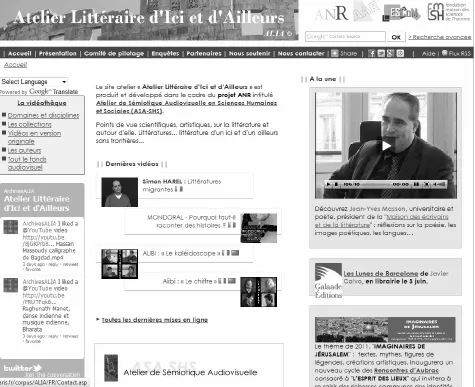
The aim of the ALIA is to create an audiovisual corpus of French and world literature, analyze it using the ASW Studio and then publish it on a portal. The analyzed and published corpus on the ALIA (LHE) portal4 (see Figure 1.1) can be accessed via several sections such as knowledge topics, thesauruses, collections of texts and so on.
The audiovisual LHE corpus is primarily composed of audiovisual texts from human and social science resources from the Archives Audiovisuelles de la Recherche [Audiovisual Research Archives - ARA] among others5 following collaboration with researcher-academics (Jean-Yves Masson, professor of compared literature at University Paris IV Sorbonne; Jean Baumgarten, director of research at CNRS and specialist in Jewish cultural history; Frank Greiner, specialist in transmitting aesthetic and literary models at the University of Lille III), public figures (Jean Lacouture, journalist, reporter and author) or partner organizations6, publishing houses7 including interviews with authors, or video examples of literary expressions.
Another partnership, based on a rewarding collaboration was “A la rencontre d’écrivains”. This association is directed by Francis Cransac, who had organized his first literary festival in 1994. Since then, this festival has been based on different themes for amateurs, academics, and professionals. The festival’s content has also been recorded and published online on the ARA portal since 20068.
This highlights the importance of an active collaboration, not only with the LHE dossier management committee, responsible for verifying each stage of experimentation in the ASW-HSS project, but also with potential external users of publications from audiovisual corpus analysis, that is the management committee including researcher-academic, Jean-Yves Masson, responsible for verifying each stage of experimentation in the project, and eminent personalities from the literary establishment.
This framework was beneficial not only for systematically analyzing a large part of the LHE audiovisual corpus (accessible via the online portal) but also for leading a series of experiments such as those carried out in the Décryptimages project9. We will examine one of these experiments on audiovisual texts examining A Thousand and One Nights.
In order to do so, we will consider the different stages creating a thematic educational dossier through an example created on an audiovisual corpus of A Thousand and One Nights. From this initial stage, which involves choosing texts from a vast collection of audiovisual literature, we will examine how their technical process depend on the type of initial sound document, that are segmented or non segmenting videos, extracting relevant parts for each specific theme, in order to adapt them to the demands of the thematic educational dossier. We will also consider the role of each of these texts in the overall structure of the learning dossier and reasons for these functions, primarily due to their semiotic features. Following this, we will focus on the process of analyzing these texts according to their individual characteristics that is semiotic in context, and final editorial choice. The aim, using this example, is to provide a critical overview both of the constraints imposed by the text and the ASW Studio, as well as the wide range of possibilities for detailed audiovisual semiotic analysis and publication for a predefined community of users.
We will conclude this chapter by examining some of the uses of the ASW studio in the context of developing digital records and sharing scientific and professional knowledge.
1.2. Creating a thematic educational dossier based on A Thousand and One Nights
1.2.1. Choosing an audiovisual corpus
The LHE workshop, like CCA or ArkWork, was principally based on audiovisual texts selected from the vast range of corpora in the Archives Audiovisuelles de la Recherche [Audiovisual Research Archives, ARA] and several theatrical productions carried out during the project. This includes interviews with academics on literature, literary production, experts on its relation with other disciplines such as human and social sciences, interviews with authors about their personal styles, as well as seminars and original stage productions and so on.
From this variety of material, there are several texts which can be selected for the theme of A Thousand and One Nights. There are three texts which are interesting for their variety in both genre and content because they provide three different perspectives on the subject:
– an interview with Joseph Sadan from Tel Aviv University (Israel) presenting A Thousand and One Nights within the general context of the “sociocultural aspects of classical Arabic literature”10. This interview was carried out during his visit to the Fondation Maison des Sciences de l’Homme (FMSH)11, Paris, in 2007;
– a seminar by Aboubakr Chraïbi entitled “En dire plus ou en dire moins: traduire les Mille et une nuits” [Saying more or less: translating A Thousand and One Nights] examining eroticism in A Thousand and One Nights, comparing the original Arabic text with 19th Century translations by renowned authors;
– an original modern stage production, adapted from A Thousand and One Nights - “L’Amour impossible d’après les Mille et une nuits” [Impossible love according to A Thousand and One Nights] – performed by Bruno de La Salle, mixing narration with instrumental music and vocals12.
1.2.2. Text analysis
Semiotic analysis of audiovisual texts is governed by original editorial choices: our selection is based on the type of publication which is a thematic educational dossier, where the dossier is aimed at an “absolute beginner” adult audience for life-long learning. Note, however, that even if these texts are compiled together, they can still be viewed separately and are reusable in other types of publications.
1.2.2.1. Building the dossier: text structure
In the learning dossier's thematic, we need to identify the role of each audiovisual text in our discourse on A Thousand and One Nights. This involves organizing them around a central axis. More generally, as shown through the interview that discusses sociocultural aspects of classical Arabic literature, we will focus the discourse on a specific theme in A Thousand and One Nights, namely eroticism, as examined in Aboubakr Chraïbi’s seminar13 and exemplified in the contemporary theater adaptation. This articulation of the dossier, that is its “mode of use” is specified in the metadescription for each audiovisual text.
This organization is applicable thanks to our videos features. Other structures can also be used depending on the genre of the texts and the style of the discourse.
1.2.2.2. Processing corpora: choice of analysis and segmentation
Exploring this theme implies that we have undertaken a detailed analysis of a segmented video14. This approach is clearly expressed and described in the metadescription section in the analysis workshop15.
However, we also need to account for the characteristics, and even constraints of each of these original texts. This is because their original form differs from each other. For example, the interview is already divided into audiovisual segments whilst the seminar and filmed stage production are not. In compliance with the analysis procedure we have opted fo...