Reverse Engineering in Control Design
eBook - ePub

Reverse Engineering in Control Design

  1. English
  2. ePUB (mobile friendly)
  3. Available on iOS & Android
eBook - ePub

Reverse Engineering in Control Design

About this book

Reverse Engineering in Control Design proposes practical approaches to building a standard H-infinity problem taking into account an initial controller. Such approaches allow us to mix various control objectives and to initialize procedures for a fixed-structure controller design. They are based on the Observer-Based Realization (OBR) of controllers. The interest of OBR from the controller implementation point of view is detailed and highlighted in this book through academic examples. An open-source toolbox is available to implement these approaches in MatlabÂŽ.
Throughout the book academic applications are proposed to illustrate the various basic principles. These applications have been chosen by the author for their pedagogic contents and demo files and embedded MatlabÂŽ functions can be downloaded so readers can run these illustrations on their personal computers.

Contents

1. Observer-based Realization of a Given Controller.
2. Cross Standard Form and Reverse Engineering.
3. Reverse Engineering for Mechanical Systems.
Appendix 1. A Preliminary Methodological Example.
Appendix 2. Discrete-time Case.
Appendix 3. Nominal State-feedback for Mechanical Systems.
Appendix 4. Help of MatlabÂŽ Functions.

About the Authors

Daniel Alazard is Professor in System Dynamics and Control at Institut Supérieur de l'Aéronautique et de l'Espace (ISAE), Toulouse, France – SUPAERO Graduate Program. His main research interests concern robust control, flexible structure control and their applications to various aerospace systems.
Frequently asked questions

Yes, you can cancel anytime from the Subscription tab in your account settings on the Perlego website. Your subscription will stay active until the end of your current billing period. Learn how to cancel your subscription.
At the moment all of our mobile-responsive ePub books are available to download via the app. Most of our PDFs are also available to download and we're working on making the final remaining ones downloadable now. Learn more here.
Perlego offers two plans: Essential and Complete
  • Essential is ideal for learners and professionals who enjoy exploring a wide range of subjects. Access the Essential Library with 800,000+ trusted titles and best-sellers across business, personal growth, and the humanities. Includes unlimited reading time and Standard Read Aloud voice.
  • Complete: Perfect for advanced learners and researchers needing full, unrestricted access. Unlock 1.4M+ books across hundreds of subjects, including academic and specialized titles. The Complete Plan also includes advanced features like Premium Read Aloud and Research Assistant.
Both plans are available with monthly, semester, or annual billing cycles.
We are an online textbook subscription service, where you can get access to an entire online library for less than the price of a single book per month. With over 1 million books across 1000+ topics, we’ve got you covered! Learn more here.
Look out for the read-aloud symbol on your next book to see if you can listen to it. The read-aloud tool reads text aloud for you, highlighting the text as it is being read. You can pause it, speed it up and slow it down. Learn more here.
Yes! You can use the Perlego app on both iOS or Android devices to read anytime, anywhere — even offline. Perfect for commutes or when you’re on the go.
Please note we cannot support devices running on iOS 13 and Android 7 or earlier. Learn more about using the app.
Yes, you can access Reverse Engineering in Control Design by Daniel Alazard in PDF and/or ePUB format, as well as other popular books in Technology & Engineering & Automotive Transportation & Engineering. We have over one million books available in our catalogue for you to explore.

1

Observer-based Realization of a Given Controller

1.1. Introduction

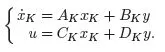
Observer-based controllers (for instance, Linear Quadratic Gaussian (LQG) controllers) are quite interesting for different practical reasons and from the implementation point of view. Probably the key advantage of these controller structures lies in the fact that the controller states are meaningful variables as estimates of the physical plant states. It follows that the controller states can be used to monitor (online or offline) the performance of the system. Such a meaningful state also allows us to initialize the state of the controller or to update the controller state during control mode switching. Note that this simple property does not hold for general controllers with state-space description:
[1.1]
image
Another well-appreciated advantage comes from the ease of implementation of observer-based controllers. In addition to the plant data, only two static gains (the state-feedback and the state-estimator) define the entire controller dynamics. In return, this facilitates the construction of gain-scheduled or interpolated controllers. Indeed, assuming the plant model is available in real time, observer-based controllers will only require the storage of these two static gains of lower dimensions instead of the huge set of numerical data in [1.1] to update the controller dynamics at each sample of time. Note that if we are using an interpolating procedure to update the controller dynamics, the general representation in [1.1] is highly questionable from an implementation viewpoint and in many cases will lead to an insuperable computational effort. This was in our opinion a major impediment for a widespread use of modern control techniques, such as H∞ and μ syntheses in realistic applications and particularly for problems necessitating the real-time adjustment of the controller gains. These approaches produce high-order controllers expressed under a meaningless state-space realization. Note also that this last point is relevant if a controller reduction has been performed after the design.
To overcome this problem a general procedure is proposed in this chapter to compute an observer-based realizations for an arbitrary given controller and a given plant (for both continuous and discrete time cases). Independently of the solver used for the control design, such a procedure allows us to provide a realization with a meaningful state vector. In [ALA 01] and [CUM 04], it is shown that observer-based realization are also convenient to isolate high level-tuning parameters (potentiometers) in a complex control law. As the observer-based realization exploits the model of the plant, we can also guess that such a realization is very convenient to update the controller to a change in the model or to build a parameter-dependent controller K(s, θ) from a parameter-dependent model G(s, θ).
Among other potential advantages of observer-based realization, we would like to point out the possibility to handle actuator saturation constraints by exploiting this information into the prediction equation. Since this matter is not covered in this book, the reader is referred to [TAR 97] and references therein for more details. More theoretical discussions on the implementation of gain-scheduled controllers which use the plant nonlinearity model are given in [LAW 95] and [KAM 95].
The practical solution to handle non-stationary problems (such as the launch vehicle control design during atmospheric flight) or nonlinear problems consists of designing a family of controllers at various flight instants or various flight conditions and then in interpolating (gain-scheduling) these various controllers. It is well-known that the non-station...

Table of contents

  1. Cover
  2. Contents
  3. Dedication
  4. Title page
  5. Copyright page
  6. Nomenclature
  7. Introduction
  8. Chapter 1: Observer-based Realization of a Given Controller
  9. Chapter 2: Cross Standard Form and Reverse Engineering
  10. Chapter 3: Reverse Engineering for Mechanical Systems
  11. Conclusions and Perspectives
  12. APPENDICES
  13. List of Figures
  14. Index