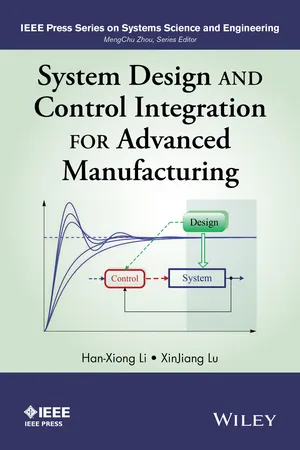
Most existing robust design books address design for static systems, or achieve robust design from experimental data via the Taguchi method. Little work considers model information for robust design particularly for the dynamic system. This book covers robust design for both static and dynamic systems using the nominal model information or the hybrid model/data information, and also integrates design with control under a large operating region. This design can handle strong nonlinearity and more uncertainties from model and parameters.
eBook - ePub
System Design and Control Integration for Advanced Manufacturing
- English
- ePUB (mobile friendly)
- Available on iOS & Android
eBook - ePub
System Design and Control Integration for Advanced Manufacturing
About this book
Information
Part I
Background and Fundamentals
CHAPTER 1
Introduction
This chapter is an introduction of the book. It briefly introduces background, motivation, and objectives of the research, followed by the contribution and organization of the book.
1.1 Background and Motivation
Since we moved into the Industrial Age, most of the products used have been manufactured by machines and production lines. The manufacturing industry has changed much from the traditional sector, like steel and auto factory, to the semiconductor or IC industry in 1980s, and to the internet-based global manufacturing nowadays. Advanced manufacturing uses the so-called “advanced,” “innovative,” or “cutting-edge” technology to improve products and/or processes. The distinctions between traditional sectors of manufacturing and advanced manufacturing are in terms of volume and scale economies, labor and skill content, and intelligence added in the system.
In modern IC industry, the higher speed, the higher precision, and the higher intelligence have become common requirements to many of the processes involved, for example, epoxy/silicone dispensing (Li et al., 2007), curing process (Li, Deng, and Zhong, 2004; Deng, Li, and Chen, 2005), bonding/wiring process (Li and Zuo, 1999), and so on. Even in a traditional industry, like the forging press machine (Lu, Li, and Chen, 2012), the machine will seek help from an intelligence unit for meeting quality and economic constraints. Modern information technology can make a traditional system more advanced.
No matter how complex or advanced the manufacturing operation is, it always consists of basic actions offered by basic systems. These basic systems could be classified into the following three different categories.
- The static system. The performance is invariant over time, so it is discrete.
- The dynamic system. The performance is varying over time, so it is continuous.
- The hybrid system. It is a combination of the above two, which forms a hybrid system with discrete/continuous parameters, or a hybrid discrete/continuous system.
Design for advanced manufacturing is actually centered on the design and control of these basic systems, as the performance of every basic system is crucial to the overall performance of the manufacturing.
Since advanced manufacturing usually involves more complex system configuration and more advanced technologies, it will require a higher quality design of each basic system involved in the operation. However, unavoidable external variations in manufacturing operations, material properties, and a complex operating environment will result in an inconsistent performance of the system, which will be a big challenge to design for manufacturing. If these variations are not properly considered in product design, the degraded performance may result in a failure in operation (Caro, Bennis, and Wenger, 2005). Thus, robust performance, insensitive to all possible changes in demand, model uncertainties, and external disturbance, is one of the most important concerns in the design of any system.
In system design, robust design is the most important method commonly used to achieve robust performance. Its fundamental principle is minimizing the sensitivity of the performance to uncontrollable variations. Most of these approaches are for static systems, a few for dynamic systems. Furthermore, design and control are always separated in both academic research and industrial applications, which leads to few effective methods for the hybrid system.
The principal goal in this book is to develop effective design methods for fundamental systems existing in advanced manufacturing, including
- novel robust design methods for both static and dynamic systems; and
- robust design and control integration methods for the hybrid discrete/continuous system.
Though these methods are studied for basic systems in this book, they should be easily applied to any advanced manufacturing or production.
There are three different sets of variables that will appear in robust design.
- Design variable (or control variable). This is the controllable variable with its nominal value to be designed ideally between the upper and lower bounds. The variations around its nominal value are usually caused by poor manufacturing.
- Uncertainty. This usually includes parameter variation, noise, and model uncertainty. It cannot be adjusted by the designer, and thus is uncontrollable.
- Performance. This is the objective of the design and depends on the system model, design v...
Table of contents
- Cover
- Chronology
- Title Page
- Copyright
- Preface
- Acknowledgments
- Part I: Background and Fundamentals
- Part II: Robust Design for Static Systems
- Part III: Robust Design for Dynamic Systems
- Part IV: Integration of Design and Control
- References
- Index
- IEEE Press Series on Systems Science and Engineering
- End User License Agreement
Trusted by 375,005 students
Access to over 1.5 million titles for a fair monthly price.
Study more efficiently using our study tools.
Frequently asked questions
Yes, you can cancel anytime from the Subscription tab in your account settings on the Perlego website. Your subscription will stay active until the end of your current billing period. Learn how to cancel your subscription
No, books cannot be downloaded as external files, such as PDFs, for use outside of Perlego. However, you can download books within the Perlego app for offline reading on mobile or tablet. Learn how to download books offline
We are an online textbook subscription service, where you can get access to an entire online library for less than the price of a single book per month. With over 1.5 million books across 990+ topics, we’ve got you covered! Learn about our mission
Look out for the read-aloud symbol on your next book to see if you can listen to it. The read-aloud tool reads text aloud for you, highlighting the text as it is being read. You can pause it, speed it up and slow it down. Learn more about Read Aloud
Yes! You can use the Perlego app on both iOS and Android devices to read anytime, anywhere — even offline. Perfect for commutes or when you’re on the go.
Please note we cannot support devices running on iOS 13 and Android 7 or earlier. Learn more about using the app
Please note we cannot support devices running on iOS 13 and Android 7 or earlier. Learn more about using the app
Yes, you can access System Design and Control Integration for Advanced Manufacturing by Han-Xiong Li,XinJiang Lu in PDF and/or ePUB format, as well as other popular books in Technology & Engineering & Industrial Engineering. We have over 1.5 million books available in our catalogue for you to explore.