![]()
Part One
Fire in the Earth System
Photo
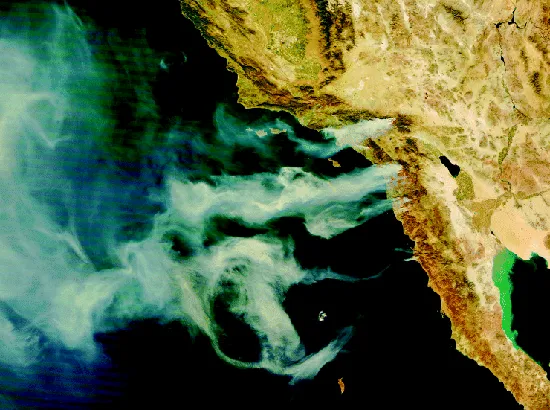
Recent research using satellite data has revolutionized our understanding on the distribution of fire on Earth. This image shows smoke plumes from Californian fires between Los Angeles and San Francisco in October 2007 billowing out over the Pacific Ocean. Red spots indicate active fires. (Image from Modis Rapid Response Project at NASA/GSFC, image 1163886).
Preface to Part One
The first part of this book is an introduction to fire that not only considers fundamentals of fire as a physical/chemical process but also includes methods for the study of fire, an appreciation of the geological history of fire and its importance in the Earth System.
For some, fire is an every day part of life; for others, it is a remote phenomenon and is unimportant; for still others, it evades consciousness altogether. This may be said not only for individuals, but also for entire subject areas where fire has yet to be given its rightful place.
In this section, we discuss the nature and occurrence of fire and illustrate ways by which it can be recognized and studied. The past ten years has seen a revolution in our perception of fire, and news of major wildfires may now be instantly broadcast through a wide range of media. In addition, the increase in the ways we can observe fire through the use of satellites and the ability to view maps of the positions of active fires – even from our mobile phones –has brought a phenomenon unfamiliar to many to the forefront of current debate on human impact on the planet.
What is less well known or appreciated is the long geological history of fire on our planet and the role that fire has played in deep time in shaping our Earth. In this section, we demonstrate the methods we can use to unravel the history of fire – not just in terms of thousands of years, but in terms of hundreds of millions of years. In only the past few years, we have begun to unravel the relationship between fire and atmospheric change, especially with oxygen in the fossil record. This has led to a reassessment of the relationship between fire and vegetation, both from an ecological as well as from an evolutionary perspective. Part One sets up, therefore, the role of fire as an Earth System process and its special role in the evolution of life on land.
![]()
Chapter 1
What is Fire?
This chapter serves as an introduction not only to Part One but also to the book as a whole. It considers many of the fundamentals of fire. We introduce here a number of concepts that are developed throughout the text and, where relevant, the chapter numbers or parts are given for reference. In addition, some areas are dealt with here because there is no space to develop them more fully within this book, as to do so would make it too long and unwieldy. Due to this, we have tried to provide a wide range of illustrative material here, as well as more extensive references for further reading.
1.1 How Fire Starts and Initially Spreads
Simply put, fire – generally called combustion – is a rapid chemical oxidative reaction that generates heat, light and produces a range of chemical products (Torero, 2013). However, in the context of vegetation fires, it is important to consider not only the range of materials that may be combusted, but also the conditions under which fire may occur and even be ignited.
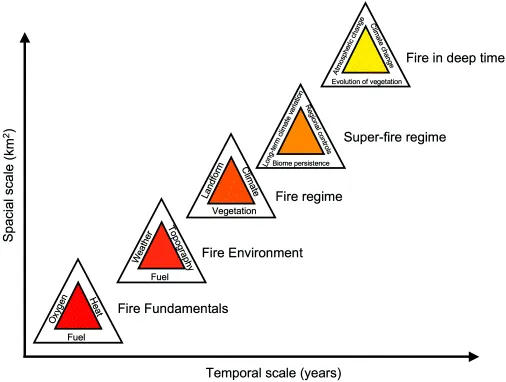
It is obvious, therefore, that the basis of a fire is the nature of the fuel that will be combusted and the type of ignition source. The general principle for vegetation fires is that there is an initial high-temperature heat source. This may be produced by lightning, volcanic activity, a spark from a rock fall or, of course, by humans. Plants contain a range of organic compounds that include cellulose, a carbohydrate that is a linear polysaccharide polymer found in many cell walls. The high initial temperature causes a breakdown of the cellulose molecule and produces a range of gaseous components that include ammonia (NH3), carbon dioxide (CO2) and methane (CH4). These gases mix with atmospheric oxygen and undergo a rapid exothermic reaction – combustion. This rapid increase in heat, together with the readily available oxygen, allows the reaction to continue and a fire is started (Cochrane and Ryan, 2009). These features may be characterized by the use of a fire triangle (Figure 1.1, Fire fundamentals).
Each element will be discussed in more detail below, but it is worth making a few general points at the outset.
- First, the fuel needs to be as dry as possible. This is because the initial heat may be dissipated by the need to evaporate water. If dry, then the heat can begin to break down the cellulose in the plant material. The moisture value of the fuel will depend on whether the plant is alive or dead. If alive, then the plant may contain moisture in the leaves, branches and trunk. If dead, the plant may be more prone to drying out.
- The second element is the fuel itself. For a fire to spread, it is necessary to have sufficient fuel to burn. Extreme build-up of litter that is dry would obviously be conducive to the spread of fire. However, how the fuel is arrayed and how quickly it is combusted is also important (Van Wagtendonk, 2006). There are also differences in the ways in which woody and non-woody vegetation burn, as well as other features such as calorific value, the rate of fire spread and its intensity (see Chapter 14, Part Four).
- Third, a key element is readily available oxygen. In today's atmosphere, where the air contains 21% O2, then combustion and fire spread is possible. For fire to be maintained, oxygen must continue to arrive at the burning point or the fire will be exhausted. This is why wind is so dangerous, as it not only drives the fire, but also replenishes the oxygen at a faster rate.
The implications of the above are also that to put a fire out, water may be added to the fuel to stop flame spread; or, in a confined space, oxygen may be excluded by smothering the fire by the use of inorganic materials such as sand or CO2 to replace the oxygen-rich air.
1.2 Lightning and Other Ignition Sources
Of all the natural ignition sources for a wildfire, lightning, volcanic eruptions and sparks from rock falls, it is lightning that is the most important. Human sources of ignition will be considered elsewhere in this book (see Part Three).
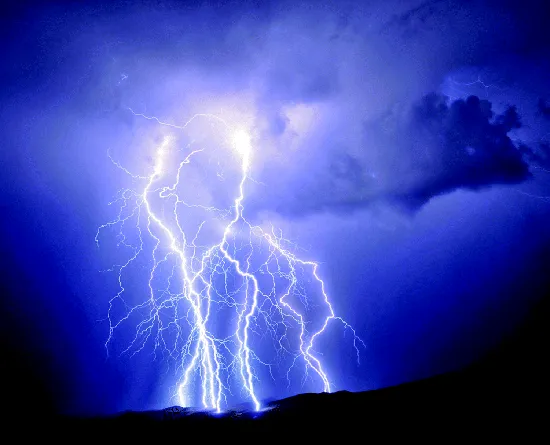
Lightning occurs when there is electrostatic discharge from the atmosphere. The most significant is sky-to-ground lightning (Figure 1.2). Here, a strong electrical charge is transferred from a cloud to the ground. Where the lightning hits the ground, there is a sudden increase in temperature, creating temperatures sometimes in excess of 30 000 °C. Lightning may or may not occur associated with rainfall.
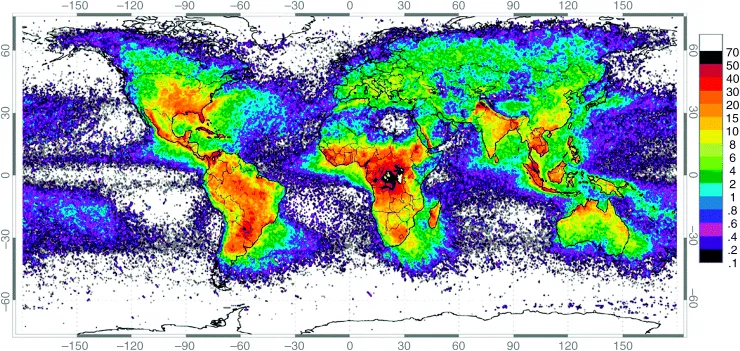
Lightning may strike across many parts of the Earth's surface, but it is found concentrated in particular regions (see map, Figure 1.3). One problem with lightning maps, however, is that they show all lightning, including cloud-to-cloud lightning, not just cloud-to-ground lightning. It is significant that there may be as many as eight million lightning strikes every day.
When not associated with rain, the lightning may be referred to as ‘dry lightning’ and may occur in cumulonimbus clouds, which then may produce pyrocumulus clouds that create more lightning as a result ...