
- English
- ePUB (mobile friendly)
- Available on iOS & Android
eBook - ePub
About this book
An evidence-based approach to improving the practice of graduate management education
Compiled by the Graduate Management Admission Council (GMAC) and with contributions by administrators and professors from the top global MBA programs, this book provides business school decision-makers with an evidence-based approach to improving the practice of graduate management education. The book is designed to help navigate the pressures and create revolutionary platforms that leverage a school's unique competitive advantage in a design distinctly tailored for today's business realities.
- Offers a unique handbook for improving graduate management education
- Contains contributions from an international group of deans and professors that lead MBA programs
- Sponsored by GMAC, owner of the Graduate Management Admission Test (GMAT) exam used by over 5, 000 programs worldwide
This important resource gives academics a proven approach for improving graduate-level management programs.
Frequently asked questions
Yes, you can cancel anytime from the Subscription tab in your account settings on the Perlego website. Your subscription will stay active until the end of your current billing period. Learn how to cancel your subscription.
At the moment all of our mobile-responsive ePub books are available to download via the app. Most of our PDFs are also available to download and we're working on making the final remaining ones downloadable now. Learn more here.
Perlego offers two plans: Essential and Complete
- Essential is ideal for learners and professionals who enjoy exploring a wide range of subjects. Access the Essential Library with 800,000+ trusted titles and best-sellers across business, personal growth, and the humanities. Includes unlimited reading time and Standard Read Aloud voice.
- Complete: Perfect for advanced learners and researchers needing full, unrestricted access. Unlock 1.4M+ books across hundreds of subjects, including academic and specialized titles. The Complete Plan also includes advanced features like Premium Read Aloud and Research Assistant.
We are an online textbook subscription service, where you can get access to an entire online library for less than the price of a single book per month. With over 1 million books across 1000+ topics, weâve got you covered! Learn more here.
Look out for the read-aloud symbol on your next book to see if you can listen to it. The read-aloud tool reads text aloud for you, highlighting the text as it is being read. You can pause it, speed it up and slow it down. Learn more here.
Yes! You can use the Perlego app on both iOS or Android devices to read anytime, anywhere â even offline. Perfect for commutes or when youâre on the go.
Please note we cannot support devices running on iOS 13 and Android 7 or earlier. Learn more about using the app.
Yes, you can access Disrupt or Be Disrupted by in PDF and/or ePUB format, as well as other popular books in Business & Business Education. We have over one million books available in our catalogue for you to explore.
Information
1
Ensuring and Enhancing Future Value
Key Topics Covered in This Chapter
- Value of graduate management education for individuals, organizations, and society
- Challenges and pressure facing future success
- Imperatives for future relevance, effectiveness, and value
Consider for the moment that there is not a single occupation in the vast world of work for which the MBA is a mandatory entry requirement. Yet, even the most casual observer of business schools would note the substantial growth in graduate management education's popularity since its inception more than a century ago. This juxtaposition suggests that although graduate management degrees may not be strict occupational prerequisites, they are indeed perceived as worthwhile investments.
But what exactly is the value of graduate management education? As it turns out, the answer may not be entirely self-evident and is most certainly taken for granted by various business school stakeholders. In fact, uncovering a cohesive narrative that articulates the value of graduate management education is quite difficult. This does not mean that significant scholarship does not exist. However, this body of work is not rooted in a particular academic domain and is challenging to comprehensively grasp and clearly explicate. With this in mind, our primary aim is to convey the central case for why graduate management education matters. Building this case is not only crucial for a deeper understanding of the current state of graduate management education but also for addressing the myriad challenges that lie ahead if it is to continue to be a valuable mechanism for professional education.
We also believe the time is ripe to remind ourselves that graduate management education has broad implications for individuals, organizations, and society. We say âremind ourselvesâ because the value provided by graduate management education is not often extolled in either the popular press or scholarly literature. Consider, for example, that the past two decades of scholarship regarding graduate management education have been absolutely replete with criticism. These frequently scathing critiques have ranged from the philosophical (for example, Ghoshal, 2005) to the functional (for example, Mintzberg, 2004). Even a blithe perusal of this literature is likely to cause one to ask, Does graduate management education do anything well? We believe the answer is resoundingly affirmative. Further, we maintain that too often, the critiques of the past decades have failed to generate ways to enhance graduate management education. In other words, we contend that it is critical to simultaneously recognize that what we do has value, but that it also needs meaningful improvement. Only a balanced perspective can bring a reinvigoration in the way graduate management education is delivered in contemporary business schools.
To fulfill our primary aim, this chapter seeks to accomplish three general goals:
1. To build a case for the value of graduate management education at the individual, organizational, and broader societal levels
2. To outline several pressures that are likely to amplify the need for innovation in the way we currently conceptualize and approach graduate management education
3. To describe a key set of imperatives for business school policy-makers and faculty to address in order to sustain and enhance the value of graduate management education.
Ultimately, we hope not only to establish the clear value proposition of graduate management education but also to compel business schools to recognize that the time is now to reexamine the fundamental tenets on which graduate management education is built.
But before we begin, let us briefly acknowledge a few premises from which our ensuing discussions flow. First, we assert that the raison d'ĂȘtre of graduate management education involves (a) inculcating individual competence in managing various organizational resources (financial, technological, and human capital) and (b) fostering a particular set of values that shape the way individuals view and interpret the world of work. This initial assertion naturally leads to another premise, which is that graduate management education has its most direct impact on individuals. This means that its influence on organizations and ultimately society occurs through a compilation process in which individual competence and values exert bottom-up effects. Simply put, graduate management education starts with people. Finally, although we recognize that graduate management education encompasses a variety of programs (for example, master of science, executive, and joint degrees), we concentrate much of our discussion on MBA programs. This acknowledges both the predominance of the MBA degree in graduate management education and the fact that the vast majority of previous scholarship has exclusively focused on the MBA.
The Impact of Graduate Management Education
Why would someone pursue graduate management education? Why would organizations seek to hire those with graduate management degrees? What are the implications of graduate manÂagement education for society at large? Such questions are fundamental to the ultimate purposes of today's schools of business. Still further, questions about the value proposition of graduate management education undergird many of the recent criticisms of business schools and, at the same time, overlay the very reasons that renovations of our current practices are critical. In the sections following, we discuss the various ways graduate management education shapes individuals, organizations, and society.
Individual Value
Here, the question of value centers on the potential individual-level benefits that coincide with graduate-level training in business schools. Considering the substantial investments of time, money, and effort that graduate-level business training requires, one would hope there would be evidence to support a viable value proposition. Indeed, there are ample reasons to suggest the value of graduate management education for individuals.
At a general level, graduate management education holds perceived value for individuals across a number of business school stakeholders. For example, prospective students frequently indicate that graduate management education will bring them increased job opportunities, salary potential, and business-related knowledge and skills (Graduate Management Admission Council [GMAC], 2012a). Such positive perceptions hold after graduation, when the vast majority of MBA alumni indicate that, knowing what they know now, they would pursue the degree again (GMAC, 2013). Among the key benefits these alumni frequently cite are opportunities to develop management knowledge and technical skills, network and form relationships of long-term value, and expand their career options (Bruce, 2010). In addition, potential employers consistently recognize the value of graduate management education when they recruit graduates, acknowledging that it instills competencies needed for successful job performance (GMAC, 2010).
In addition to perceptions of value, there is evidence that graduate management education has significant competency and career consequences for individuals. For example, graduate management education is capable of increasing cognitive and interpersonal competencies related to managerial effectiveness (Boyatzis, Stubbs, & Taylor, 2002; Hoover, Giambatista, Sorenson, & Bommer, 2010). MBA programs typically require coursework that, at a minimum, touches the key competencies required for managerial performance, including managing human capital, strategy and innovation, decision-making processes, administrative activities, external constituents and context, and logistics and technology (Rubin & Dierdorff, 2009). MBA programs generally include instruction on additional key areas of business management, such as integrative or systems thinking (Atwater, Kannan, & Stephens, 2008). The personal competence that is gained from graduate management education benefits individual careers in both the long and short term (Zhao, Truell, Alexander, & Hill, 2006). For instance, longitudinal studies show that individuals who complete the MBA report greater early career success than similarly qualified individuals without the degree (Inderrieden, Holtom, & Bies, 2006). Finally, building social capital and increasing networking opportunities are frequently listed as advantages of pursuing graduate management education (Vaara & Fay, 2011).
Graduate management education also provides significant economic consequences for individuals. For example, those who complete their MBAs stand to earn as much as 81 percent more after graduation than before they entered the MBA program, and employers report a five-year stable salary premium of US $40,000 for an MBA graduate over someone with a bachelor's degree (GMAC, 2012b). Such findings are consistent with other research showing that MBA salaries and rates of return are substantial (Connolly, 2003). As a result, some have concluded that the âMBA yields an excellent return on investment for nearly everyone, regardless of the type of program, the race of the student, or even the ranking of the schoolâ (Holtom & Inderrieden, 2007, p. 36).
This discussion strongly suggests that graduate management education holds both perceived and actual consequences for individuals. This is not to say that current models of graduate management education are without need of improvement, a point to which we return later in the chapter. However, graduate management education does appear to be a fruitful, systematic training ground for managerial competence that brings with it numerous personal benefits coinciding with its completion.
Organizational Value
Given the consequences of graduate management education for individuals, the question becomes whether or not organizations benefit as well. There are several reasons to believe they do. For example, graduate management education offers cross-functional exposure that is difficult to either imitate or systematically implement in other organization-specific training settings. In addition, graduate management education serves as a filter of sorts; organizations can reasonably assume that individuals who apply and eventually matriculate from business schools possess demonstrated ability and motivation that underlies effective job performance. Finally, the intent of graduate management education is to train individuals in evidence-based, state-of-the-art management practices that help solve complex organizational problems. By continuing to hire MBAs, organizations give the impression that they perceive such value in graduate management education. As an example, a 2012 survey of 1,096 employers found that nearly four in five companies planned to hire at least one MBA candidate (GMAC, 2012b).
Beyond simple market demand, there are other reasons to believe such training adds value to organizations. For instance, at their essence, MBA programs are formalized management development programs, and research has consistently demonstrated the effectiveness of formal programs in promoting managerial competence (see Burke & Day, 1986; Collins & Holton, 2004). Of particular value to organizations is the fact that managerial competence has been linked to a variety of outcomes. These outcomes include reductions in large employee-related costs such as turnover (Griffith, Hom, & Gaertner, 2000) and counterproductive behaviors (Greenberg, 1990); increases in employee and team performance (Judge & Piccolo, 2004; Stajkovic & Luthans, 2003) and organizational citizenship (Podsakoff, MacKenzie, Paine, & Bachrach, 2000); and improved overall commitment and satisfaction (Podsakoff, Bommer, Podsakoff, & MacKenzie, 2006). Still other research suggests that when it comes to outcomes such as revenue and environmental sustainability, companies led by executives with graduate management education often outperform companies with executives who do not (Jiang & Murphy, 2007; Slater & Dixon-Fowler, 2010).
Another way in which graduate management education benefits organizations is through management practices that are first taught to students and then transferred to the students' eventual employers. Not only do many of these strategies defy the âcommonsenseâ approaches routinely found in contemporary organizations (Pfeffer & Sutton, 2006), but evidence also indicates that effective management practices are quite rare in industry (Bloom, Sudun, & Van Reenen, 2012). For example, the evidence is rather clear that downsizing seldom, if ever, makes a firm more competitive (see Cascio, 2005; Datta, Guthrie, Basuil, & Pandey, 2010), yet the practice is commonplace in today's organizations. Other specific management practices, such as internal promotion or succession planning, have been convincingly linked to better organizational performance...
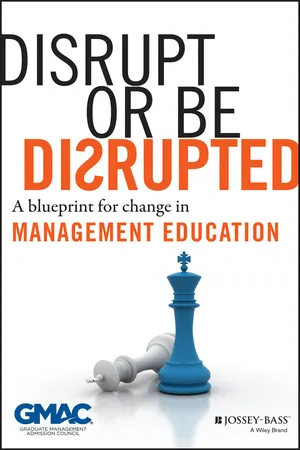
Table of contents
- Cover
- Title page
- Copyright page
- Foreword
- Introduction: The Change Imperative
- 1: Ensuring and Enhancing Future Value
- 2: Framing and Making Strategic Choices
- 3: Managing Aspirations, Resources, and Cost Structures
- 4: Intellectual Signatures: Impact on Relevance and Doctoral Programs
- 5: Curriculum Matters: Toward a More Holistic Graduate Management Education
- 6: Overlooked and Unappreciated: What Research Tells Us About How Teaching Must Change
- 7: Student Engagement: Selection, Management, and Outcomes
- 8: Reclaiming Quality in Graduate Management Education
- Epilogue
- Acknowledgments
- About the Contributors
- Name Index
- Subject Index