![]()
1
PON IN THE ACCESS PICTURE
1.1 WHY PASSIVE OPTICAL NETWORK (PON) FOR THE LAST MILE ACCESS?
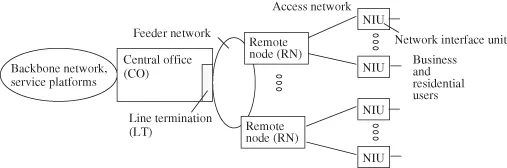
As part of the telecommunications network, the access network covers the “last mile” of communications infrastructure that connects individual subscribers to a service provider’s switching or routing center, for example, a telephone company’s central office (CO). We will use CO, a term from the traditional public network, for convenience, although the switching or routing center could be operated by any entity under a different name, such as headend. The access network is the final leg of transmission connectivity between the customer premise and the core network. For a variety of access solutions including the PON, the access network consists of terminating equipment in the CO, a remote node (RN), and a subscriber-side network interface unit (NIU), as Figure 1.1 shows. The feeder network refers to the connection between CO and RN, while the distribution network joins the NIU to the RN. Downstream program services, one of many applications of a broadband access system, may be broadcast, multicast, or individually directed to the users, depending on the service objectives and enabling technologies.
The access network has consistently been regarded as a bottleneck in the telecommunications infrastructure [GREEN]. This is primarily because of the ever-growing demand for higher bandwidth, which is already available in large measure in the core optical network and in local area networks (LANs) but is more limited in widely deployed residential access technologies such as digital subscriber line (DSL) and cable data. Business customers using the relatively expensive DS-1 (1.544 Mbps) and DS-3 (45 Mbps) legacy access services are similarly limited. We have, then, a large disparity between legacy access systems with per-user rates in the low megabits per second, and the network operator’s optical backbone network using multiple carrier wavelengths in wavelength division multiplexing (WDM) systems in which each wavelength carries data at rates of tens of gigabits per second. The disparity between legacy access systems and both wired and wireless LANs, which have been scaled up from 10 to 100 Mbps and are being upgraded to gigabit rates, is equally dramatic. The tremendous growth of Internet traffic accentuated the growing gap between the capacities of backbone and local networks on the one hand and the bottleneck imposed by the lower capacities of legacy access networks in between. This was, and in many cases still is, the so-called last mile or last kilometer problem. Upgrading the current access network with a low-cost and high-bandwidth solution is a must for future broadband access, and is being actively implemented by many operators.
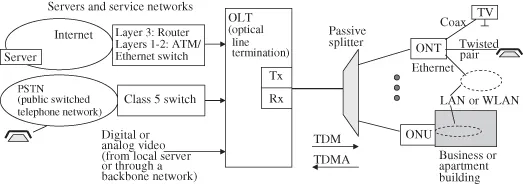
Operators expect that large capacity increases in the access network, facilitated by advances in enabling technologies, will stimulate diverse services to the customer premise and new revenue streams. To realize truly high-speed broadband access, major worldwide access providers, including, but not limited to, AT&T, Verizon, British Telecommunications (BT), and Nippon Telegraph and Telephone (NTT), are making significant investments in fiber-to-the-home (FTTH) and broadband wireless access (BWA). Among the many possible wired approaches, the PON (Figure 1.2) is especially attractive for its capability to carry gigabit-rate network traffic in a cost-effective way [LAM]. In comparison with very high-speed digital subscriber line (VDSL) and cable data infrastructure, which requires active (powered) components in the distribution network, PONs lower the cost of network deployment and maintenance by employing passive (not powered) components in the RN between the optical line terminal (OLT) and optical network unit (ONU) or terminal (ONT).
A decision for deployment of PON depends, of course, on the operator’s perception of revenues versus costs. Investment must be made in the following [BREUER]:
- the aggregation link in the backhaul network between a PON access site, where the OLT, possibly heading several PONs, is located (shown as a CO in Figure 1.1), and a transport network point of presence;
- the PON access site itself, where the RN is located;
- the feeder links between the OLT and the passive splitters of the several PONs; and
- the “first mile” including a passive splitter and its access lines to user optical network terminations (ONTs or ONUs).
As access sites are more densely deployed, the total per-ONT cost initially decreases due to shorter links through the feeder network. However, beyond a certain optimum density of access sites, cost climbs as the costs of access sites and aggregation links begin to overwhelm the savings from shorter feeder links. As noted in [BREUER], with appropriate selection of access sites, PON is significantly less expensive than active optical fiber access networks, perhaps by a factor of two in relation to point-to-point (P2P) gigabit Ethernet, which is not only more expensive but also consumes much more energy.
Note that the OLT corresponds to the line termination (LT) in Figure 1.1, the splitter to the RN in Figure 1.1, and the ONU to the NIU in Figure 1.1. The terms ONU and ONT are sometimes used interchangeably, although the ONU may have additional optical networking connected to its subscriber side, while the ONT does not.
The PON standards of current interest include broadband passive optical network (BPON) [ITU-T G.983.1], Ethernet passive optical network (EPON) (Institute of Electrical and Electronics Engineers [IEEE] 802.3ah incorporated into IEE 802.3-2008), gigabit-capable passive optical network (GPON) [ITU-T G984.1], and 10G PON (IEEE 802.3av-2009 and ITU-T G.987). Note that “x” denotes several possible integers denoting different documents of the standard. All of these PONs use time division multiplexing (TDM) downstream, with data sent to different users in assigned slots on a single downstream optical carrier, and time division multiple access (TDMA) upstream, with greater flexibility in requesting and using time on the single upstream optical carrier. The development of BPON and GPON was stimulated and advanced by the work of the Full Service Access Network (FSAN) industry consortium (http://www.fsanweb.org). The standardization process for EPON began in 2000 with IEEE 802.3’s establishment of the Ethernet in the First Mile Study Group and the later formation of the P802.3ah Task Force [ECHKLOP]. Work is also in progress on WDM-PON [BPCSYKKM, MAIER] for future large increases in capacity following from the use of multiple wavelengths.
This guidebook covers the major concepts and techniques of PONs, including components, topology, architecture, management, standards, and business models. The rest of this chapter introduces nonoptical access technologies and important features of the entire family of optical access systems, which we collectively denote as fiber-to-the-building (FTTB), fiber-to-the-business, fiber-to-the-cabinet (FTTCab), fiber-to-the-curb (FTTC), FTTH, fiber-to-the-node, fiber-to-the-office, fiber-to-the-premise, and so on, or FTTx. Section 1.4.1 offers additional defining information about PON. Chapter 2 covers PON architecture and components, elaborating on the major alternatives introduced above. Chapter 3 describes PON techniques and standards, largely in the physical level (PHY) and medium access control (MAC) layers of the protocol stack. Chapter 4 describes recent advances, particularly WDM-PON, interoperability with other optical networks, and what is coming in the near future, including wireless/optical integration.
1.2 SERVICES AND APPLICATIONS
PONs offer many possibilities for service replacement and for support of applications, in both residential and business markets. We describe here several of the most significant, beginning with replacement of other high-speed access services such as asymmetric digital subscriber line (ADSL), very high speed digital subscriber line (VDSL), cable data, DS-1, and DS-3.
1.2.1 Displacement of Legacy High-Speed Access Services
The nonoptical, copper-based “broadband” access services offer downstream burst data rates ranging from hundreds of kilobits per second to about 10 Mbps, and many of them are asymmetric with considerably lower upstream data rates. The average data rate per subscriber may be further limited to something well below the maximum burst rates. Much higher rates are possible under recent standards but are not commonly deployed. Several of these services will be described in the next section, together with the still developing broadband over power line (BoPL) and BWA, including mesh IEEE 802.11 (Wi-Fi) and IEEE 802.16 (Worldwide Interoperability for Microwave Access [WiMAX]) networks.
For mobile users and applications, PON cannot replace the wireless alternatives. It can, in fact, enhance them, as discussed in Chapter 4. But for fixed residential users, PON can yield a higher ratio of performance to cost than any of the available alternatives that are described in Section 1.3. Its current data rates of 50–100 Mbps per subscriber in both downstream and upstream directions compare favorably with the commonly deployed version of the fastest copper-based system, VDSL, with its 50 Mbps divided between downstream and upstream traffic. Of equal importance is the fact that the RN of a VDSL system is active, unlike the passive RN of a PON system, requiring more initial outlay and recurrent maintenance expense. The cost and other advantages of PON, over various active access systems, as noted in [SHUMATE], include its elimination of
- active optoelectronic and electronic devices operating in an often harsh outside environment,
- power conversion equipment and backup batteries in that location,
- electromagnetic interference (EMI) and electromagnetic compatibility (EMC) issues,
- energy costs, and
- environmental controls.
In addition, a PON node reduces the failure rate and associated repair costs typical of powered nodes, and its bandwidth-independent components allow future upgrades at minimal cost.
For a “greenfield” deployment without existing wiring, the total initial investment is comparable for both VDSL and PON, and the PON advantage in capability and lower maintenance cost is clear. For a PON overbuild, on top of an existing copper plant, the initial investment for PON is greater than that for VDSL because of the added expense of deploying the new optical distribution network. It is difficult to claim a clear economic advantage for PON in this case, but there is a compelling case in its higher current data rate and the possibility of much higher rates through future deployment of WDM end equipment without modifying the passive splitter.
For business customers, PON can provide higher data rates at costs lower than those of DS-1 and DS-3 services. Network operators are motivated to make this replacement because of the lower maintenance costs and much greater service flexibility, allowing easy changes in capacity allocations to different users served by the same PON splitter. PON services that are currently available, mostly BPON and GPON in the United States and EPON (1 Gbps in each direction) in East Asia, are offered at costs that are very competitive in comparison to legacy DS-1 (1.5 Mbps) and DS-3 (45 Mbps). Even when shared among a number of users, GPON’s data rates (2.5 Gbps downstream and 1.5 Gbps upstream with 10 Gbps downstream being introduced) and EPON’s data rates (1 Gbps in each direction with 10 Gbps being introduced) compare favorably with those of the legacy services.
1.2.2 Internet Protocol (IP) over PON
All of the current and contemplated access systems support IP traffic to a lesser or greater extent. BPON is oriented toward cir...