![]()
1
Cell and Body Tissue Physiology
Anthony Wheeldon
Senior Lecturer, Department of Adult Nursing and Primary Care, School of Health and Social Work, University of Hertfordshire, Hatfield, Hertfordshire, UK
Contents
Introduction
Anatomy of the cell
The cell membrane
Cytoplasm
Nucleus
Mitosis and meiosis
The organelles
Types of cells
Tissues
Tissue repair
Conclusion
Activities
Glossary of terms
References
Key Words
- Plasma membrane
- Organelles
- Connective tissue
- Passive transport
- Nucleus
- Cell cycle
- Muscle tissue
- Active transport
- Cytoplasm
- Epithelial tissue
- Nervous tissue
- Bulk transport
Test Your Prior Knowledge
- What are the three main parts of a human cell?
- Describe the structure and function of a human cell.
- Describe the phases of a cell cycle.
- - - - - - - - - -
Learning Outcomes
On completion of this chapter the reader will be able to:
- Outline the structure and function of a human cell.
- List and describe the functions of the organelles.
- Explain the phases of a cell cycle.
- Explain the cellular transport system.
- Describe the structure and function of epithelial tissue, connective tissue, muscle tissue and nervous tissue.
- Explain the process of tissue repair (inflammation).
- - - - - - - - - -
Don’t forget to visit to the companion website for this book ( www.wiley.com/go/fundamentalsofappliedpathophysiology) where you can find self-assessment tests to check your progress, as well as lots of activities to practise your learning. Introduction
To understand the human body and how it works (and also how it fails to work properly), it is important to understand the anatomy and physiology of the cell. Living organisms show a wide diversity as regards their size, shape, colour, behaviour and habitat. In spite of this, however, there are many similarities between organisms, and this fundamental similarity is known as the ‘cell theory’. This cell theory states that all living organisms are composed of one or more cells and the products of cells. Despite the fact that the cells belong to different organisms, and cells within the same organism may have different functions, there are many similarities between them. For example, there are similarities in their chemical composition, their chemical and biochemical behaviour and in their detailed structure.
All cells have many characteristics, but these characteristics can differ from cell to cell, such as:
- Cells are able to carry out certain specific functions, i.e. they are active.
- Cells need to consume food to live and to carry out their functions. Although they do not have mouths, they are still able to ‘catch’ and digest their food and use it for growth and reproduction. The correct term for this is endocytosis – they surround and engulf organisms such as bacteria and digest them.
- Cells can grow and repair.
- Similarly, cells can reproduce themselves. They do this by a process known as simple fission. This means that they reproduce themselves by dividing into two, and then each new cell grows to full size before it divides by simple fission and so on. In other words, cells replicate themselves.
- Like humans, cells can become irritable if something upsets or stimulates them.
- The nutrition that cells taken in is also used for the storage and release of energy (just like humans), thus enabling them to grow and repair themselves.
- Similarly, just as humans do not utilise all the food they eat – some of it cannot be used and so is excreted, cells excrete what they do not need or cannot use.
- Just as all humans will eventually die, so will cells. Some have a short life, whilst others survive many years – but eventually they will die.
So, cells are not all that different from humans in many respects. They do what humans do – albeit in different ways.
Anatomy of the Cell
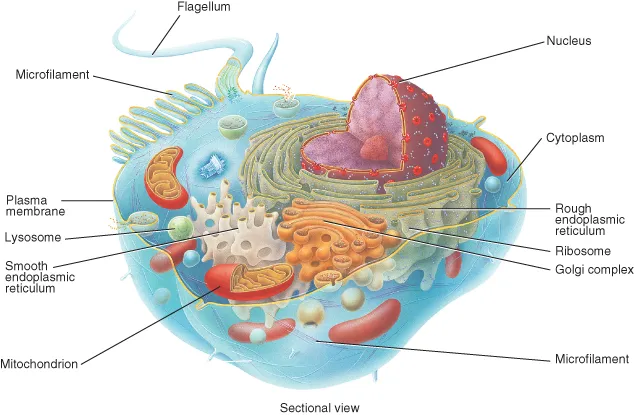
Each cell has a structure that is almost as complex as the human body (Figure 1.1). For example, each cell contains as many molecules as the body has cells. There is no such thing as a typical cell. However, each cell is surrounded by a membrane and contains protoplasm. This protoplasm consists of a nucleus, which is kept separate from the rest of the cell by a nuclear membrane (although the nuclear membrane disappears during the process of cell division), and an opaque substance called cytoplasm (Watson, 2005). The cells themselves consist of water, proteins, lipids, carbohydrates and various ions such as potassium (K+) and magnesium (Mg2+). Within the cytoplasm there are also many complex protein structures called organelles.
Cells vary in size from 2 to 20 µm. For example, a lymphocyte (a type of blood cell) is about 8–10 µm in diameter.
All the cells in the body, apart from those on the surface of the body, are surrounded by a fluid that is known as extracellular fluid (i.e. fluid outside of the cell).
The Cell Membrane
The cell membrane can vary from 7.5 to 10 nm in thickness. It acts just like a ‘skin’ that protects the cell from the outside environment. In addition, it regulates the movement of water, nutrients and waste products into and out of the cell.
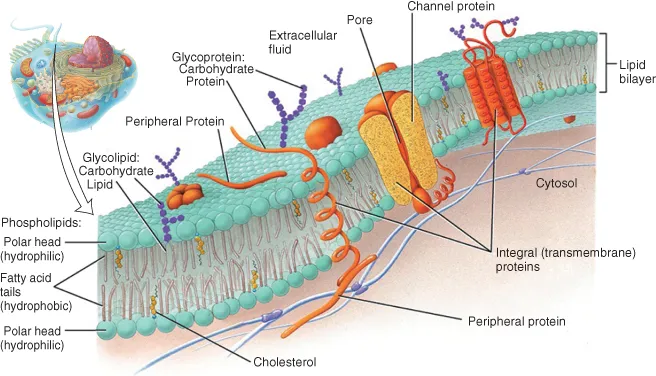
The cell membrane is made up of a double layer (bilayer) of phospholipid (fatty) molecules with protein molecules interspersed between them (Figure 1.2). A phospholipid molecule consists of a polar ‘head’ which is hydrophilic (water loving) and ‘tails’ which are hydrophobic (water hating). The hydrophilic ‘heads’ are attracted to water and are found on the inner and outer surfaces of the cell (water is the main component of both extracellular and intracellular environments), whilst the hydrophobic ‘tails’ are found in the middle of the cell membrane where they can avoid water. These phospholipid molecules are arranged as a bilayer with the heads facing outwards. This means that the bilayer is self-sealing. It is the central part of the plasma membrane, consisting of the hydrophobic ‘tails’, that makes the cell membrane impermeable to water-soluble molecules, and so prevents the passage of these molecules into and out of the cell (Marieb, 2010). However, if the membrane just consisted of these phospholipid molecules, then cells would not be able to function – within the cell membrane there are also plasma membrane proteins (PMPs), which can be either integral or peripheral.
Some of the integral PMPs are embedded amongst the tails of the phospholipid molecules, whilst others penetrate the membrane completely (Figure 1.2). Subunits of some of these integral proteins can form channels which allow for the transportation of materials into and out of the cell. Other subunits are able to bind to carbohydrates to form receptor sites. These receptor sites are important, as will be discussed in Chapter 3 – inflammation, immune response and healing.
Peripheral PMPs bind loosely to the surface of the cell membrane and so can easily be separated from it. Some of them function as enzymes to catalyse cellular reactions, whilst others are receptors for hormones and other chemicals, or function as binding sites for attachment to other structures (Marieb, 2010).
Functions
- Endocytosis and exocytosis –...