![]()
CHAPTER 1
OVERVIEW OF BROADBAND WIRELESS NETWORKS
Mobility and flexibility make wireless networks effective extensions and attractive alternatives to wired networks. Wireless networks provide all the functionality of wired networks, but without the physical constraints of the wire itself. However, the wireless link possesses some unique obstacles that need to be solved. For example, the medium is a scarce resource that must be shared among network users. It can be noisy and unreliable where transmissions from mobile users interfere with each other to varying degrees. The transmitted signal power dissipates in space rapidly and becomes attenuated. Physical obstructions may block or generate multiple copies of the transmitted signal. The received signal strength normally changes slowly with time because of path loss, more quickly with shadow fading and very quickly because of multipath fading. The most distinguishing issues in wireless network design are the constraints placed on bandwidth and power efficiency.
The broadcast nature of wireless transmission offers ubiquity and immediate access for both fixed and mobile users, clearly a vital element of quad-play (voice, video, data, and mobile) services. Moving from one location to another does not lead to disruptive reconnections at the new site. Wireless technology overcomes the need to lay cable, which is difficult, expensive, and time consuming to install, maintain, and especially, modify. Providing wireline connectivity in rural or remote areas runs the risk of someone pulling the cable (and accessories such as amplifiers) out of the ground to sell! A wireless network avoids underutilizing the access infrastructure. Unlike wired access (copper, coax, and fiber), a large portion of wireless deployment costs is incurred only when a customer signs up for service. The Fiber-to-the-Home (FTTH) Council reported that in September 23, 2008, there were 13.8 million FTTH networks in North America but the adoption rate is only 3.76 million (about 27%) even though many of these homes are located in strategic neighborhoods. The take up rate improved marginally to 34% (7.1 million connected homes) with 20.9 million homes passed on March 30, 2011. The cable industry’s capital expenditure over the last 15 years is estimated at $172 billion. Broadband usage for cable services fared better but still fall below 50%. According to the National Cable and Telecommunications Association (NCTA), there were 129.3 million homes passed by cable video service in June 2011 (which translates to over 96% of U.S. households passed), but the take up rate is 45.5%. These numbers are unlikely to increase significantly in future with high-speed wireless and free broadcast services becoming widely available.
Terrestrial wireless access may offer portable and mobile service without the need for a proprietary customer premise equipment (CPE), such as a set-top box. This facilitates voice, TV, and Internet connectivity inside and outside the residential home. For instance, such connectivity can be made available on virtually any open space (e.g., on a fishing boat!), on fast moving vehicles and trains, and even when the subscriber moves to a foreign location. The ability to connect disparate end-user devices quickly and inexpensively remains one of the key strengths of wireless. New smartphones and tablets all come with two or more wireless network interfaces but no wired interfaces, thus making wireless connectivity indispensable. These devices demand higher wireless rates to support multimedia applications, including high-quality video streaming, which is in contrast to low bit rate voice applications supported by legacy cellular systems.
Because cellular systems cover long distances, they involve costly infrastructures, such as base stations (BSs) and require users to pay for bandwidth on a time or usage basis. Each BS may potentially serve a large number of mobile handsets. Coordination between BSs as users move across wireless coverage boundaries is achieved using a mobile backhaul, which also carries a variety of user traffic. The BS may prioritize near and far handsets. For example, the BS can reduce interference by transmitting at a lower power to closer handsets. In contrast, on-premise and geographically limited wireless local area networks (wireless LANs) require no usage fees, employ lower transmit power, and provide higher data rates than cellular systems. Wireless LANs are built around cheaper access points (APs) that connect a smaller number of stationary user devices, such as laptops or tablets to a wired network. However, achieving reliable high-speed wireless transmission is a challenging task. Besides the need to overcome traditional issues, such as multipath fading and interference from known and unknown sources, broadband wireless transmission also demands new methods to support highly efficient use of limited radio spectrum and handset battery power. This chapter discusses several fundamental topics related to broadband wireless networks. These include environmental factors, frequency bands, multicarrier operation, multiple antenna systems, medium access control, duplexing, and deployment considerations.
1.1 INTRODUCTION
Mobile broadband represents a multibillion dollar market. Service providers, including incumbent cable/telephone wireline providers, can increase the number of subscribers significantly by leveraging on broadband wireless solutions (e.g., in areas not currently served or served by competitors). The performance of a broadband wireless network is heavily dependent on the characteristics of the wireless channel, such as signal fading, multipath distortion, limited bandwidth, high error rates, rapidly changing propagation conditions, mutual interference of signals, and the vulnerability to eavesdrop and unauthorized access. Moreover, the performance observed by each individual user in the network is different and is a function of its location as well as the location of other interacting users. In order to improve spectral efficiency and hence, the overall network capacity, wireless access techniques need to be closely integrated with various interference mitigation techniques including the use of smart antennas, multi-user detection, power control, channel state tracking, and coding. Broadband wireless networks must also adequately address the combined requirements of wireless and multimedia communications. On one hand, the network must allow users to share the limited bandwidth resource efficiently to achieve higher rates. This implies two criteria: maximizing the utilization of the radio frequency spectrum and minimizing the delay experienced by the users. On the other hand, because the network supports multimedia traffic, it is expected to handle a wide range of bit rates together with various types of real-time and non–real-time traffic attributes and quality of service (QoS) guarantees.
More than 60% of Americans are using a wireless device to talk, send email, take pictures, watch video, listen to music, and play online games. Compressed video is a key traffic type that needs to be accommodated due to the emergence of many personal smartphones and tablet computers. Despite the smaller displays, many of these devices can support high-definition (HD) video with 720p (1280 × 720 pixels) picture resolutions. Highly efficient video coding standards, such as H.264/MPEG-4 Advanced Video Coding (AVC), are normally used to compress these videos for wireless delivery. This enables efficient use of radio spectrum, but the higher compression efficiency may also result in higher bit rate variability. In addition, compressed video is very sensitive to packet loss, with very limited time for packet retransmission, and wireless channels tend to be more error-prone than wired networks. Although wireless rates are typically lower than its wired counterparts, serving bandwidth-intensive applications, such as HD videos, may not always be an issue since such videos can be downloaded in the background. Users tend to watch videos in their own time, rather than according to broadcast schedules. However, real-time video applications (e.g., Skype video chat) may pose a problem depending on bandwidth availability.
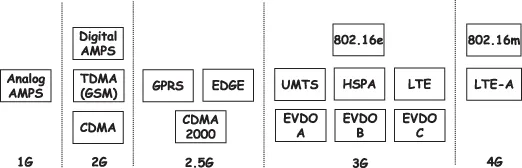
Figure 1.1 shows the evolution of wireless access standards. Since the late 1990s, there were numerous digital cellular standards supporting second-generation (2G), 2.5 generation (2.5G), and third-generation (3G) services. These standards can be broadly categorized under code division multiple access (CDMA) or time division multiple access (TDMA), and there was much debate on the individual merits and capacity of these systems. However, high-speed fourth-generation (4G) wireless standards are converging towards multicarrier transmission as the defacto method and currently there are only two 4G standards. Unlike legacy digital cellular services that primarily support voice and low rate data, the demand for 4G wireless is driven by millions of personal devices that require high-speed Internet connectivity. These sleek devices exude mass appeal due to their usability, and many devices employ an open software platform for users to program their own applications or download other applications. 4G wireless is the missing link that allows multimedia applications running on these devices to become portable, thus enabling on-the-go entertainment.
1.2 RADIO SPECTRUM
To encourage pervasive use of a wireless technology, the operating radio frequency (RF) band should be widely available. Locating a harmonized band is a difficult task because spectrum allocation is strictly controlled by multiple regulatory bodies in different countries. These include the Federal Communications Commission (FCC) in the United States, the European Committee of Post and Telecommunications Administrations (CEPT), Ofcom in the United Kingdom, the Radio Equipment Inspection and Certification Institute (MKK) in Japan, the Australian Communications and Media Authority (ACMA), and others.
1.2.1 Unlicensed Frequency Bands
Many wireless networks operate on unlicensed frequency bands, as illustrated in Figure 1.2. Many of these bands are available worldwide. Since the allocated spectrum is not licensed, large-scale frequency planning is avoided and ad hoc deployments are possible. Perhaps the most popular band is the 2.4 GHz industrial, scientific and medical (ISM) band, which has been adopted by the IEEE 802.11 wireless LAN standard. The rules for operating in this band were first released by the FCC in 1985, which also includes the 900 MHz and the 5.8 GHz bands. Another band that has become popular is the 5 GHz Unlicensed National Information Infrastructure (U-NII) frequency band. The large amount of radio spectrum in this band enables the provision of high-speed Internet and multimedia services. The rules for operating in the 5 GHz U-NII band were ...