- A thoroughly comprehensive guide to the life, work, and thought of Arthur Schopenhauer
- Demonstrates the range of Schopenhauer's work and illuminates the debates it has generated
- 26 newly commissioned essays by some of the most prominent Schopenhauer scholars working today reflect the very latest trends in Schopenhauer scholarship
- Covers the full range of historical and philosophical perspectives on Schopenhauer's work
- Discusses his seminal contributions to our understanding of knowledge, perception, morality, science, logic and mathematics, Platonic Ideas, the unconscious, aesthetic experience, art, colours, sexuality, will, compassion, pessimism, tragedy, pleasure, and happiness
- English
- ePUB (mobile friendly)
- Available on iOS & Android
eBook - ePub
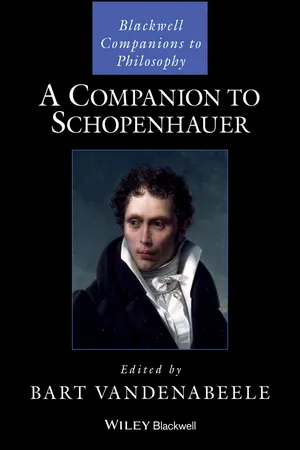
A Companion to Schopenhauer
About this book
A Companion to Schopenhauer provides a comprehensive guide to all the important facets of Schopenhauer's philosophy. The volume contains 26 newly commissioned essays by prominent Schopenhauer scholars working in the field today.
Information
Part I: Nature, Knowledge and Perception
1
Schopenhauer on Scientific Knowledge
There is a good deal of truth in the way in which Schopenhauer describes the contrast between the genuine philosopher and the academic scholar who regards philosophy as a sort of scientific pursuit.
(Schlick 1981, 41)
Philosophy is for Schopenhauer not a sort of scientific pursuit nor is science a sort of philosophical pursuit, and it is in this context that he propounds his view of scientific knowledge and of knowledge in general. Those few philosophers who have given it proper consideration, notably Gardiner (1967) and Hamlyn (1980, 1999), and more recently Young (2005), have pointed out that Schopenhauer’s view presents some serious, seemingly insurmountable, difficulties. In this chapter I try to redress the balance by arguing that Schopenhauer can be credited with a coherent and viable, in some respects indeed very perceptive view of (scientific) knowledge once a couple of misconceptions, which are the source of these difficulties but which are neither required by this view nor are of any use to it, are disposed of. I offer instead some adequate replacements which are to its benefit, much as they are in line with the overall framework and the objectives of his philosophy. This will also enable us to assess this view in the context of the debates that have emerged in the modern-day philosophy of science and epistemology.
1. The Principle of Sufficient Reason and Knowledge
In The Fourfold Root of the Principle of Sufficient Reason (henceforth FR), Schopenhauer tackles the principle of the same name in the context of the relation that the knowing subject has to the object of knowledge, making his view of knowledge part of his account of this principle. This principle, which he calls the basis of all science (FR, 4), has for him four different forms sharing the same root, one of which is of particular interest for his view of scientific knowledge as obtained by the natural sciences. Owing to these interconnections, an examination of his view of scientific knowledge also needs to be an examination of this principle and of Schopenhauer’s conception of knowledge in general. This is evidenced by what he has to say about this principle and its root.
Schopenhauer states the principle of sufficient reason as follows: “Nothing is without a ground or reason why it is” (FR, 6). Then he provides the statement of its root:
Our knowing consciousness, … , is divisible into subject and object, and contains nothing else. To be object for the subject and to be our representation … are the same thing. All our representations are objects of the subject, and all objects of the subject are our representations. Now it is found that all our representations stand to one another in a natural and regular connexion that in form is determinable A PRIORI. By virtue of this connexion nothing existing by itself and independent, and also nothing single and detached, can become an object for us.
(FR, 41–42; italics in the original)
All knowledge thus concerns representations. But no representation can become an object of knowledge if it is not grounded, if it does not have a reason, in other representations.
Schopenhauer then goes on to remark that it is this connection which is expressed by the principle in its universality. This connection takes on different forms according to the difference in the nature of objects, but it is still always left with that which is common to those forms and is expressed in a general and abstract way by the principle. Hence, the relations, forming the basis of the principle, constitute its own root. “Their number can be reduced to four, since it agrees with four classes into which everything is divided that can for us become an object, thus all our representations” (FR, 42). As will become clear, it is two of these forms that are of special interest for the aims and the scope of the present chapter – that of becoming and that of knowing, as Schopenhauer calls them.
2. Some Epistemological Distinctions
According to Schopenhauer, not all of our knowledge is conceptual. Our basic knowledge of intuitive or perceptive representations, i.e., of objects presented to us in our sensory perception, does not involve concepts. In order to have this kind of knowledge it is required by the principle of sufficient reason that objects stand in natural and regular connections, although the knower need not know what they are. Our knowledge of these regular connections, which amount to causal, law-like, relations, is also taken to be non-conceptual. When, on the other hand, it comes to conceptual, abstract knowledge, this principle requires that if a judgment (representation) – itself composed of concepts – is to express a piece of knowledge, it must have a sufficient ground or reason, for which it is further required that it be known by the knower (FR, 156). Non-conceptual knowledge is the business of the faculty of understanding, which has the one function of causal inference, while conceptual knowledge is the business of the faculty of reason, which has the one function of forming concepts. Since the perception of the non-linguistic animals is in relevant respects similar to ours, Schopenhauer believes that they too have understanding though they do not use concepts, i.e., have no faculty of reason (see FR, 71–72; 110–11).
The following claims can be distinguished here:
1. In addition to conceptual knowledge of objects there is also non-conceptual knowledge of them.
2. In order to have non-conceptual knowledge of objects it is required that they stand in causal, law-like, relations which constitute their ground or reason.
3. Knowledge of causal, law-like, relations between objects is non-conceptual.
4. If a judgment is to express a piece of knowledge, it must have a sufficient ground or reason (to be specified below).
5. This ground or reason needs to be known by the knower.
One may think it impossible for us to apprehend causal, law-like, relations between objects short of applying any concepts (see Gardiner 1967, 121–22). If so, (3) is false and so is (2) insofar as it entails (3). One can also question (2) together with (4) and a fortiori (5) on a more general level by urging that our having the respective kinds of knowledge is not subject to the conditions respectively imposed on them by Schopenhauer in (2) and (4). Claim (5) may be found to be too severe; and (1) may seem problematic particularly because of its association with
6. The faculty of abstraction, pertaining to reason, which creates concepts by way of analyzing intuitive, i.e., perceptive, representations (e.g., FR, 146–47; see also WWR II, 66).
This doctrine, which Schopenhauer adopts from the British empiricists, is thought to be very dubious. On this issue Hamlyn remarks:
How reason is supposed to abstract from perceptions remains, as with all doctrines of abstraction, unclear. If the abstraction is a cognitive act it must work on what is already known in the perceptual instances; but if something is indeed known in them they must surely presuppose already some concept of the object perceived. How then is that concept obtained? On the other hand, if the abstraction is not a cognitive act of that kind, but the concept comes into being, so to speak mechanically, it remains quite obscure what principles govern the selection of instances in such a way that they give rise to the concept.
(Hamlyn 1980, 23)
(In order to assess Schopenhauer’s view of knowledge, all these claims need to be tackled, but since claim (2) is not directly relevant to the topic of the present chapter I shall not deal with it here. See Bozickovic (1996) for a discussion of some of the issues concerning this claim.)
3. Non-Conceptual Knowledge of Objects
Claim (1) raises the issue of whether all our perceptual knowledge of objects is conceptual. Many recent philosophers would side with Schopenhauer in claiming that it is not. One of them is Evans (1982) who has claimed that the content of perceptual experience is non-conceptual. In a similar vein, Chalmers (1996) has urged that the content of awareness and of experience is generally non-conceptual in that it does not require an agent to possess the concepts that might be involved in characterizing that content. As he notes, it is quite plausible that an animal such as a dog or a mouse might have fine-grained representations of color distinctions in the cognitive system, while having only the simplest system of color concepts (Chalmers 1996, 383). (Schopenhauer would, of course, deny that it possesses any concepts, but the point is the same.) Conceptual content comes into play only when one moves from a perceptual experience to a judgment about the world based on that experience, usually expressible in some verbal form (Evans 1982, 227). Judgments belong with beliefs as more sophisticated cognitive states connected with the notion of reasons (Evans 1982, 124; see also Chalmers 1996, 232).
It is important to note that Schopenhauer’s distinction between non-conceptual and conceptual knowledge of objects is logically independent from the dubious doctrine of abstraction which he takes the shift from the former to the latter kind of knowledge to rely on. In spite of this doctrine, it was very perceptive of him to draw the distinction itself. To see its merit, we can think of it in the light of Evans’s further suggestion concerning the links between the non-conceptual and the conceptual contents which does not rely on any operation of abstraction and with which the latter can be substituted on Schopenhauer’s behalf. For Evans, perceptual experiences with non-conceptual contents are informational states. Yet, such states are not ipso facto perceptual experiences, i.e., states of a conscious subject. An informational state should count as an experience only if its non-conceptual content is available as input to a thinking, concept-applying, and reasoning system (Evans 1982, 157–58). In such a system, conceptual capacities first become operative when it makes a judgment of experience whereby a different species of content comes into play. This way, an unmysterious link between the two kinds of content is established without resorting to an operation of abstraction, and the full merit of drawing the distinction between them is recognized. (The existence of this distinction is still denied by John McDowell (1994) on the grounds that it is a requirement of having experiences that we are able to re-identify them under concepts. This requirement, however, seems to be gratuitous.)
By the same token, this applies to the link between knowledge of and knowledge that. It has been urged that (in the ordinary non-Russellian sense) knowledge of an object generally implies knowledge that something is the case with regard to it which is itself conceptual. Hence, knowledge of an object is something that one could not have unless one was already equipped with concepts to some extent (Hamlyn 1999, 57–58). Both these claims, however, are readily accounted for on Schopenhauer’s behalf in terms of Evans’s view while fully acknowledging the conceptual/non-conceptual distinction.
This requires that Schopenhauer’s theory of concepts be readjusted. Other than dropping his reliance on the doctrine of abstraction, he would have to abandon the Kantian view of concepts as rules for classifying things, which, as pointed out by Young (2005), does not preclude that some of these rules are biological products of evolution also possessed by non-linguistic animals. Schopenhauer’s objectives would be more adequately met by tying concept-possession to language as hinted at by Evans, i.e., by claiming that to have the concept of an X is to be able to use properly the word “X” (or a word of a different language having the same meaning). In this way Schopenhauer could establish that a great deal of our knowledge about the world is non-conceptual. While his examples of this knowledge hover between knowledge we do not and knowledge we cannot articulate in words, it is the latter that, as Young puts it, makes his discussion of non-linguistic animals the crux of the matter (Young 2005, 44–45).
This view of concept-possession can also accommodate Schopenhauer’s claim that, in accordance with (4) and (5) in their application to concepts rather than judgments, in terms of which they are stated above, our cognitive grasp of a certain concept (i.e., the meaning of a concept-word) is grounded in our cognitive grasp of other concepts (i.e., the meanings of other concept-words) which is also at odds with the doctrine of abstraction. For, being able to use properly the word “X” requires something like this on any view that rejects the doctrine of semantic atomism – the doctrine that one can grasp the meaning of a word without knowing the meanings of other words. (For a criticism of this doctrine, see Dummett (1981); see also Brandom (1994, 87–89), who takes inferential articulation to be a distinguishing mark of concept-use.)
4. Non-Conceptual Knowledge of Causal Relations
Consider now claim (3) – that knowledge of causal, law-like, relations between objects is non-conceptual. What Schopenhauer has in mind is that the faculty of understanding, which has the one function of causal inference, conceives every change in the phenomenal world as an effect and refers it to its cause quite directly and intuitively without the assistance of reflection, i.e., of abstract knowledge by means of concepts and words (FR, 103). That this is how every change is conceived is part of Schopenhauer’s view that the subject’s body is both the starting-point of all of his perceptions as well as being for him an object amongst objects liable to the laws of this objective corporeal world (FR, 124). Changes in the phenomenal world are governed by what Schopenhauer calls the law of causality. It is the principle that, “if a new state of one or several real objects appears, another state must have preceded it upon which the new state follows regularly, in other words, as often as the first state exists” (FR, 53). It is “known a priori and is therefore transcendental, valid for every possible experience, and consequently without exception” (FR, 20, 63). Since the relation between cause and effect is held to be a necessary one, this law authorizes us to form hypothetical judgments. In this way it shows itself to be a form of the principle of sufficient reason in which all hypothetical judgments must rest and all necessity is based. This form of the principle, which is of particular significance for his view of scientific knowledge, Schopenhauer calls the principle of sufficient reason of becoming because its application always presupposes a change, “the appearance of a new state and hence a becoming (ein Werden)” (FR, 63).
To be sure, for Schopenhauer this law, “the only form under which we are able to conceive changes at all, always concerns merely states of bodies …” (FR, 65; also FR, 111). This should also apply to those changes in organic nature whose explanation, Schopenhauer claims, refers us entirely to final causes. For, final causes need not be thought of as future states (WWR II, 327ff.). As for many philosophers of the past, the motion of bodies plays for him a fundamental role in hi...
Table of contents
- Cover
- Blackwell Companions to Philosophy
- Title page
- Copyright page
- Dedication
- Notes on Contributors
- Acknowledgments
- A Note on Cross-References
- List of Abbreviations
- Introduction
- Part I: Nature, Knowledge and Perception
- Part II: World, Will and Life
- Part III: Art, Beauty and the Sublime
- Part IV: Compassion, Resignation and Sainthood
- Part V: Schopenhauer’s Context and Legacy
- Index
Trusted by 375,005 students
Access to over 1.5 million titles for a fair monthly price.
Study more efficiently using our study tools.
Frequently asked questions
Yes, you can cancel anytime from the Subscription tab in your account settings on the Perlego website. Your subscription will stay active until the end of your current billing period. Learn how to cancel your subscription
No, books cannot be downloaded as external files, such as PDFs, for use outside of Perlego. However, you can download books within the Perlego app for offline reading on mobile or tablet. Learn how to download books offline
Perlego offers two plans: Essential and Complete
- Essential is ideal for learners and professionals who enjoy exploring a wide range of subjects. Access the Essential Library with 800,000+ trusted titles and best-sellers across business, personal growth, and the humanities. Includes unlimited reading time and Standard Read Aloud voice.
- Complete: Perfect for advanced learners and researchers needing full, unrestricted access. Unlock 1.5M+ books across hundreds of subjects, including academic and specialized titles. The Complete Plan also includes advanced features like Premium Read Aloud and Research Assistant.
We are an online textbook subscription service, where you can get access to an entire online library for less than the price of a single book per month. With over 1.5 million books across 990+ topics, we’ve got you covered! Learn about our mission
Look out for the read-aloud symbol on your next book to see if you can listen to it. The read-aloud tool reads text aloud for you, highlighting the text as it is being read. You can pause it, speed it up and slow it down. Learn more about Read Aloud
Yes! You can use the Perlego app on both iOS and Android devices to read anytime, anywhere — even offline. Perfect for commutes or when you’re on the go.
Please note we cannot support devices running on iOS 13 and Android 7 or earlier. Learn more about using the app
Please note we cannot support devices running on iOS 13 and Android 7 or earlier. Learn more about using the app
Yes, you can access A Companion to Schopenhauer by Bart Vandenabeele in PDF and/or ePUB format, as well as other popular books in Philosophy & Modern Philosophy. We have over 1.5 million books available in our catalogue for you to explore.